



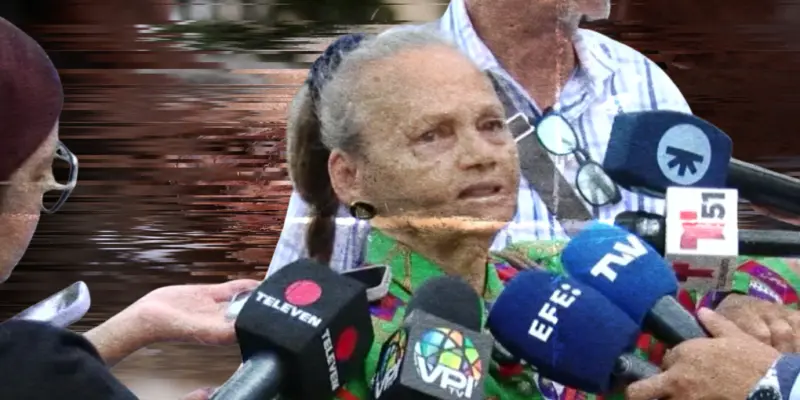
Carmen Navas speaking to the press in Caracas, Venezuela. Collage created by Global Voices using a screenshot from the YouTube video “Her heart couldn’t bear the pain: this is how Carmen Navas lived her final days before passing …”, uploaded on May 19, 2026 by YouTube user NTN24. Fair use.
Read our special coverage on Venezuela’s fight for democracy and the political crisis that has unfolded since the 2024 presidential elections, after the documented allegations of electoral fraud.
A Venezuelan mother and her son have become the most recent painful reminder of the state of human rights in the South American nation.
Carmen Teresa Navas, 82, died of natural causes on the night of Sunday May 17, days after finding about the death of her 51-year-old son, Víctor Hugo Quero Navas, who was arbitrarily detained in Caracas on January 1, 2025 under terrorism charges. According to the Venezuelan human rights NGO Foro Penal, Quero Navas was a forcibly disappeared political prisoner.
Over the course of 16 months, having no idea about her son’s passing, Navas tirelessly searched for information about him in courthouses and public offices, and showed up at public demonstrations on behalf of political prisoners, always asserting his innocence.
According to the Ministry of State Penitentiary, Quero Navas died of “acute respiratory failure” in a Caracas hospital while in state custody on July 31, 2025 and was buried in a mass grave, given that “no visitations from relatives had been requested at his detention place.” Authorities said had been detained at El Rodeo I prison, near Caracas.
This case is not an exception: under the interim administration of Delcy Rodríguez, the lives of more than 400 political prisoners remain at risk. Four other mothers, who had also been waiting for information on their sons’ release, have died this year, without ever learning of their children’s fate.
Navas’ case, however, has become emblematic of sustained campaigning, highlighting the role of mothers in human rights defense in Venezuela and the toll that political violence and prolonged uncertainty take on their health.
Sixteen months of searching
Carmen Navas came to the attention of media in Venezuela after steadily showing up at protests in support of political prisoners holding a photo of her child — like at the camp set up next to Zona 7, a detention center in eastern Caracas, in February 2026. “Proof of life for my son!” Navas exclaimed, surrounded by other mothers and sympathizers. “Freedom, freedom, freedom!”
Víctor Quero was a jeans merchant, initially detained under terrorism charges. Even after his mother’s repeated media appearances, the state failed to provide her with solid information about him. Undeterred, she personally went to several detention centers looking for answers, as chronicled by local journalist Maryorin Méndez, who closely tracked her case.
During a visit to El Rodeo I, a recently released political prisoner, Daniel Camara, told Navas that he had met Víctor at the prison, but that “he was taken away last October.”
Every time Navas enquired, officials and public servants told her that her son was not detained, imprisoned or registered in the penitentiary system. Yet, a tribunal denied him conditional release under a new Amnesty Bill on May 6, 2026. The very next day, the Penitentiary Service Ministry issued a statement confirming that Quero had been dead and buried since July 2025:
🫓 The Rodríguez-sponsored law is so hollow that authorities denied amnesty to a man who has been dead for 10 months.
Víctor Hugo Quero died in July, the Prisons Ministry admitted yesterday. His 82-year-old mother, Carmen Navas, had been searching for him since January 2025. https://t.co/24uBQJonYJ
— Caracas Chronicles (@CaracasChron) May 8, 2026
Navas only saw her son’s face again at his official exhumation and reburial on May 8 where, as told by El País, she asked officials to place her socks and hat on him.
Navas and her son now lie side by side in Caracas’ Cementerio del Este (Eastern Cemetery); her May 19 funeral was attended by hundreds of mourners.
Nearly two weeks prior, on May 7, the attorney general’s office announced a full inquiry into Quero Navas’s death in custody, echoed days later by acting president Delcy Rodríguez. The United Nations’ Working Group on Enforced or Involuntary Disappearances expressed “grave concern” over his enforced disappearance and made an immediate call for an independent investigation.
At least ten Venezuelan state institutions appear to have concealed information, misinformed authorities, or ignored Navas altogether, highlighting the need for such an investigation. Many experts argue that this case is a stark reminder that Venezuela’s repressive apparatus remains intact:
Venezuela in mourning
On social media, Venezuelan citizens and activists erupted in grief over the death of Navas, who had last been seen praying in an open funeral Mass for her son. A lot of outrage was also being expressed over her son’s fate.
In a joint statement, local Venezuelan feminist organizations, including Uquira and Surgentes DDHH, said that they “exalt [Navas’s] memory, dignity, her pain and her tireless search for justice.”
Ramón Centeno, a journalist and former political prisoner whose mother, Omaira Navas (no relation to Carmen or Víctor), passed away shortly after his January 14 release, tweeted “There will be justice.” He also remembered the other mothers of political prisoners who died waiting on word of their sons.
An open protest in memory of Carmen Navas and Víctor Quero Navas was held on May 18, near Universidad Central de Venezuela.
“They did not die, they were killed!” chanted demonstrators. The non-violent protest was met with repression by security forces. Two people were detained and several more injured:
The day after Navas’ burial, Jorge Rodríguez, head of Venezuela’s National Assembly and brother to Delcy Rodríguez, announced the pending release of an additional 300 political prisoners, though no names or exact release dates were shared.
