



When delegates gathered for COP30 in Belém, Brazil in November 2025, they scrutinized various sectors of the global economy for their contributions to rising greenhouse gases. Agriculture, aviation, steel, cement — all were on the table. One topic not discussed was war.
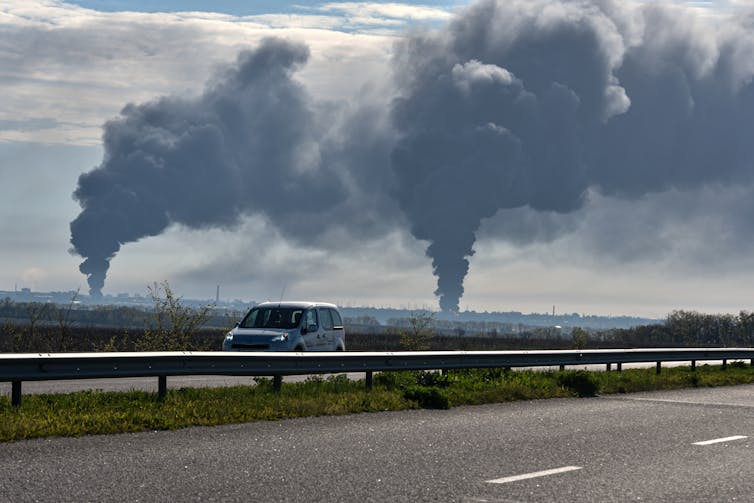
This isn’t a minor oversight. Militaries are significant contributors to greenhouse gas emissions. Russia’s invasion of Ukraine has generated an estimated 311 million tonnes of what’s known as CO₂ equivalent, comparable to the combined annual emissions of Belgium, New Zealand, Austria and Portugal. CO₂ equivalent is the metric used to compare the warming impact of various greenhouse gases to carbon dioxide.
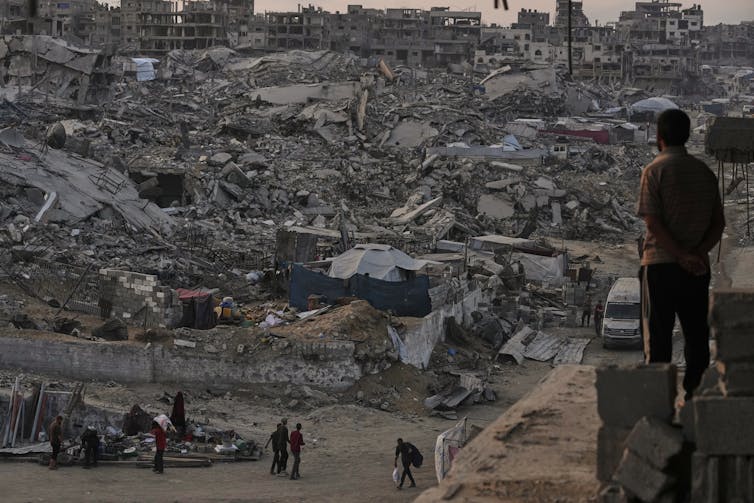
Recently published research calculated that the first 15 months of Israel’s war in Gaza generated more than 33 million tonnes of CO₂ equivalent, comparable to the combined 2023 annual emissions of Costa Rica and Slovenia.
In February 2026, Israel and the United States launched a war against Iran, joining a long list of other conflicts where emissions go uncounted in global inventories.
These are massive emissions, and they are generated with no formal mechanism to record, report or attribute them, and no accountability for the climate costs that affect people in conflict zones and far beyond.
A recent article by Neta Crawford, a researcher with the Cost of War project at Brown University, highlights how armed forces, militarization and war fuel climate change. She argues that military emissions and conflict-related emissions remain undercounted, even though they undermine efforts to mitigate climate change.
The military emissions gap
(AP Photo/Mykola Synelnykov)
Estimates suggest militaries and their supply chains account for approximately 5.5 per cent of global greenhouse gas emissions, which is enough to make them the world’s fourth largest emitter if counted as a country. And that figure only covers peacetime.
This is what researchers call the military emissions gap: the difference in emissions between what governments report and what their armed forces actually emit.
The problem starts with the rules. Under the United Nations Framework Convention on Climate Change (UNFCCC), countries have been exempt from fully reporting military emissions since the Kyoto Protocol negotiations in the 1990s. The United States successfully lobbied for the exclusion on national security grounds.
The 2015 Paris Agreement introduced voluntary reporting. However, as a 2025 briefing from the Conflict and Environment Observatory and Griffith University made clear, the result is a system that is “patchy, incomplete or missing altogether.”
The top three military spenders — the U.S., China and Russia — either submit no data or incomplete, non-disaggregated figures. This is a structural blind spot that excludes one of the most carbon-intensive sectors from meaningful accountability.
What wars cost the climate
(AP Photo/Jehad Alshrafi)
Crawford’s study on Gaza provides a comprehensive account of the war’s full carbon cycle. It found that direct combat emissions — jets, rockets, artillery, military vehicles — account for just 1.3 million of the 33.2 million tonnes of CO₂ equivalent.
The vast majority, more than 31 million tonnes, are projected to come from the reconstruction of destroyed infrastructure: nearly 450,000 apartments, over 3,000 kilometres of roads, schools, hospitals and water systems. Rebuilding what war destroys is, climatically speaking, the biggest act of war of all.
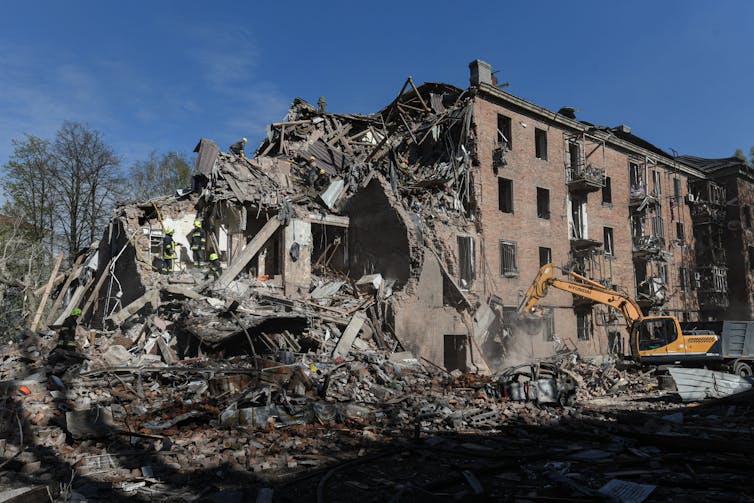
A report on Russia’s invasion of Ukraine by the Initiative on GHG Accounting of War found that direct combat emissions constitute 37 per cent out of total emissions between February 2022 and 2026. The war has ignited thousands of fires in forests and wetlands, accounting for 23 per cent of its total carbon footprint.
Russia’s attacks on electrical infrastructure have further released sulphur hexafluoride, a greenhouse gas 24,000 times more potent than CO₂, from high-voltage switching gear. And the rerouting of civilian aircraft around Ukrainian and Russian airspace has added an estimated 20 million extra tonnes of CO₂ equivalent compared to pre-invasion flight paths.
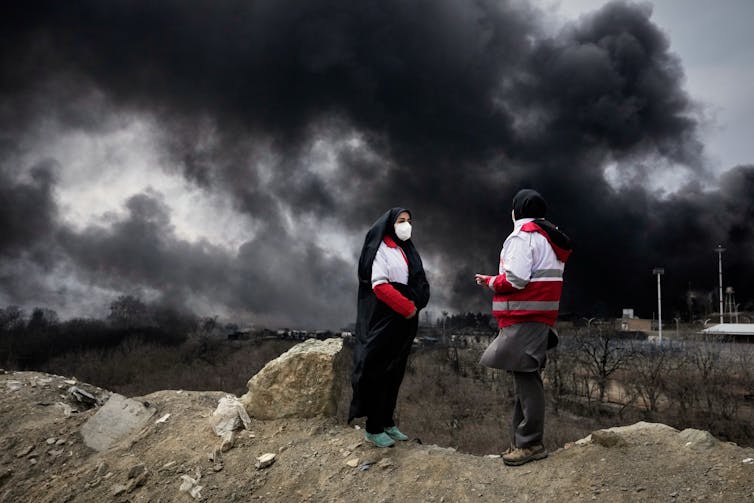
In Iran, it is estimated that the U.S.-Israel war has unleashed over five million tonnes of CO₂ equivalent — largely from infrastructure destruction and energy-related impacts.
None of this appears in any country’s reports on emissions to the UNFCCC.
What needs to change
(AP Photo/Vahid Salemi)
In July 2025, the International Court of Justice (ICJ) delivered an advisory opinion establishing that states have binding obligations to assess, report and mitigate harms to the climate system. In a separate declaration, ICJ judge Sarah Cleveland stated that those obligations extend to harms resulting from armed conflicts and other military activities.
The UN General Assembly has called for Russia to compensate Ukraine for all damages resulting from its invasion. When wars of aggression are launched, the emissions generated in fighting them, surviving them and rebuilding belong on the aggressor’s carbon ledger. When Russia invaded Ukraine, it generated a climate debt on behalf of the entire planet. The same can be said of other aggressors.
The Intergovernmental Panel on Climate Change (IPCC) is the UN body responsible for assessing the science related to climate change. The IPCC is currently in its seventh assessment cycle, with reports expected in late 2029.
This assessment cycle must include a dedicated report for conflict emissions covering infrastructure destruction, fighting and post-conflict reconstruction. The UNFCCC must make reporting military emissions mandatory and develop a framework for attributing conflict emissions under its Enhanced Transparency Framework.
Civil society and academia have already done the hard work of showing it can be done. Organizations like the Conflict and Environment Observatory have built methodologies from scratch, using open-source data. The science exists. What’s lacking is the political will to enshrine it in global climate governance.
(AP Photo/Mykola Synelnykov)
The richest countries spend roughly 30 times more on their armed forces than they contribute in climate finance to developing countries. Global military spending has reached a record $2.7 trillion. This is more than the total $2.2 trillion invested globally in clean energy in 2025.
As conflicts proliferate, the world is committing to an ever-larger unaccounted carbon liability. The climate finance gap is also likely to get worse as countries cut international development aid to direct funds to higher military spending.
Every degree of warming we are trying to avoid is undermined by wars. Accounting for conflict emissions is a vital way to make climate science whole.
This article was co-authored by researchers who are part of the Accelerating Community Energy Transformation initiative: Curran Crawford, Basma Majerbi, Madeleine McPherson (University of Victoria) and Samaneh Shahgaldi (Université du Québec à Trois-Rivières).