



A data center. Image via Canva.
This post is part of Global Voices’ April 2026 Spotlight series, “Human perspectives on AI.” This series will offer insight into how AI is being used in global majority countries, how its use and implementation are affecting individual communities, what this AI experiment might mean for future generations, and more. You can support this coverage by donating here.
Data centers are largely invisible behemoths that power today’s digital age. The facilities are made up of huge warehouses that house servers and other IT infrastructure necessary to process the so-called new oil: data. With the current boom in generative artificial intelligence (AI), the demand for data centers is projected to rise exponentially, around 20 percent every year until 2030, says UNDP.
This urgent demand for data centers has been driven by AI and tech companies, which have been aggressively lobbying different governments and pushing narratives that this technology will drive economic growth and progress. As a result, data centers are emerging in regions where they were not historically prioritized, particularly in the Global South. As UNDP mentions, within Latin America and the Caribbean, for example, digital infrastructure is concentrated in just a handful of countries and is mostly privately owned and backed by US investment groups.
Steven Gonzalez Monserrate, ethnographic researcher of cloud infrastructures and author of the book “Cloud Ecologies,” calls this process “Terraforming,” changing Earth and the specific way humans live to accommodate computers. He explains:
We are seeing again the flow of resources these data centers produce to the global north through Western companies. This way, they are entrenching inequalities and creating new colonialism. They are taking land. They are taking natural resources. They might not themselves be countries, but they are behaving like states. Google and Amazon are increasingly behaving like states. They are spending a lot of money to influence politicians. They are spending a lot of money on building infrastructure for their workers and creating these little enclaves within countries for their workers.
Indeed, in one investigation, “Big Tech’s Invisible Hand” by Centro Latinoamericano de Investigación Periodística (CLIP), together with Agência Pública and 15 media partners, found that tech executives held thousands of meetings with government officials from around the world between 2012 and 2025. And, among the matters discussed, AI, data centers, tech infrastructure, energy, taxes, and government regulation took the center stage — especially in Latin American countries such as Brazil, Chile, Mexico, and Argentina.

A resident in Uruguay grapples with the ongoing drought. Screenshot from YouTube.
Data centers nearly always affect nearby communities, and the impact is rarely positive. This is because the facilities generally require substantial energy, land, and water resources, and those built specifically to sustain generative AI even more so. These immense demands have already overwhelmed countries in the Global North. So how are countries in the Global South faring? Particularly those with lower GDPs, which already struggle with infrastructure challenges, water shortages, and electric grid management.
In this cross-border article, Global Voices is sharing stories from several countries in Latin America where communities are pushing back against AI-driven data center development.
The cost of data centers
According to the Data Center Map, Brazil has 206 data centers from 34 markets, leading the Latin America ranking. The federal government has implemented a National Data Center Policy and estimates USD 3 trillion in investments in this sector over the next five years. Officials have also introduced a special tax scheme to incentivize new enterprises to invest in data centers.
“Brazil needs a clear policy to attract data centers,” said Márcio Elias Rosa, minister of Development, Industry and Commerce, in an interview with the EBC, a state-owned Brazilian media group, in April. “We must be careful when doing a policy to incentivize attracting data centers with the need to be compatible with environmental issues. Because a data center consumes a lot of energy and hydric resources, water for refrigeration.”
One of the most striking examples of how these incentives can disadvantage surrounding communities is the “AI City” project, which will be launched in Eldorado do Sul, Brazil, by Scala, a company that already operates data centers in Brazil, Chile, and Mexico. Eldorado in Rio Grande do Sul was one of the cities devastated by a historic flood in 2024, in the southernmost state of Brazil. The floods are considered the worst climate disaster ever recorded in the state, as an estimated 90 percent of its territory was underwater for days. Residents remain terrified that the disaster could repeat itself, as flooding is an annual reality in the region, even in less severe years.
The project was first announced in 2024, and once complete, Scala’s venture will be the largest data center in Latin America. This structure is estimated to occupy an area of 7 million square meters and cost at least USD 50 billion.
Ambiental Media published an exclusive story in March 2026 reporting that the state government agreed to simplify the environmental licensing process to push project permits through “in the shortest time possible.” The outlet also stated that, by simplifying it, “the company is not required to do an Environmental Impact Study (EIA), nor public hearings.” The Ministry for Mining and Energy authorized access to 1.8 GigaWatts of power, which equals the energy consumed by a city with 6 million inhabitants.
Representatives from the energy sector and tech companies are pressuring the federal government to introduce more incentives. A study by IDEC (Consumers’ Defense Institute) entitled “We are not data centers’ backyard,” analyzed cases in Latin America to find a scenario of “communities running out of water, pricier electric bills and projects approved without consulting the population.” The document stresses the need for effective and clear regulation policies to limit the expansion of projects that could bring social and environmental threats:
A ausência de diretrizes robustas pode contribuir para a reprodução de modelos de desenvolvimento que geram impactos socioambientais significativos, os quais, conforme apontado por diferentes levantamentos e estudos recentes, tendem a se concentrar em países do Sul Global, como o Brasil, em razão de marcos regulatórios menos restritivos.
The absence of robust guidelines could contribute to reproducing developmental models that generate significant social-environmental impacts, which, as reported by numerous reports and studies recently, tend to concentrate in Global South countries, such as Brazil, due to less restrictive regulatory marks.
Developments in Chile, Uruguay, and Argentina
In 2017, there were six data center projects in Chile. In 2026, there will be 66. In Argentina, there are currently 42 data centers, and in Uruguay, 10. The tech giants that are caught in the AI race, Microsoft, Amazon, Google, and to some extent, Oracle, are all investing in data centers in Latin America.
Steven Gonzalez Monserrate, who is researching the environmental and political impact of data centers, said in an interview with Global Voices that when tech companies approach politicians, they often offer glamorous promises to local authorities and communities about job creation, economic gains, and technological advancements. As Monserrate explains:
Think of data centers as the future. They think of computers and A.I. This is the future. And why would you want to stop the future? And that’s kind of the narrative. But very few people actually understand how these work. And the mayor doesn’t understand how the data center works. They just see dollar signs, and they get really excited, and they want to have an economic incentive.
But in reality, AI data centers do not bring that many economic rewards to local economies. Once they’re built, most require a dozen or a few dozen people to operate, rather than the thousands politicians envision.

A worker in a Google data center. Screenshot from Google Sustainability’s YouTube video.
They also consume vast amounts of utilities: energy, water, and land. This strains local infrastructure, raises electricity prices, and can even create shortages — particularly in times of scarcity, such as the one caused by oil shortages from the US’s war on Iran. Moreover, because they have to function 24/7, 365 days a year, operators are now relying on diesel or gas backup generators, which create air pollution. In addition, they create noise pollution, which can stress communities and create mental and physical problems for nearby residents. Gonzales says:
Most data centers have air chiller units on top of the facility. And those air chillers make a loud kind of rattling, humming noise. And since the data center doesn’t stop running, it’s a constant operation, you’re going to get that noise constantly. And there’s been a number of really compelling studies on the effects of noise pollution over time on human bodies.
Some of those effects are psychological, but they affect your sense of well-being: anxiety, high blood pressure, and stress.
Communities are right to be concerned about the introduction of new data centers. An investigation by Amenaza Roboto, produced in partnership with the Pulitzer Center’s AI Accountability Network, found that the environmental impact goes beyond water and electricity usage. Using 25 years of NASA satellite data, reporters found that a data center operated by Antel, Uruguay’s state telecommunications company, creates a heat island visible in satellite imagery, raising temperatures measurably above the surrounding area. Google is currently building a data center just 11 kilometers away that will be five times larger than the Antel center, yet the environmental impact assessment made no mention of the heat island effect.
Community resistance
In Chile and Uruguay, local communities actually managed to stop Google from building two data centers — at least temporarily.
In February 2024, local residents and activists in the town of Cerrillos, on the outskirts of Santiago, Chile’s capital, stopped Google from building a data center, preventing it from using water to cool its servers. They took the issue to the environmental court, which partially blocked Google’s permit (issued in 2020), preventing it from building a data center in the town. The court urged the tech giant to revise its application and consider the environmental impact.
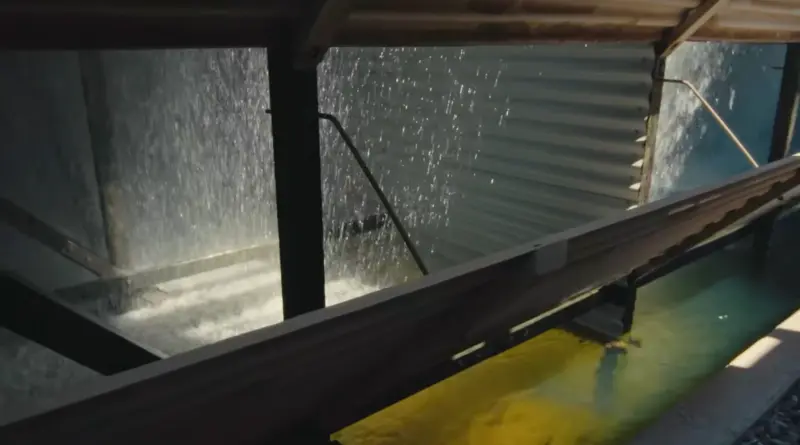
The cooling system at a Google data center. Screenshot from Google Sustainability YouTube.
Google had announced it would modify the cooling system to use less than the planned 169 liters of water per second. However, following the court decision, it suspended the project and a USD 40 million investment in what would have been the country’s second data center. The other, built in 2015 and still operating, is situated in Quilicura, on the outskirts of Santiago. At the time of writing this article, there was no news about whether Google would resume construction.
Droughts have affected various regions of Chile over a 40-year period, from 1979 to 2019. Furthermore, northern Chile is one of the driest regions in the world, and the central region, which is home to 70 percent of the national population, has had a permanent water deficit since 2010.
In 2023, in the midst of Uruguay’s worst drought in 74 years, Google bought 29 hectares (72 acres) of land to build a data center in the Canelones department, in southern Uruguay, reported The Guardian. This data center would have used 7.6 million liters of water per day to cool its servers, equivalent to the daily domestic use of 55,000 people. The water would come directly from the public drinking water system. Public anger remained widespread, and citizens blamed the country’s economic policy, saying that more than 80 percent of water goes to industry.
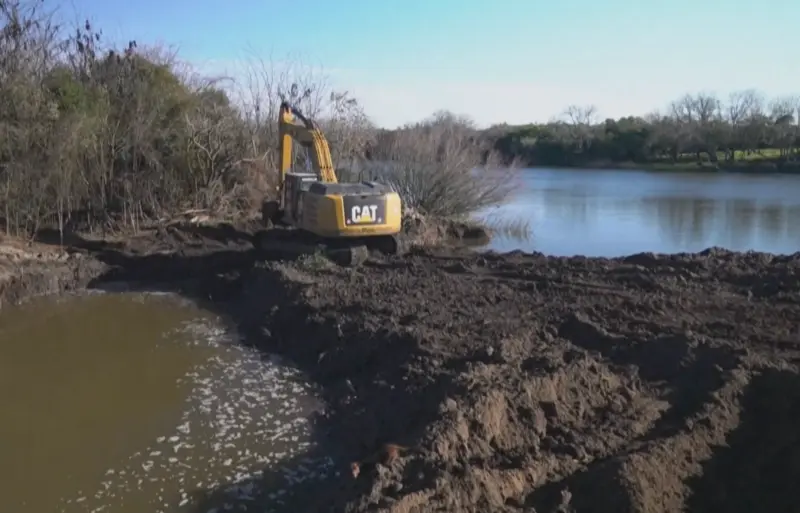
A Google data center under construction. Screenshot from Google Sustainability YouTube.
Google had paused the construction shortly after it started in 2023. It is still listed as “under construction” on Google’s data centers web page. However, the construction was approved after Google agreed to change the cooling system to an air conditioning-based method, rather than water-based. “Protests by civil society achieved important changes in the Google project, which was initially going to use large quantities of water.” However, the new plan “has been approved under time pressure, making it hard to assess its impacts,” said Ana Filippini, from the Movement for a Sustainable Uruguay (MOVUS).
Argentina is grappling with its own data center conundrum as it struggles to balance ecological preservation, with fear around missing out on the AI race. The Stargate Argentina project was announced by OpenAI CEO Sam Altman (via video appearance) and Argentina’s President, Javier Milei, in October 2025 as a historical milestone.
Indeed, while Open AI would not build or sustain the planned data center itself, the tech giant promised to invest (or rather, as Buenos Aires Times points out), agreed to purchase everything produced by the data center, which would be built by the local company.
However, experts warn that Argentina does not yet have a regulatory framework tailored to the installation and operation of large-scale data centers. In practice, the only applicable regulation is the Incentive Regime for Large Investments (RIGI), which offers tax, customs, and financial benefits to attract capital. While this regime may attract investments, it does not address key issues such as environmental safeguards, water use, energy consumption, or long-term planning.

Patagonia, Chile. Image from Wikimedia Commons. License CC BY 2.0
Patagonia is seen as an attractive location because of its energy resources, including natural gas and renewable sources such as hydropower and wind energy. But there are many environmental concerns. Overall, Neuquén province appears to be among the most favorable locations for initial deployment, given its growing shale gas industry and clean energy assets. But data centers require significant amounts of water, especially for cooling systems. In regions like Neuquén, water scarcity is already an issue and is expected to worsen with climate change.
Communities in the region have raised alarms about cumulative environmental impacts. They point to existing problems linked to oil and gas extraction, such as spills, contamination, and insufficient infrastructure.