



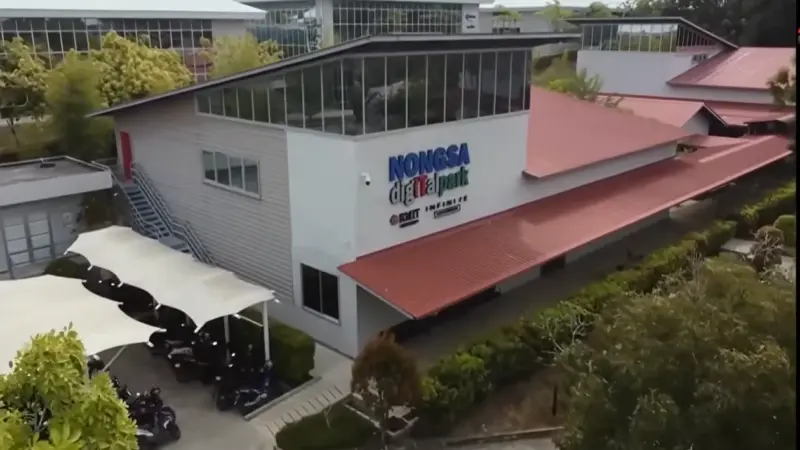
Nongsa Digital Park in Batam, Indonesia. Screenshot from YouTube video of Channel News Asia. Fair use.
This post is part of Global Voices’ April 2026 Spotlight series, “Human perspectives on AI.” This series will offer insight into how AI is being used in global majority countries, how its use and implementation are affecting individual communities, what this AI experiment might mean for future generations, and more. You can support this coverage by donating here.
The rise of Artificial Intelligence (AI) led to a surge in the establishment of data centers across Indonesia, but several stakeholders have raised concerns about its impact on the local water supply.
The rapid growth of generative AI is expected to generate USD 243.5 billion in economic production capacity, which is equivalent to around 18 percent of Indonesia’s 2022 gross domestic product.
To unlock this potential, it requires resources to build AI-ready data centers.
“Data centers are not just technological infrastructure; they are the key to creating a new AI-driven economy and enabling inclusive digital transformation,” said Dharma Simorangkir, president director of Microsoft Indonesia.
As of April 2026, there are 170 data centers in the country. This number is bound to increase after Singapore, a major digital hub in Southeast Asia, imposes stricter requirements on data center investments.
Cities near Singapore, like Johor in Malaysia and Batam in Indonesia, have attracted data center investments to cater to the high demand for AI-related infrastructure in the region.
But accompanying this positive economic prospect is the concern that it could also cause some harm in communities because data centers require massive amounts of water.
Data centers need large air-conditioning units and advanced liquid-cooling systems to operate.
DataCenterBoom!, which monitors the social impact of data centers, noted in a report that a medium-sized data center consumes approximately 300,000 gallons of water per day (110 million gallons per year), equivalent to the annual water consumption of approximately 1,000 households.
In Indonesia, nearly half of the 170 data centers are located in hot places. This means their excessive consumption of water could undermine public access to this essential resource.
In 2025, the Media Monitoring Repository on AI Incidents in Indonesia recorded six cases involving data centers linked to database leaks, performance failures, and excessive energy consumption.
The situation in Batam could illustrate how the rise of data centers has exacerbated the city’s water problems. There are 18 data centers at the Batam Industrial Complex, and similar facilities have been approved to turn the shipbuilding and manufacturing hub into a regional digital powerhouse.
Researcher Rezza Aji Pratama has written about the resource requirements for data center investments in Batam. At the Kabil Industrial Park, new data centers will need 56 megawatts and up to 3 million liters of water per day for cooling, which is enough to meet the daily needs of around 30,000 people. The proposed nine data centers in Nongsa Digital Park will need a load capacity of 285 megawatts and around 29 million liters of water per day. The existing and the planned data centers would consume around eight percent of Batam’s water supply.
A tech company has this message on its website promoting data centers in Batam. “With access to renewable energy sources, abundant water supply, and strict environmental regulations, Batam is embracing sustainable development.”
But Batam has consistently faced water woes. In September 2024, a local protest demanded that authorities address how the data centers are reducing the water supply in their communities. Uba Ingan Sigalingging of the Gerakan Bersama Rakyat summed up the water problem in Batam in a media interview.
The situation of water congestion in Batam is currently like a lottery, it’s just a matter of waiting for which housing won’t receive water today. I think the people of Batam have been too patient in facing this problem, the demonstration earlier was the peak and the condition will only get hotter in the future.
In December 2024, dozens of residents from the Teluk Mata Ikan fishing village gathered in front of data center facilities at the Nongsa Digital Park and protested the uninterrupted flow of water in the tech complex while their communities suffer from constant water shortages. Authorities immediately resolved the issue and attributed the problem to a “technical glitch” that disrupted the water distribution.
The water situation is a reminder to balance Batam’s aggressive push to become a digital center by addressing the basic needs of the local population.
“We are not opposed to development, but the local government must carefully balance industrial expansion with environmental sustainability,” environmentalist Gari Dafit Semet said in an interview with Channel News Asia.
In an interview with Jakarta Post, Hotmauli Sidabalok, researcher at Yayasan Amerta Air Indonesia, warned that failure to address the concern on water scarcity could lead to environmental justice.
The situation may lead to environmental injustice. Human needs, with water being a basic necessity, compete with the demands of data centers. Not to mention the broader implications for ecosystem inequality. This becomes even more concerning in the context of climate change, which is already contributing to increasing water scarcity.
As AI becomes more widespread, Indonesia can benefit from tech investments, but the concern about the excessive resource use of data centers is a reminder that the principles of sustainability and justice should guide the policies and practices of authorities and all stakeholders.