



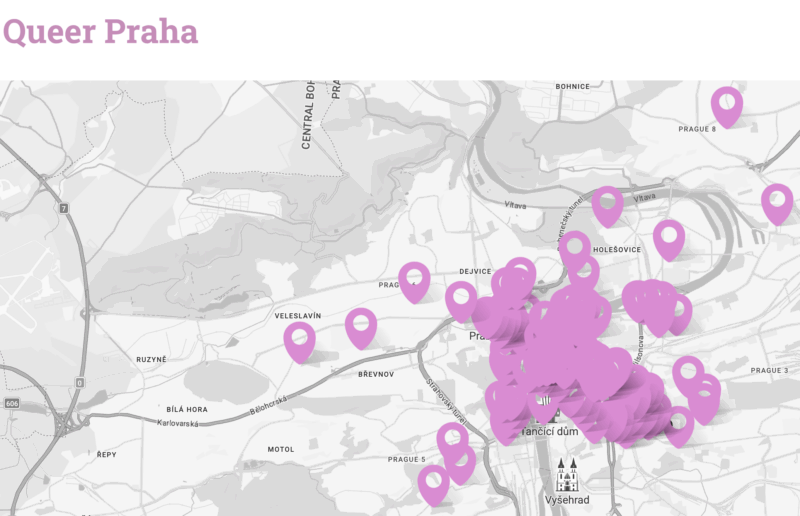
Screenshot of the interactive Prague Gay Map from Teplá Praha (Queer Prague).
In the Czech Republic, the debate on LGBTQ+ people’s rights oscillates between a tolerant rhetoric towards this community and exploitation by predominantly right-wing politicians, who consider the gender issue as something foreign, if not a violation of local traditions. However, as shown in an interactive map of Prague, listing historical figures and places associated with this community, LGBTQ+ people have always been part of Czech culture.
Homophobic rhetoric under the pretext of political protectionism
In Central and Eastern Europe, which remains more marred by homophobia than Western Europe, where LGBTQ+ activism has been changing attitudes and laws since the 1980s, the Czech Republic is considered a comparatively more tolerant country. Progressive narratives on gender issues in the inter-war period, and one of Europe’s lowest levels of religiosity (about 20 percent of believers ), may explain why.
But this is not to say Czech LGBTQ+ people are protected equally by law or on the streets. Although homosexual relationships, condemned during the communist era, were decriminalized in 1961 and registered partnerships were passed in 2006, parliament has refused to ratify the marriage bill for same-sex couples, despite positive changes to inheritance rights in 2024. That said, almost two-thirds of Czechs support the bill’s approval.
However, according to a study conducted in 2024, more than 40 percent of Czechs belonging to this community report instances of verbal or physical abuse. In more than 90 percent of cases, victims do not file complaints.
The most serious homophobia probably comes from politicians. They don’t hesitate in making public homophobic statements in a country that is a member of the European Union and, therefore, bound to anti-discrimination legislation under Article 21 of the EU Charter of Fundamental Rights.
As reported in this Global Voices article, leading figures, such as former president Miloš Zeman, former prime minister Petr Fiala, and Senator and presidential candidate Pavel Fischer, have made public discriminatory remarks without any consequences. They often present gender diversity as a “cultural import” from Brussels or the United States.
A recent incident emphasized the culture of impunity toward some politicians. Minister of Foreign Affairs Petr Macinka from the far-right party Motorists for Themselves, who attended the Munich Security Conference in February 2026, clashed with former U.S. Secretary of State Hillary Clinton on gender. He said:
There is male, and female, and the rest, probably, is a social construct.This [the issue of gender] is something that went too far.
The medieval roots of Prague’s queer scene
It was in light of this disregard that the Czech LGBTQ+ activist group and NGO, Společnost Pro Queer Pamět (Society for Queer Memory), launched an initiative, educating citizens about the ancient, vibrant history of LGBTQ+ people’s presence in Czech culture.
In February 2022, the NGO launched an online interactive map of Prague, called Queer Prague, listing places where LGBTQ+ people lived and worked, as well as locations with monuments associated with this community. This guide, first published in print in 2014, features 160 points that, when clicked, open information pages explaining the cultural and historical context of LGBTQ+ people or places.
The famous Republic Square, Náměstí Republiky, once named Josef Square during the Austro-Hungarian Empire until 1918, in the historic center of the city, was known as a “cruising area,” a public meeting place for gay men:
Korso urningů
Ladislav Jackson, a representative for the NGO, explained the project’s origin and development in an interview with Global Voices:
Všechno začalo v roce 2009, kdy se konala vůbec první mezioborová konference Homosexualita v české vědě, kde se setkalo významné množství historiků, historiček, historiků a historiček kultury, umění a literatury. Výsledkem byly tři akademické knihy, které pak historik Jan Seidl navrhl přetvořit v praktický průvodce po Praze s názvem Teplá Praha (anglicky Queer Prague). Kniha se záhy vyprodala, tak jsme přistoupili k vytvoření on-line verze. Místa jsou tedy jakákoli místa, o kterých víme, že byla nějakým způsobem spojena s minulostí queer osob, historií queer emancipace a queer kultury. Nejstarší místo je z roku 1376, kdy je zaznamenán vůbec první soudní případ homosexuálního chování, šlo ale o násilné, zavrženíhodné akty. Pak je tam několik příběhů z dob novověku, většina událostí je ale z první poloviny 20. století.
It all started in 2009, at the first Interdisciplinary Conference on Homosexuality in Czech Science, which brought together historians of art, culture, and literature. It resulted in three academic works, which the historian Jan Seidl suggested transforming into a practical guide for Prague titled ‘Queer Prague.’ As the book quickly flew off the shelves, we created an online version. The places mentioned are all those that we know are somehow associated with LGBTQ+ people’s history, their emancipation, and queer culture. The oldest place dates back to 1376, the year of the first recorded homosexuality trial, involving violent and reprehensible acts. Then there are modern-day stories, but most of the events happened in the first half of the 20th century.
For Jackson, the most interesting points on the map are those associated with two leading Czech artists, Jan Zrzavý and Toyen:
Ukazují totiž, že queer minulost nejsou jen tragické příběhy a příběh ze soudních spisů, ale velmi komplexní svědectví o tom, jak lidi v minulosti dokázali svou jinakost předávat prostřednictvím umění a současně nacházet strategie, jak žít relativně šťastné životy.
They show how the queer past isn’t just about tragic stories and judicial archives, but also about complex accounts of how people once expressed their otherness through art, finding strategies to live relatively happy lives.
Jackson also believes that LGBTQ+ history awareness remains very limited:
Bohužel už pak ale lidé neznají konkrétní příběhy, významné osobnosti, které se o to odtrestnění a další narovnávání práv zasloužili, jak se queer lidem žilo, čemu čelili v Rakousku-Uhersku, za tzv. první republiky, během druhé světové války, za státního socialismu. Jak se narovnávala práva hned po revoluci v roce 1989. Co všechno to pro queer lidi znamenalo. I v dnešní době je queer historie zásadní, protože je instrumentální v udržování a rozšiřování/narovnávání občanských a lidských práv LGBTIQ+ osob. Ukazuje totiž, že queer lidé tu byli vždycky a jsou všude, nejde o žádnou novinku a rozmařilost zkažené doby. Bez queer historie, muzeálního a archivního uchovávání se žádná vyspělá společnost neobejde
Unfortunately, people often don’t know much about the lives of the influential figures who fought for decriminalization and equal rights, focusing on their daily lives and the challenges they faced in the Austro-Hungarian era under the First Republic (1918–1948), during the Second World War, and under the socialist regime (1948–1989).
People also know little about the rights advancements after the Velvet Revolution in 1989 and what they meant. Today, queer history remains vital as it plays an instrumental role in maintaining and expanding LGBTQ+ people’s civic and human rights. It shows that queer people have always been there and are everywhere. This phenomenon isn’t new or a remnant of an immoral era. No developed society can forget about queer history and its preservation in museums and archives.