



For years, Pedro Almodóvar’s films have deployed variations on the same narrative device: a prevailing sombre tone is carefully established, and then punctured by unexpected yet striking bursts of humour.
This is evident throughout his oeuvre: the bourgeois lady who scolds her nun daughter for interrupting her while forging Marc Chagall paintings in All About My Mother; the receptionist who phones a friend to recount the consistency of her bowel movements in Talk to Her; the father and son who go to a second-hand shop to sell everything the mother left behind when she fled the family home in The Skin I Live In.
Each of these moments are, as the critic Roland Barthes would put it, the film’s punctum: the poignant and unexpected detail which pulls our attention onto the image, shifting the work’s thematic and formal boundaries.
Almodóvar is the cultural figure who, more than any other, carries the torch of esperpento, a Spanish literary genre that highlights and distorts popular traditions, portraying folklore with the wisdom of having experienced it firsthand. He is also an intensely avant-garde director, and while each frame of his films exudes edginess, his staging reflects global trends in interior design, art and fashion.
This duality allows him to present details that range from the hyper-kitsch – a legionnaire doll perched atop the TV cabinet in The Flower of my Secret, for instance – to high fashion, such as Tilda Swinton in a multicoloured Loewe jumper with a four-figure price tag in The Room Next Door.
With his 24th film, Bitter Christmas, now in the running at this year’s Cannes film festival, what can we expect in the latest offering from Spain’s veteran, standout director?
The two lives of Almodóvar
Bitter Christmas is, in its own way, another game of balances. It tells the story of a director (Leonardo Sbaraglia) making a film about another director (Bárbara Lennie). Self-referential storytelling is not new territory for Almodóvar (take 2019’s Pain and Glory, for example), and this approach seems ideal for exploring some of the themes at the core of his more autobiographical works: creativity, family and motherhood, and most importantly, the relationship between art and life.
So how does this latest film fit into the director’s body of work? Many have attempted to categorise Almodóvar’s output, but the acclaimed 1999 film All About My Mother is typically cited as the main turning point – from an Almodóvar who was quintessentially Spanish and light-hearted to a more mature and self-reflective artist.

El Deseo / Teresa Isasi
Two factors influence this view. First is the film’s unanimous acclaim; it garnered numerous awards at film festivals around the world, including the Oscar for Best Foreign Language Film. Secondly, the film marked a break from Almodóvar’s madcap comedy, striking a much more restrained, dramatic tone that is typically understood as “serious”.
But the extent of this shift is debatable. Almodóvar had already broken into the world of international awards well before All About My Mother came out – his 1989 film Women on the Verge of a Nervous Breakdown was nominated for an Oscar. He had also tackled non-comedic melodrama in 1987’s The Law of Desire.
Nevertheless, it is true that this film marked a new direction. In it, Almodóvar left behind one set of mannerisms and references (1980s Madrid, comedic provocation) and adopted others (a more profound and human drama, an international perspective) because he too had repositioned himself in the world. And so, we understand that this evolution can only be the result of changes in his own life.
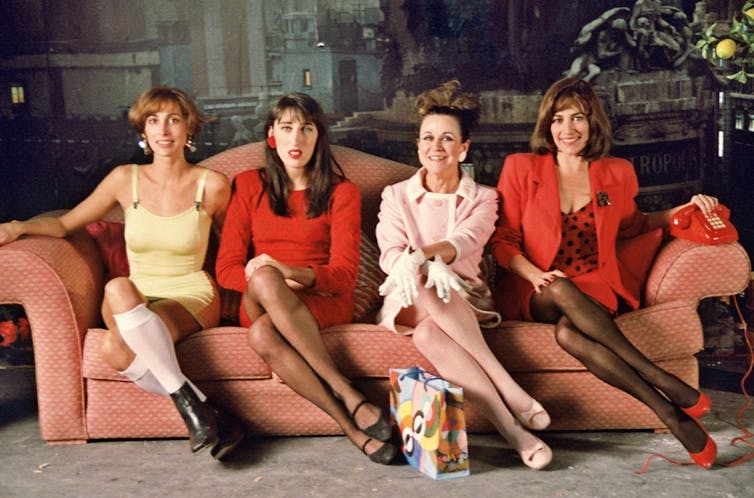
Up until Women…, Almodóvar’s films had a clear setting – Madrid – and certain predominant stylistic features: comedy of errors, libertine lifestyles, and multiple, chaotically intertwined narrative threads.
Even so, this did not prevent other styles from appearing from time to time, such as the more passionate drama of Dark Habits or the neo-realist portrait of What Have I Done to Deserve This? Almodóvar gained experience along this path, evolving from his experimental early films to the technical mastery and narrative clarity of his later output, with each work peppered with references to underground, pop and traditional culture.
El Deseo DA S L U Foto Macusa Cores
In the early 1990s, however, the filmmaker joined forces with the French production company Ciby 2000 (which had also funded the work of filmmakers like David Lynch and Emir Kusturica) and his vision went global. High Heels became a hit in France, Everything About my Mother broke away from the heart of Madrid and moved to cosmopolitan Barcelona, and The Room Next Door took viewers, led by Hollywood actresses, to another continent altogether.
The director is an increasingly global figure, but also, inevitably, a more mature one. The self-referential humour of 2013’s I’m So Excited is an exception in a body of work that has otherwise leaned more and more towards other themes, such as family drama (Volver) or thrillers (Bad Education).
His own life is also becoming increasingly burdened with responsibilities and concerns. As he adopts a more pronounced political stance and his own body begins to show the signs of age, his films have gradually shed their frivolity and moved towards stronger narrative and formal realism.
Bitter Christmas
The final link in this chain is Bitter Christmas. The film suggests a continuation into the more subdued, autumnal phase of his work – a phase shaped both by his global reach and his own personal evolution. Like the rest of us mortals, Almodóvar cannot reclaim his lost time, nor does he wish to.
As fans, however, we will continue to look for – and even expect – those occasional comedic sleights of hand in every new film, those fleeting glimpses of his more playful era that remind us, through a series of surreal and down-to-earth moments, who Pedro Almodóvar really is: a working-class man forged in the excesses of the Movida, now a well-heeled cultural icon, and forever the filmmaker who best knows how to reflect his own life in art.

A weekly e-mail in English featuring expertise from scholars and researchers. It provides an introduction to the diversity of research coming out of the continent and considers some of the key issues facing European countries. Get the newsletter!