



British-American journalist and filmmaker Louis Theroux has a long history of documenting outlandish and extremist communities, from the Westboro Baptist Church in The Most Hated Family In America to The Settlers in the West Bank.
His deadpan, nerdish delivery, in contrast to his interviewees’ more animated behaviour, has become a signature style. The humour in these awkward scenarios makes him a bit of a legend in the internet era.
He gave South Africa one of its earliest memes when he interviewed a gangster for his documentary Law and Disorder in Johannesburg.
Read more:
Inside the Manosphere: Louis Theroux opts for superficial spectacle over serious scrutiny
With a new documentary, Inside The Manosphere, on Netflix, Theroux is back. And this time he takes on possibly one of the most troubling cultural formations of the internet era: the online “manosphere”. This misogynist movement of male influencers and broadcasters has gone from the margins to the mainstream, gaining followers, political power and influence along the way.
As a lecturer in film and media, with a focus on the relationship between technology and filmmaking, I’m interested in how Theroux’s new documentary is not about the manosphere alone but also about who has the power to frame the story.
It reveals the diminishing status of traditional media in the public sphere – and how powerful these online creators are in shaping narratives around the world.
HS TikkyTokky
Inside the Manosphere is a captivating watch. It begins with Theroux in Marabella, Spain, where he finds his main protagonist (perhaps antagonist) HS TikkyTokky, or just Harrison to his doting mum.
The 23-year-old British influencer sells an extreme mirage of masculinity to his followers; it promotes traditional values (for women) but also a wild and promiscuous lifestyle (for men). Theroux shows us TikToks of HS egging on his followers to “smash” the subscribe button and sign up for whatever dubious financial product he may be selling at the time. Theroux signs up for one in the film and loses most of the money he puts in.

Screengrab/Netflix
HS owns an adult content agency. However, he says he would “disown” his hypothetical daughter if she did this kind of sexually explicit work.
Read more:
Louis Theroux’s Inside the Manosphere exposes the business model of misogyny
He puts out streams manufacturing extreme content for “clout” (influence) and then selling products to loyal followers, mostly impressionable young boys.
A global issue
Media scholars have written that the manosphere exists on a spectrum as a network of diverse individuals. Many of these content creators are “relatively uncontroversial”, in Theroux’s words. However, research has shown that algorithms promote extreme content to young people and that harmful content has been “normalised”.
Read more:
News influencers are reshaping the media – insights from Kenya, Nigeria and South Africa
This kind of content ripples around the world. A recent report shows how online news creators in Africa have an increasing grasp over eyeballs compared to mainstream media.
The study finds most of these news creators are men, and many focus on commentary skewed towards the right. African countries have their own versions of the manosphere.
The Red Pill
Many of these men espouse “red pill ideology”, a reference to the sci-fi film The Matrix. It seeks to “wake up” men from a “woke” ideology that promotes feminism, body positivity and queer rights. Essentially these men feel that feminism is an oppressive system or matrix they must push back against.
Read more:
The Matrix: how conspiracy theorists hijacked the ‘red pill’ philosophy
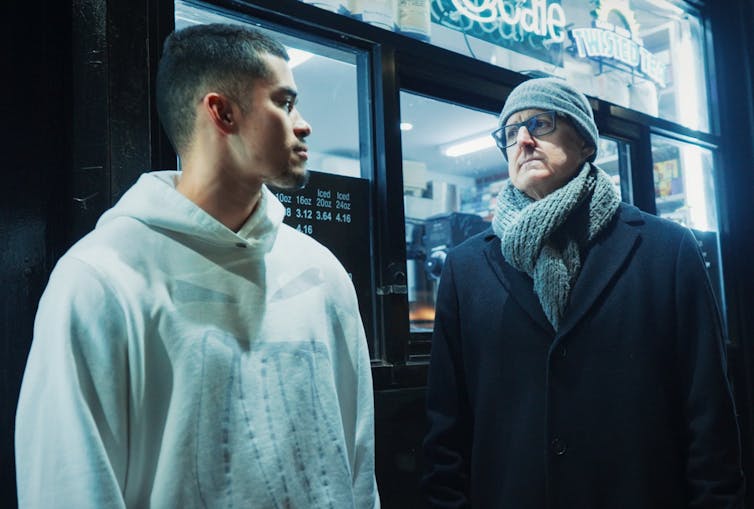
Theroux flies from Marbella to Miami to meet Justin Waller (an affiliate of Andrew Tate, arguably the manosphere’s most notorious figure) and Myron Gaines, co-host of the controversial Fresh and Fit podcast. Eventually he ends up in New York with rightwing influencer Sneako.
All these interviewees embrace a form of “red pill” ideology, indulge in conspiracy theories and are affiliated to the Make America Great Again movement in some way. All have bought into extreme antisemitic talking points, all believe “the Jews” have a secret society that runs the world.
Screengrab/Netflix
All of these men have said violent and misogynistic things, yet all claim to love and support women. Some of them are in committed relationships, where they claim to practise “one-sided monogamy” and frame it as virtuous.
Cameras are turned
There seems to be a common thread of distrust and suspicion of Theroux throughout the documentary. As viewers we see how the camera is turned on the filmmaker in the online streams of the manosphere creators. Mostly they take issue with him as a representative of the mainstream media and for not being “alpha” enough.
Read more:
A dictionary of the manosphere: five terms to understand the language of online male supremacists
One of HS’s camera men livestreams Theroux’s entire final shoot, with viewers sending in comments. This is where one of the most illuminating moments in the documentary happens.
Prompted by his viewers, HS asks Theroux if he believes that Israel is committing a genocide in Gaza. Theroux seems to fumble, leading HS to quickly declare “Louis’s owned by the Jews!” The film cuts to the livestream comments, which confirm this sentiment.
This could have been a moment for Theroux to dispel the marrying of Zionism or the state of Israel to Judaism as a faith. Or to say that many human rights organisations, including some within Israel, have described the country’s actions as genocidal. This is a missed opportunity that seems to conflate support for Palestine with antisemitic views.
This has been a trend in traditional media. To be fair to Theroux, he did an entire documentary on Israeli settlers and land grabs in the West Bank.
Read more:
I’m a Black woman and the metaverse scares me – here’s how to make the next iteration of the internet inclusive
In an online sphere that prioritises winning over actual discourse, Louis Theroux shows us that the traditional TV documentarian no longer holds the same power to decide how the story is framed.
Online content creation initially democratised media production, but has become increasingly dangerous, and tech companies have capitulated to the worst of human behaviour, as long as it drives engagement.
This is the dark side of participatory culture. The tools that gave us all the ability to share our own views and values are now putting impressionable people in danger.
Into The Manosphere is a troubling descent into a world where oppressed groups are portrayed as the oppressor.
Watching this content can be sickening. However, we need to pay attention to the consequences.