



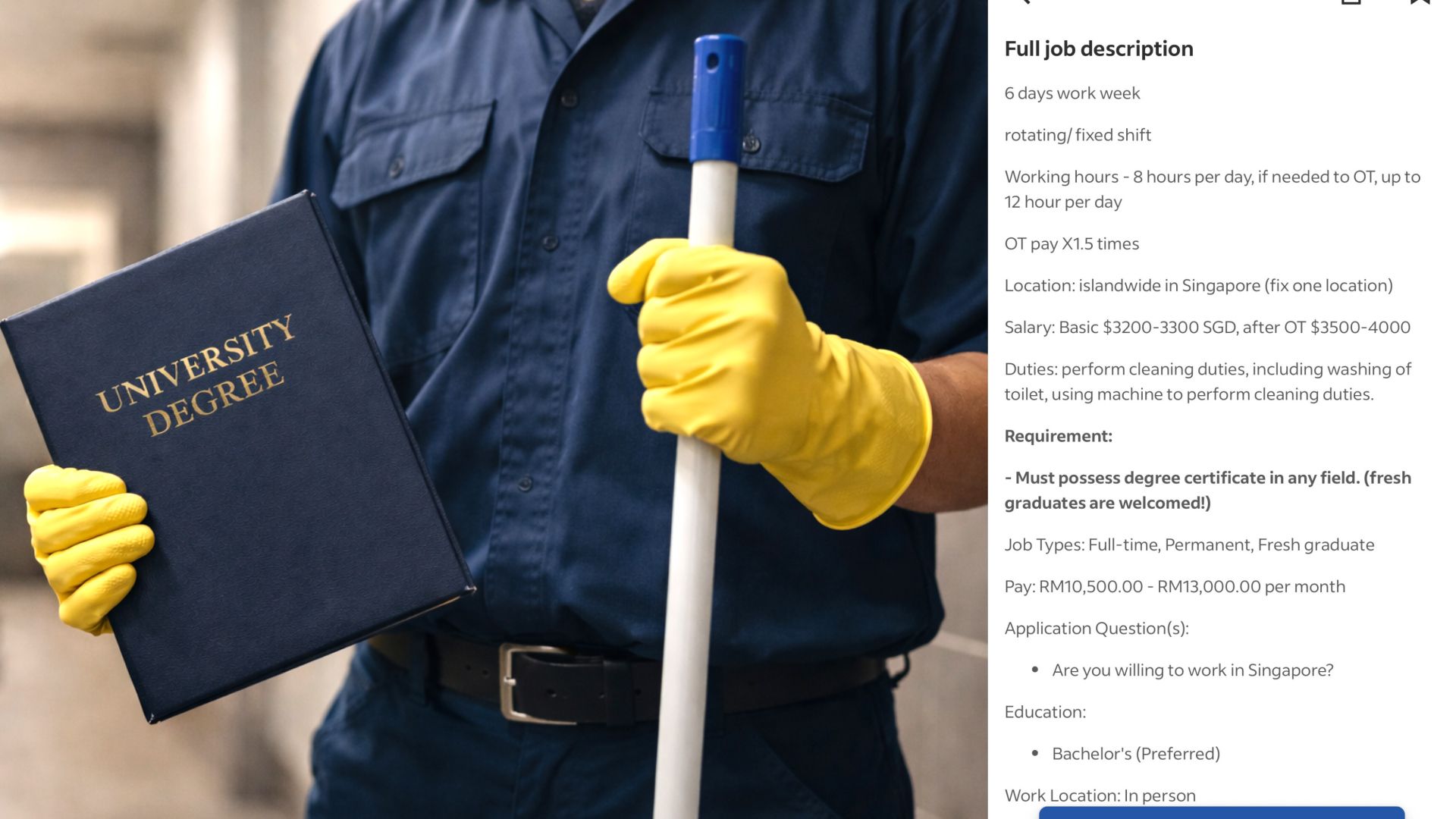
SINGAPORE/MALAYSIA: A job ad for toilet cleaners in Singapore is circulating again on social media, raising eyebrows and drawing laughter online, not just for the offered salary, but mostly for the academic degree requirement attached to it.
The listing that seems to target both Singaporeans and Malaysians alike offers salaries between S$3,200 (RM10,500) and S$4,000 (RM13,000) a month, depending on overtime. The job involves general cleaning, including toilets, across multiple locations. The twist is that applicants must hold a university degree.
The reaction was that many online found it ridiculous. Some poked fun at the idea that years of study now end up in scrubbing floors. Others questioned how academic training improves cleaning work. A few called it the most “overqualified” cleaning role they had seen.
Why does the degree requirement exist
Behind the humour sits a more practical reason. Singapore’s foreign labour system separates workers into tiers. Lower-skilled roles are subject to Work Permits, which come with stricter quotas and higher levies for employers.
Degree holders, however, may qualify for passes like the Employment Pass or S Pass. These often carry different cost structures and fewer restrictions. This creates a workaround, as requiring a degree allows employers to tap into a different hiring pool even if the job itself doesn’t require academic training.
So it is less about skills but more about policy.
A salary that still turns heads
Despite the odd requirement, the salary caught attention nevertheless because when the currency is converted, the role pays far more than similar jobs in Malaysia. With overtime, the monthly income can reach around S$4,000. That’s enough to make some overlook the mismatch between qualification and task.
For cross-border workers, especially those commuting or relocating for work, the numbers still make a lot of sense.
A job market under pressure
This is where the story becomes more than a viral moment. The listing exposes a labour market under pressure. Employers are balancing costs, quotas, and manpower needs. Workers, meanwhile, are navigating a system in which qualifications can shape access, even in roles that don’t require them.
It also points to a growing disconnect when a degree, once tied to specialised work, is now sometimes used as an entry ticket rather than a measure of skill.
For Singaporean readers, this sits alongside concerns about job structures, foreign labour rules, and wage-setting across sectors.
Workers respond to offered job salaries, not job titles
Strip away the jokes, and the logic is that employers optimise within the system they are given. Workers respond to offered job salaries, not to job titles.
The odd part is not so much the cleaning job. It is more about how a degree has become a tool for navigating policy rather than a reflection of what the job requires.
A more direct approach would be to align job requirements with actual skills, while keeping hiring rules transparent and fair. That would reduce the need for these workarounds and make job listings look a lot less strange.