



A placard held by a young man as school protests continued across France appeared to capture the mood on the streets. Young people, it said: “want the Bac (high school diploma), not the BAC”. The Brigade Anti-Criminalité (BAC) is a police unit widely known for its aggressive tactics in tackling street crime.
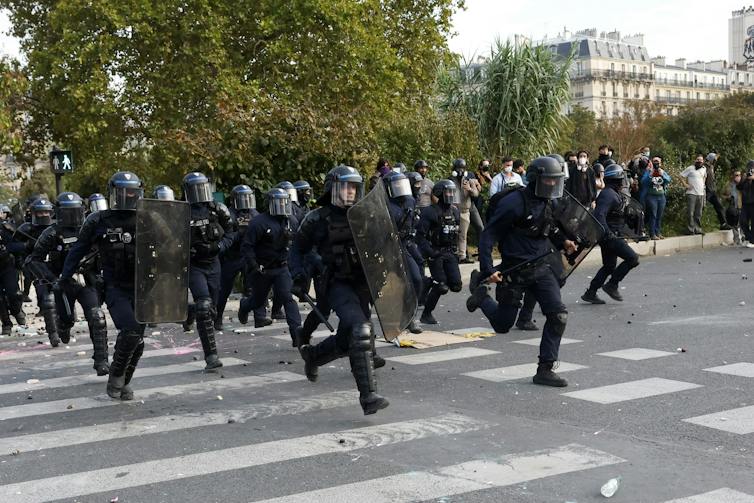
The protests, which began as demonstrations over conditions in high schools (lycées) in Paris have spread across France. Hundreds of thousands of school students and young people have taken to the streets in many cities. After several young people were injured, including a 15-year-old who lost a hand to a stun grenade, the police response has sparked a debate over what some consider to be heavyhanded tactics. The use of stun grenades by police in this protest has now been banned.
The use of force by French police (and its military predecessors) has been a regular topic for debate over more than two centuries. In the 19th century, the army was responsible for public order policing in France. When they opened fire on protesters in February 1848, killing dozens, public outrage boiled over into revolution. It toppled King Louis-Philippe and his regime, marking the start of the Second Republic (1848-1852).
To deal with social unrest after the first world war, the first permanent units for public order policing were created, the “gendarmerie mobile”, joined after the second world war by the Compagnies Républicaines de Sécurité (CRS). Both are highly professionalised and well-trained units, with considerable experience in containing the street protests which have been a big part of French political life since the revolution of 1789.
Yet both are also far more militarised and confrontational in approach than the riot police of most other European countries – hence the slogan coined in the 1968 student protests, “CRS=SS”. Their arsenal of riot-control weapons includes tear gas, the infamous batons or matraques, as well as stun grenades and other projectiles. The risk of public outrage at police brutality fanning the flames of protests into the fire of revolution was certainly present in 1968.
Read more:
French student protests: comparisons with 1968 will only serve the political extremes
The spectacle of police brutality during the gilets jaunes (yellow vest) protests, which raged on French streets between November 2018 and July 2020, also undoubtedly consolidated widespread public support for the movement. This same dynamic appears to be in play today, because the protesters are mainly under 18 and therefore children under French law. As children they are supposed to benefit from enhanced protection and safeguarding.
The deployment of the BAC is particularly disturbing. These units are not public order specialists. They are mainly plain-clothes police, who drive around in vans patrolling the suburbs and intervene very aggressively against petty criminality, including drug dealing, vandalism and robbery.
They also conduct the hated routine identity checks, which disproportionately target ethnic minority youth. These police often use rubber bullets, which although technically less lethal, can still cause excruciatingly painful and life-changing injuries.
In 2005, the BAC chased three teenagers into an electricity substation, where two of them, aged 15 and 17, were electrocuted and died. This led to some of the most intense urban rioting in the history of France.
French sociologist Didier Fassin noticed in research for his 2013 book, Enforcing Order, that some officers of the BAC sported insignia indicative of far-right and white supremacist views.
Vandals and hooligans?
Government officials have tried to discredit the protests by claiming that they have been infiltrated by so-called casseurs (hooligans). This use of this label for violent demonstrators was popularised in the repressive police crackdown of the early 1970s, following the 1968 protests.
EPA/Mohammed Badra
The label was revived in 2019. It’s now been co-opted in the nickname for proposed new emergency legislation popularly known as the “casseurs-payeurs” law. If it is passed, demonstrators could be fined up to €10,000 (£8,500) for continuing to participate in a protest after being asked to disperse and in which damage had occurred. This is regardless of whether they are directly responsible for any of the damage in question.
The government has been advised that this measure is compatible with the constitutional right to demonstrate, yet there is no doubt that it would significantly reduce the scale of street protest. Given the vital role which such protests do in fact play in the political life of France, many question whether the proposed law is compatible with democracy.
Marine Le Pen, the far-right candidate in next year’s presidential election, said “I believe that the police are doing their job in difficult circumstances”. Yet there have been numerous reports of excessive use of force by police against children. Le Pen’s statement offers a chilling foretaste of one plausible future for the country.
The fact that the police are not being more effectively restrained by ministers (a few minor concessions aside) indicates that the government does not want to be seen to be weak on law and order in the run-up to the elections.