



 [embedded content]
That is what happened on the street. What happened online, alongside and ahead of it, is the subject of a new report by Funky Citizens, the Bucharest-based civic organisation where I research digital manipulation and disinformation. Together with colleagues, we analysed 1,186 public Facebook posts and 100 TikTok videos published in Romanian on September 14 and 15, tracking which narratives about the protest circulated, how identical or near-identical wording moved between pages seconds apart, and what language accompanied calls for mobilisation.
The clearest finding does not concern the violence. It concerns the night before. Between 7:00 and 7:15 p.m. on September 14, dozens of Facebook pages republished, almost word for word, a message claiming that “almost 200,000 farmers” were expected in Victoriei Square the next day. The following day, according to press reports, over 3,000 people showed up. Using a 300-second window to flag identical or near-identical wording published by different pages, we mapped the resulting coordination network. Roughly 90 percent of the 2,253 account pairs in the final network, built over the full two days, had already formed within those 15 minutes on the evening before the protest even began.
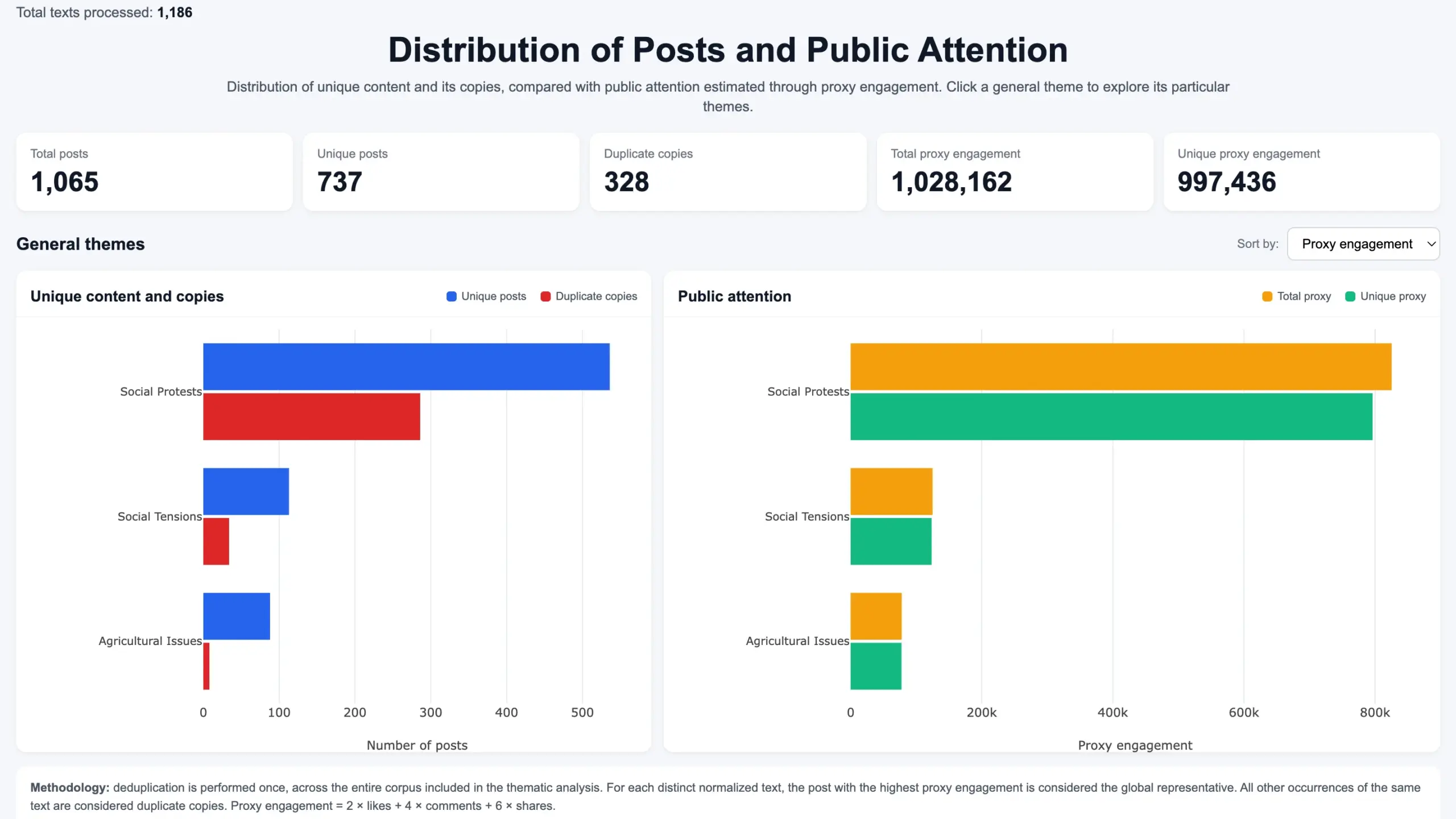
Distribution of posts and public attention. Graph by Funky Citizens, used with permission.
By 3:30 p.m. on September 15, the network comprised 160 accounts and 12 distinct texts multiplied across it. The structure was highly concentrated: two clusters of 50 accounts each, built around two near-identical versions of the “200,000 farmers” message, accounted for 100 of the 160 accounts and close to 90 percent of all connections. The most visible nodes we could identify by name, pages such as Case de Vis, femina.ro and ROL.ro, are content-aggregation and syndication pages, not overtly political ones. Republishing identical text within seconds is, by definition, coordinated distribution in a technical sense. It does not, on its own, establish who organised it or why; our dataset does not permit conclusions about intent.
Around this coordination, four narrative threads ran through the corpus. One concerned the farmers’ concrete economic demands: halting slaughter, resuming exports, fair prices. A second covered the escalation with the Gendarmerie, split between accounts blaming protesters for forcing police lines and accounts blaming the police, alongside a recurring claim that “provocateurs” had been planted in the crowd. A third thread politicised the protest outright, built around AUR leader George Simion’s calls for calm and for the Gendarmerie to show restraint, and around disputes over whether his intervention helped or undermined the farmers’ cause. A fourth thread, more detached from the day’s events, covered structural problems in Romanian agriculture, from delayed EU funding for machinery to the shift toward no-till farming.
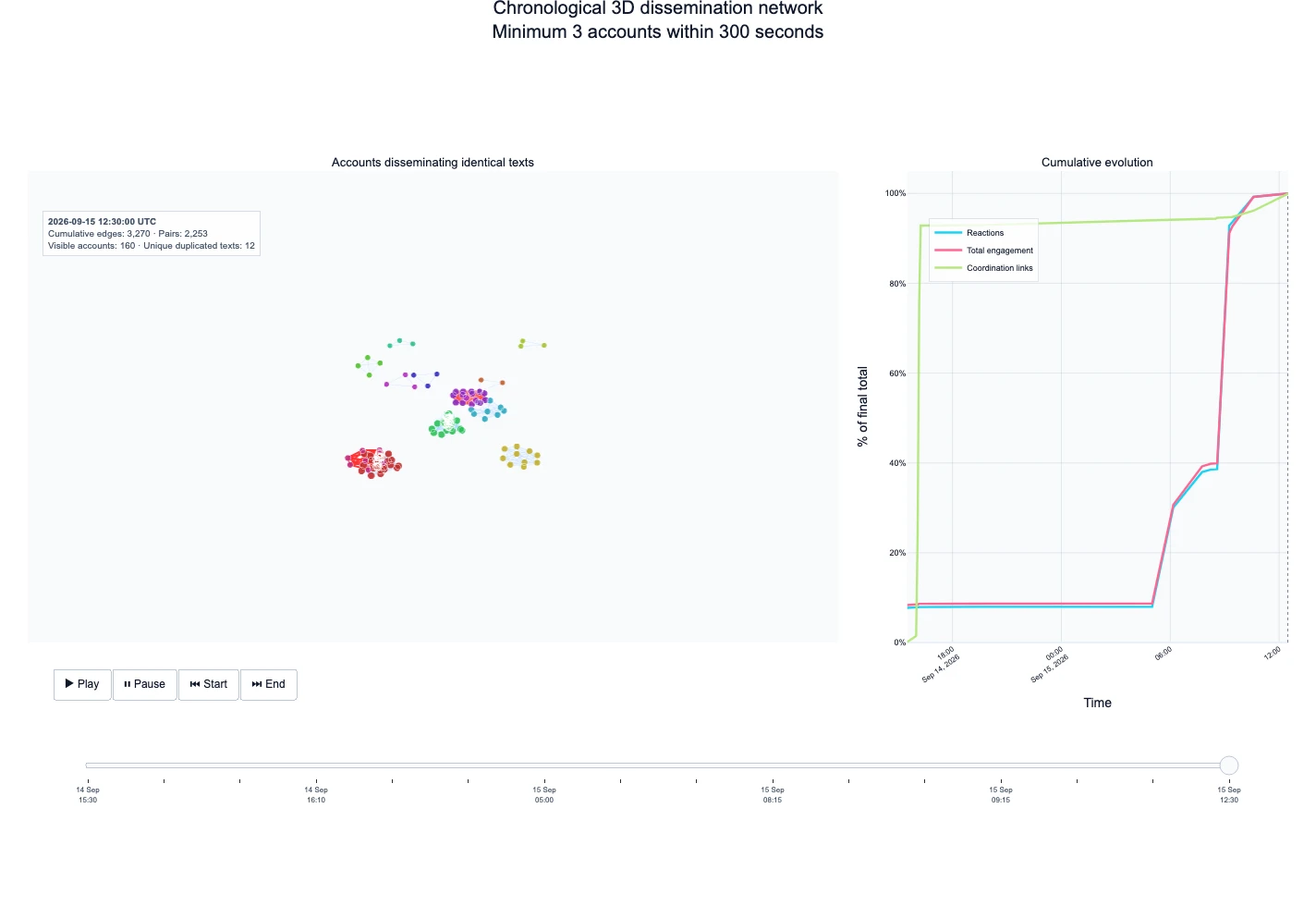
Chronological 3D dissemination network. Graph by Funky Citizens, used with permission.
References to the European Union split into two distinct registers. Sixty-seven posts mentioned Brussels or the EU in connection with the protest. Some described concrete negotiations over the export ban with the European Commission; others recast the EU as an adversary, with formulations such as “Europe’s goal is to leave us without animals, without livestock farming, without agriculture in Romania,” or claims that “the EU would want to starve Romania.”
We separately tracked two Telegram channels previously documented by the “Elie Wiesel” National Institute and by the security think tank GLOBSEC, as part of pro-Kremlin propaganda networks active in Romania and Moldova. Their framing of the protest shifted within hours. At 11:56 a.m., one channel described the demonstration, listing the farmers’ demands. By 2:06 p.m., a second channel had moved to warning that “the usurpers” would use the protest to stage “provocations, then escalation, then a state of emergency.” By 4:03 p.m., after the clashes, the same channel pivoted again to attacking how television stations covered the confrontation. A similar shift, from grievance to provocation-and-escalation to media distrust, recurred in posts using explicit mobilisation language, including calls to “occupy Bucharest” and declarations that “the REVOLUTION has begun.”
On TikTok, where we sampled 100 videos from 34 accounts under the hashtag #protest, the same divide surfaced. Thirty-one videos mentioned the Gendarmerie directly in their description, and the single most shared video, announcing renewed clashes and dozens of arrests, drew nearly 30,000 interactions on its own.
None of this tells us who organised the protest, or who benefited from inflating expectations about it. What the data show is a pattern familiar across Romania and the wider region: a real economic grievance, amplified within hours by dense clusters of accounts republishing identical text, and folded into pre-existing narratives about stolen elections, an illegitimate government and a “system” to be confronted.
Distinguishing the farmers’ protest from its online amplification, and the amplification from any deliberate political instrumentalisation, is not a footnote to understanding what happened in Victoriei Square. It is the story.