



Treasurer Jim Chalmers would have sighed with relief at this week’s economic growth figures. Despite some preview talk of possible stagnation, we saw modest growth of 2.1% in the year to the end of June.
But every economic number these days seems to bring a negative. Economists immediately strengthened their predictions of another interest rate rise.
For the average Australian, just where we are economically is at best confusing, at worst alarming. For years, people have been under cost-of-living pressure. Real wages fell by more than 5% over the five years from 2021. This year’s extended Middle East conflict has added to the strains. The housing market is disoriented after the budget’s tax changes.
In this week’s Essential poll, nearly six in ten people think the country is headed in the wrong direction.
The government tries to empathise with people’s circumstances while claiming it’s pulling the right levers, an assertion strongly contested by the opposition which, in particular, flails high government spending.
The public no longer trusts the messaging from either side. Many frustrated voters are combining their economic and political grievances into support for One Nation.
In light of the often baffling picture, this column asked two independent economists, Chris Richardson and Saul Eslake, for their snapshots of our economic health – or lack of it.
Richardson points to growth easing as interest rates have risen. Over the longer term, “Australia’s economy has been getting bigger mostly because we have more people. On a per-hour-worked basis, the economy is only 1% bigger today than it was a decade ago,” which is “depressingly weak”.
Inflation “has been frustratingly slow to come to heel” and the job isn’t finished, Richardson says. “Even more frustratingly, we still have inflation at around 3.5% (well above the 2.5% target for it) even though Australia’s economy has already slowed a lot.”
A combination of weak growth and lingering inflation is happening “because the engine of the economy – productivity – has been stalled for a long time”.
“With a weak engine behind it, the Australian economy doesn’t need to be travelling fast at all before it starts to blow black smoke in the form of inflation.”
Given we’ve had multiple interest rate rises and the budget’s tax changes have taken some heat out of housing prices, Richardson predicts we’ll probably see only one more rate rise (either this month or in November).
That could be followed, on his assessment, by one or two rate cuts next year, driven by low growth. “But not more than that: higher interest rates look set to be the new normal.”
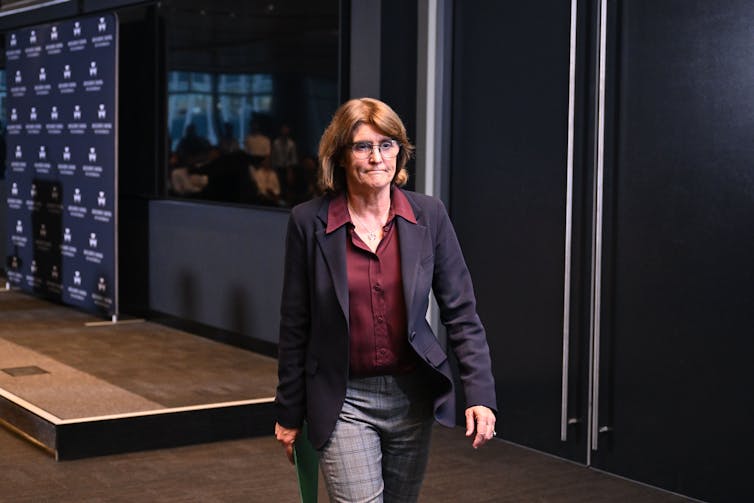
Dean Lewins/AAP
Higher interest rates and the budget’s tax changes are driving down housing prices – the question is, how far? Richardson says “there’s momentum in that fall – having dropped by around 4% already, they could fall another 6% before stabilising”.
But, he says, taxes and interest rates alone “can’t fix Australia’s broken housing market. Doing that would require local councils saying ‘yes’ to much more building than they’ve done in decades.”
Eslake says that in an “underlying” sense the economy is growing at about 2% a year – roughly in line with the Reserve Bank’s assessed “speed limit” (how fast the economy can grow without triggering unacceptably high inflation). “Of this, a bit under 1.5% is coming from population growth, and a little over 0.5% is coming from per capita real GDP growth, that is, improving material living standards.”
Australia’s inflation rate has only been inside the Reserve Bank’s 2–3% target on two occasions in the past almost five years, Eslake says. He says the most recent inflation numbers (3.5% annual in July) have increased the odds of a rate increase at the RBA’s September meeting, taking the cash rate to its highest level since late 2011.
“The RBA can’t afford to repeat the mistake which (with the benefit of hindsight) it made last year, in cutting rates before inflation was sustainably back within its target band. That means the RBA is probably going to want to see at least two quarters with the annual ‘underlying’ inflation rate being 2-point-something – which on its own forecasts won’t be until the first half of 2028.”
Eslake says a key reason for this combination of weak economic growth and persistent inflation is the economy’s “abysmal productivity growth performance”.
Wednesday’s national accounts show “overall labour productivity growth over the year to the June quarter of –0.2%, the worst performance since the year ended March 2025”.
“And it isn’t solely because of the growth in the so-called ‘care’ economy,” Eslake says.
“Labour productivity in the ‘non-market’ sectors of the economy declined by 0.3% over the year to the June quarter, but ‘market sector’ productivity also declined by 0.2%. Big declines in productivity in the mining and construction sectors are a large part of this story.
“Weak productivity growth means that the ‘speed limit’ is also very low by historical standards. In effect, we can’t sustain economic growth of more than about 2% per annum and have inflation at around 2½%.”
Both Richardson and Eslake highlight that Australia is in a very bad place when it comes to productivity. Chalmers’ rhetoric since the election has put much focus on productivity, but so far the government’s talk has outpaced the walk.
Unsurprisingly, the government is pinning hopes on Artificial Intelligence.
This week Chalmers released a Treasury analysis of the economic implications of AI. Although hedged with qualifications and uncertainties, the paper argued AI could help Australia reach Treasury’s long-term target of an annual growth of 1.2% in productivity, although it emphasises it will only provide some of this growth. AI is not a “substitute for domestic structural reforms”.
The government is currently preparing legislation setting out conditions for data centres. That’s necessary not only to encourage investment but to maintain the social licence for data centres which, if the US experience is anything to go by, are likely to become more unpopular as time goes on.
But Productivity Commission chair Danielle Wood stresses it’s not all about data centres.
“What matters much more for productivity is how quickly businesses are adopting AI and embedding it into their processes. At the moment we are lagging nations like the United States, the United Kingdom and Germany when it comes to business takeup.
“There isn’t a single policy answer for this but regulatory clarity, skills and training support, and government’s own adoption can play a role”, Wood says.
The productivity mountain is a steep one to climb.