



For Andy Burnham, walking into the bear pit that is Prime Minister’s Questions, it must have been hard to stay calm. His audience was a room of closely packed MPs, some hostile, some friendly – all very loud – many wanting to make a mark.
And the full audience for PMQs extends far beyond the MPs in the chamber. Prime ministers are thinking about the media, external groups, foreign governments, voters and financial markets. The reactions of any of these matter. The PM has the dual worry of dealing with opposition questions while also demonstrating his or her worth to the party members sitting behind them. Backbenchers can signal a lack of confidence through quietness or just not turning up.
It is no wonder that preparing for PMQs is, in itself, demanding. Alastair Campbell, who advised Tony Blair when he was opposition leader and in the early days of the New Labour government, is clear about just what it took. Preparation can take hours. Nerves don’t disappear. And it doesn’t appear to have got any easier in recent years.
Burnham is, of course, new to this. And unlike many in his position, he hasn’t had a chance to rehearse as opposition leader. He was wise to spend part of Tuesday’s return to parliament on a statement and a lengthy question-and-answer session. It gave him a warm-up for the main event.
After Keir Starmer was ousted as prime minister, Labour MPs will be willing Burnham to show that he can succeed. So how did he do in his first PMQs, and what can we glean from it?
Restraint?
This was not a “full-blooded” PMQs. Burham chose not to mount attacks where others might have. A question from Reform UK’s Danny Kruger, for example, could have led to a reply focusing on the party’s reported problems. That it did not, may mean Burnham wants to move away from such attacks – or that he considers Reform less significant than it has been in recent years.
Burnham’s jibes at the Conservatives were not fierce either. He merely criticised past statements made by Tory leader Kemi Badenoch and her shadow cabinet and sought to associate them with the economic failings of past governments. Prime Minister’s Questions is an adversarial event and it will be worth watching whether more obvious hostilities develop in future.
Sharper exchanges in turn end up generating sharper questions, so PMQs could move from point-scoring debate to abusive exchange. But Burnham may have some way to go to match David Cameron, who was identified by researchers as the rudest prime minister at PMQs.
At length
Speaker Lindsay Hoyle warned that Burnham’s long answers may cause the session to overrun. Burnham clearly wanted to spend time on each answer, but this can be a blessing and a curse for a PM. Longer answers mean you can say everything you want. But sometimes the short, sharp reply is most effective at putting your opponent off their stride. The prime minister may have to learn brevity.
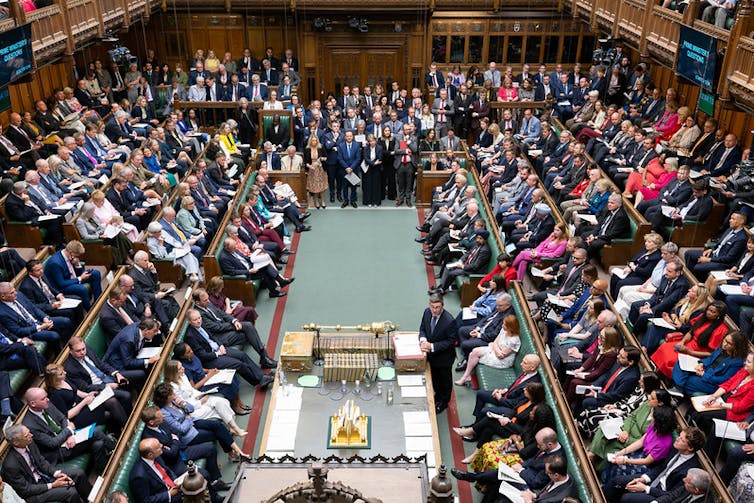
House of Commons, CC BY-NC-ND
Moving on
One of the tricks of dealing with difficult subjects is the “bridge”. That is, taking the topic and linking to something else that you actually do want to talk about. Burnham showed some ability here, linking at one point from a question about public spending to the needs of young people not in education, employment or training (Neets).
His bridge from the Bayeux Tapestry and French president Emmanuel Macron to small boat crossings didn’t work, however. He is clearly a bit rusty in the use of this technique.
Are you listening?
Badenoch was keen to paint the PM as someone who won’t answer questions about spending, and as such as a PM who leans towards more tax and more spend. This may be the beginning of a strategy to frame him as vague and unwilling to commit to specific action in the face of obvious problems. Once an idea like this takes root, it is very hard to shift.
But neither Badenoch nor Burnham has the proper measure of the other yet, and it will take a few more outings before there is a sense of how successful this strategy may prove.
The right man for the job?
As Burnham did not ascend to Downing Street immediately after a run of other roles in parliament, or after a general election, he needed to make his experience clear. He name-checked things he had achieved or initiated, specifically in Greater Manchester, as a way of underlining his credentials.
These references, plus the use of “I”, were designed to demonstrate his ability to get things done, rather like the way it is used in job interviews. Using “I” instead of “my government” or “we” also demonstrates engagement with the topic.
Play nicely
During some replies, Burnham touched on cross-party working, and made an on-the-spot pledge to meet Cornish MPs (not all of whom are Labour) for talks. Offering cross-party working can remove the sting from an attack and make the prime minister seem reasonable. This appears to be a feature of Burnham’s approach and it will be interesting to see if it develops into genuine cooperation with at least some other parties.
Prime ministers often say they want to change aspects of PMQs. Burnham himself has indicated that he wants a different, less Punch-and-Judy tone. Back in 1997, Tony Blair made the move from two shorter sessions a week to one longer one. Blair said he wanted a more considered approach, with more questions and more answers. Whether prime ministers get what they want, of course, is not entirely down to them. They may get the last word, but they don’t control the cast.