





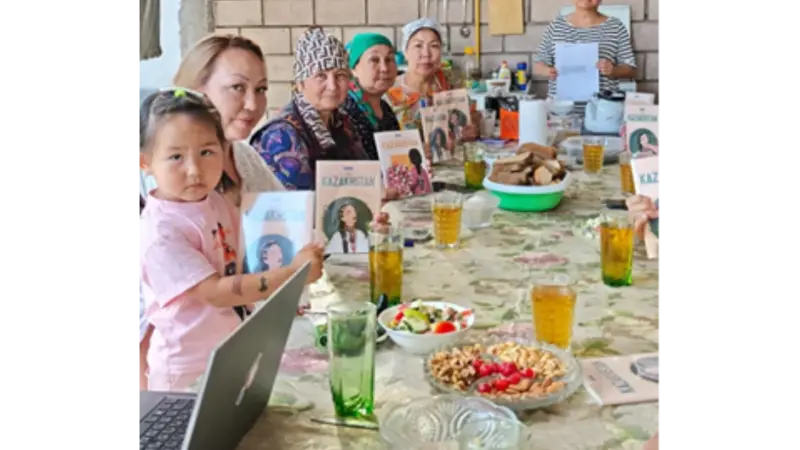
Participants of the project in Qyzylsay, Kazakhstan. Photo by Nazgul Aidabossynova. Used with permission.
This interview is part of a series of spotlights on the work of some of the grantees of the Digital Spark granting scheme, as part of the Regional Support Mechanism EECA project, implemented by the Metamorphosis Foundation and TechSoup, in partnership with CIVICUS and under the Digital Democracy Initiative (DDI) that covers the Global South. It is being published on Global Voices as part of a content-sharing agreement.
Women in the rural areas of Kazakhstan are among those most affected by climate change, energy deficit, and poor governance. They bear the heavy burden of water shortages, especially in the southern parts of the country, where this problem is the most acute due to dense population, economic reliance on agriculture, and water losses related to outdated irrigation infrastructure.
In the village of Qyzylsay, located in the southern Jambyl region, the water shortage has become a major issue affecting the daily lives of women. It forces them to spend multiple hours a day outside their homes to secure water for their households, gardens, and animals. Their grueling work often goes unnoticed and unpaid, and their geographical remoteness places limits on access to information and government services, exacerbating their situation.
In 2026, Nazgul Aidabossynova, a local activist, implemented a project to help local women improve their livelihoods by training them to engage with the government more effectively and efficiently, calculate the cost of their labor and products, and mobilize collective efforts to solve community problems. Global Voices conducted an email interview with Aidabossynova to learn more about her initiative. The interview has been edited for clarity and brevity.
Global Voices (GV): Please tell us about your organization and why you chose to get involved with the Digital Sparks project.
Nazgul Aidabossynova (NA): I represent a community-based initiative led by rural women in Qyzylsay. Our work focuses on supporting women who manage households, small farms, livestock, and care responsibilities, while also facing limited access to information, public services, and opportunities for civic participation.
We chose to participate in the Digital Sparks project because digital tools can make a direct, practical difference in women’s daily lives. Many women already own smartphones, but previously used them mainly for calls and WhatsApp.
The project created an opportunity to turn these devices into tools for accessing eGov services, documenting community problems, managing farm and household responsibilities, protecting digital security, and communicating with local authorities.
GV: What issue/challenge in your community prompted you to undertake this project?
NA: The key challenge is unreliable access to water in Qyzylsay. Water often disappears from the pipes during the day, particularly in summer. This affects gardens, livestock, household work, and the health and well-being of families.
The burden falls disproportionately on women. They wake early to store water, carry water for household and agricultural needs, care for the livestock, and wait for irrigation turns. Much of this work is unpaid, time-consuming, and rarely recognized.
Women also faced barriers in reporting water problems: they knew what was happening, but often lacked the knowledge, evidence, and confidence needed to raise concerns effectively with local institutions.
GV: What are the key changes/activities that your organization implemented during your participation in the project?
NA: The project delivered four practical training sessions for ten rural women.
The first one, titled “Your Phone is More Than WhatsApp: Smartphone as Your Household Assistant”, taught them how to use smartphone reminders, photo-diaries for farm and livestock work, eGov services, strong passwords, and basic digital-security practices.
In the second workshop, titled “Smart Water: When Your Garden Tells You It’s Thirsty”, participants learned about water rights, the responsibilities of relevant local authorities, and water-supply mapping using timestamped and GPS-tagged photographs.
The third session, titled “Numbers Don’t Lie: When You Count Everything, You Earn More”, covered how to track unpaid work and calculate the real cost of agricultural products such as milk. It also discussed the economic value of time saved through smart irrigation.
In “Honest Agreement: When Technology Helps Us Trust Each Other”, the fourth and final session, participants prepared time-to-income plans, mapped local support networks, discussed peer mentoring, and agreed to begin work toward a cooperative approach to water advocacy and shared smart-irrigation infrastructure.
GV: How did your participation in the project impact your organization’s beneficiaries and the community that you serve? Please provide examples.
NA: The project helped participating women see smartphones as tools for independence, civic participation, and practical problem-solving, rather than only communication devices.
For example, women learned that they can use eGov services to request certain official documents online, reducing the need to spend time and money traveling to administrative offices.
They also learned to create structured evidence of water problems. A photograph of a dry canal, broken pipe, or contaminated water source becomes more useful for advocacy when it includes the date, location, and a written description.
The training on unpaid labor and production costs was especially meaningful. Participants calculated the value of their time and better understood the real cost of milk production and irrigation work. The discussion showed that manual irrigation may take up to 60 hours per month.
This helped participants recognize that their time has economic value, and that shared smart-irrigation solutions could create more time for income, education, rest, and community participation.
The group also began a peer-learning process. Three participants started sharing the knowledge gained during the training with neighboring women.
GV: How has your own knowledge, awareness, and experience with digital democracy and civic space changed, thanks to your participation in the project?
NA: My understanding of digital democracy has become much more practical. Before this project, digital tools could be viewed mainly as a way to communicate or access information.
Through Digital Sparks, I saw how digital tools can strengthen people’s ability to exercise rights, access public services, collect evidence, engage with local authorities, and organize collectively.
I also gained a stronger understanding of the link between digital inclusion, women’s unpaid labor, climate-related water challenges, and civic space.
For rural women, digital capacity is not only about technical skills. It is about having a voice, being able to document problems, understanding their rights, and participating in decisions that affect their families and community.
GV: What are the most valuable lessons and experiences you are taking away from this project?
NA: The most valuable lesson is that digital literacy has the greatest impact when it is directly connected to people’s real, daily needs. In Qyzylsay, water shortages, agricultural work, unpaid care responsibilities, and access to public services were the issues that made digital tools relevant and useful.
Another important lesson is that women need not only information, but also confidence and collective support. When participants understood their rights, calculated the value of their labor, and learned how to create reliable evidence, they became more prepared to speak with local authorities and work together.
The project also showed the value of peer learning. Participants are more likely to trust and learn from women in their own community who face similar challenges.
GV: What comes next? How will you apply the learning and digital capacity you have built in your future work and within your community?
NA: We will continue the peer cascade model, with trained participants sharing basic smartphone, eGov, digital safety, and evidence documentation skills with other women in Qyzylsay.
The group intends to develop a cooperative approach to the village’s water challenges. The planned cooperative would support joint advocacy, shared learning, and exploration of funding opportunities for smart-well or shared irrigation infrastructure.
In future work, we will continue combining digital skills with women’s economic empowerment, rights awareness, and local civic participation, so that rural women’s work, knowledge, and needs become more visible.