





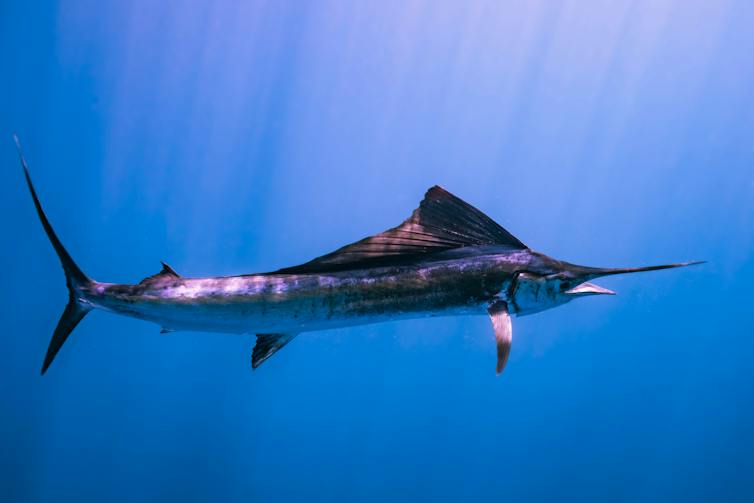
Filmmaker and outdoorsperson Quinn Barabash recently made headlines when he found a nearly two-metre-long swordfish carcass on the remote shores of Haida Gwaii in northern British Columbia.
Swordfish are large-bodied, highly migratory fish typically found in temperate and warmer tropical waters far south of Haida Gwaii. They are thought to have only been documented in B.C. twice before, so it’s a rare find. Long-term ocean warming alongside the developing El Niño may be making B.C.’s waters more attractive to these warm-water species.
While this sighting is unusual and exciting, it also serves as a reminder that our oceans are rapidly changing and we need to adapt to these changes.
Warm water visitors
This isn’t the first time a warm water species has appeared along B.C.’s coast. During the 2014-16 marine heatwave known as “the Blob,” ocean sunfish, Humboldt squid and triggerfish were all sighted off B.C. More recently, tropical barracuda and even a great white shark have been spotted.
Marine species can move to new locations as they follow favourable ocean conditions. During extreme events like marine heatwaves, these shifts can bring species far outside their normal ranges.
These sightings make good headlines, but the bigger story is what ocean warming and environmental extremes mean for marine ecosystems and the fisheries and communities that depend on them.
Fisheries at risk
Our recent global study analyzed three decades of data covering 1,246 species across 254 regions. We found that unusually high ocean temperatures and very low primary production can substantially increase the likelihood of extremely low fish catch.
The risk was even greater when these extremes occurred together or across multiple years. Two consecutive extreme temperature years increased the likelihood of extremely low catch by 40 per cent globally.
Extreme events can abruptly disrupt marine food webs and the productivity of fish stocks, and the effects can last years after the water cools. A warming ocean changes what species are caught and how predictable the catch is from year to year.
Extremes are projected to get more frequent and intense with climate change, which increases the challenges for fishers. This year’s El Niño growing in the tropical Pacific is forecast to be one of the strongest on record and adds another layer of uncertainty.
If unusually warm ocean temperatures arrive on B.C.’s coast, they may create more favourable conditions for warmer water species, but they can be devastating for species that cannot tolerate the high temperatures.
Read more:
How can the same El Niño cause drought in one part of the world and floods in another?
Long-term warming adds to the problem
(Michael Worden)
Extremes are only part of the story. The North Pacific has warmed faster than any other ocean basin since 2013, meaning extreme events are unfolding on top of an already warmer baseline. Long-term warming is also changing the abundance and distribution of species that B.C.’s fisheries depend on.
Declining Pacific salmon populations have been linked to ocean warming and are affected at all stages of their life cycle. Warm waters can cause physiological stress on fish, increase their susceptibility to disease and affect their ability to reproduce.
Fish biomass is also expected to decline over the long term under climate change, which compounds the stress from extreme events. Another study by our team found that marine heatwaves could more than double the impacts of long-term ocean warming on fish stocks in the Northeast Pacific by mid-century.
Fisheries need to adapt and prepare
We can’t control when extreme events occur, but we can make fisheries more resilient to their impacts. Keeping fish stocks healthy and their habitats intact may make them more resilient to climate shocks.
Early warning systems and flexible, climate-informed plans could give fisheries managers and fishing communities time to adjust fishing strategies, quotas or other activities before an extreme event reaches its full impact.
Cutting greenhouse gas emissions and transitioning away from fossil fuels remains essential to limit future change. Our projections have shown that much of the near-term climate risk to fish and fisheries is already locked in. Climate adaptation is essential to manage these risks and is more effective with stronger emission reductions.
Continuing climate change may turn the swordfish on Haida Gwaii from a one-off sighting to a long-term change. Our fisheries need to be prepared for these changes to become the new normal.