



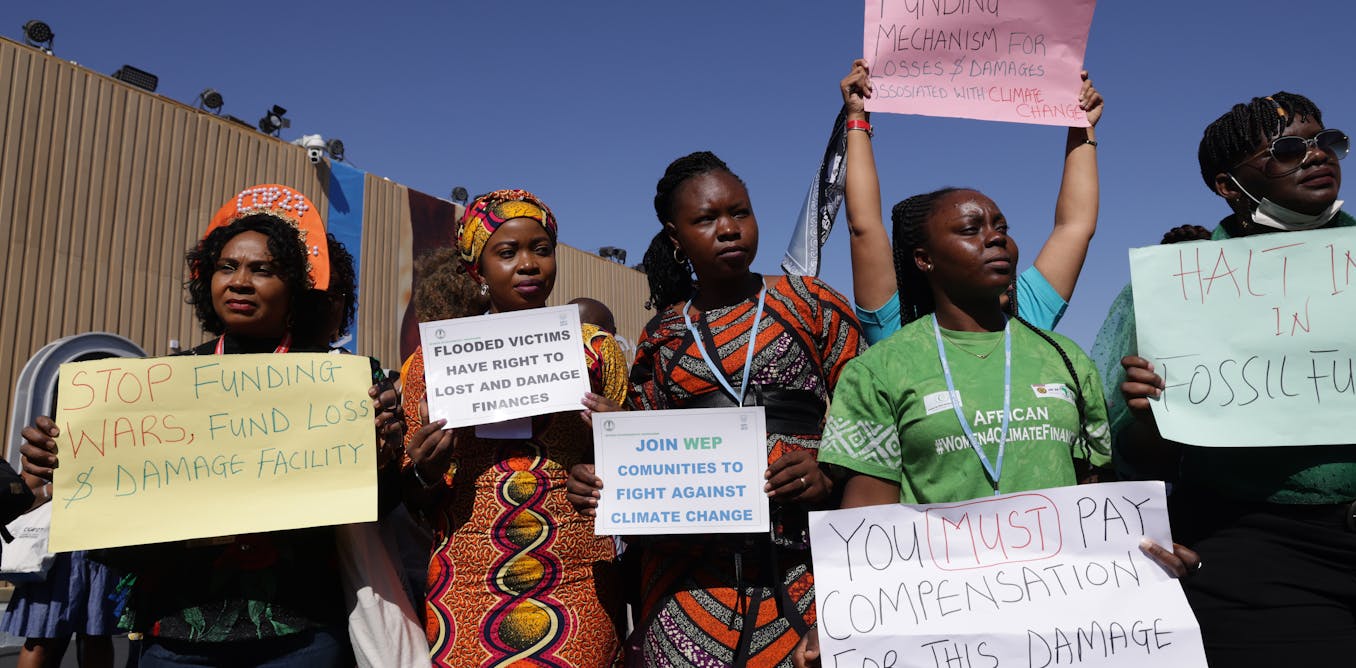
African countries have committed themselves to cutting greenhouse gas emissions and protecting their people from the worsening effects of climate change. These commitments form part of the Paris Agreement, an international climate treaty adopted in 2015 in which countries agreed to take steps to limit global warming.
Doing this requires billions of dollars in climate finance for clean energy and for making agriculture, water systems and infrastructure resilient to climate change.
But the finance reaching Africa falls far short. The continent received an average of US$43.7 billion a year in 2021 and 2022 – only about 23% of what is needed. Africa needs roughly four dollars for every dollar it currently receives.
Read more:
The international order is shifting: African countries have an opportunity to reshape global power relations
The money is also distributed unevenly. The ten African countries most vulnerable to climate change receive only 11% of the continent’s climate finance, while another ten attract 76% of private climate investment. African countries need financing for mitigation (reducing the emissions causing climate change) and adaptation (preparing people, economies and infrastructure for unavoidable droughts, floods and extreme heat). Current finance covers only 18% of planned mitigation projects and 20% of adaptation costs.
I’m an economist specialising in climate change and governance, with a long background at the United Nations and the African Union. I argue that Africa may be committed to the Paris Agreement, but the international financial system is pricing much of the continent out of implementing it.
Climate finance tends to flow to countries where investors believe their money will be safe and profitable. Countries needing the most help often receive the least because investors see them as less likely to repay loans or produce sufficient returns. The system therefore makes finance more expensive and difficult to obtain for countries whose vulnerability makes their need greatest.
Read more:
African countries shouldn’t have to borrow money to fix climate damage they never caused – economist
Africa must negotiate for affordable funding that builds its industries, energy systems, transport, cities and skills – not simply ask for more money labelled “climate finance”. Climate finance should not be separated from development funding. Investment in electricity, transport, cities, irrigation, technology, manufacturing and education is needed both to grow economies and to protect people from climate change.
The transition will be fair only if African countries turn their minerals and renewable energy into local jobs, products and stronger economies, instead of being left to export critical minerals that power the just transition while taking on more expensive debt to adapt to the climate damage caused by developed countries.
Money promised is not money delivered
There has been an extraordinary number of climate-finance announcements, initiatives, coalitions, road maps, reform plans and targets. But promising money is not the same as delivering it.
In 2009, developed countries committed to providing developing countries with US$100 billion in climate finance every year. The money was supposed to be available annually by 2020. But the Organisation for Economic Co-operation and Development’s calculations showed the only time more than US$100 billion in climate finance reached the developing world was in 2022. This was two years after the deadline.
Read more:
Climate finance for Africa: the key challenges and what needs to be done about them
There is an important lesson in this. The world congratulated itself on finally exceeding a target that had been negotiated 13 years before and was supposed to have been reached two years earlier.
It is also important to understand that the US$100 billion target was never calculated based on what developing countries actually needed to respond to climate change. It was a number negotiated by governments through a political process.
The next major climate-finance promise came at the COP29 climate negotiations in Baku, Azerbaijan. Governments agreed to provide developing countries with at least US$300 billion a year by 2035. They also set a much bigger goal of increasing climate finance from all sources to US$1.3 trillion a year by 2035.
But look closely at how this promise has been designed:
-
the guaranteed target is US$300 billion a year
-
the deadline is still ten years away
-
the money can come from a “wide variety of sources”
-
the much larger US$1.3 trillion goal depends on money from everyone. This includes governments, private investors, international financial institutions and alternative sources.
The larger the announced amount becomes, the less clear it is who is responsible for providing the money.
Read more:
Africa’s top climate change challenges: a fairer deal on phasing out fossil fuels and mobilising funds
Climate-finance announcements are not the same as money countries can spend. Pledges are promises, commitments are formal allocations and only disbursements are actual payments. Loans are not grants, private finance is not public funding, and a promised trillion dollars does not simply appear in African budgets.
For example, the 2022 Bridgetown Initiative helped international development banks create about US$400 billion in additional lending capacity over ten years. However this must serve many countries, not just those in Africa. Governments and financial institutions have become adept at designing plans to mobilise trillions. The trillions themselves remain elusive.
The price of money
The amount of climate finance is not the only issue. Its cost also matters. Financing large wind and solar projects costs at least two to three times more in Africa than in advanced economies and China. This is because borrowing costs and investor returns are higher.
Renewable energy projects require large upfront investment, so expensive finance raises the price of electricity. Cutting average financing costs by one percentage point would reduce wind and solar generation costs by at least 8%.
Read more:
African countries can’t resolve their debt crisis under a system rigged against them
Climate negotiations must therefore address interest rates, guarantees, currency risks and the additional costs charged when lenders consider countries risky.
Africa has around 20% of the world’s population but attracts less than 3% of global energy spending. It does not lack bankable sunlight; it lacks affordable capital.
Countries more at risk of climate disasters are also seen as riskier to lend money to, so they pay more for climate finance. This means they can’t invest enough in building infrastructure that can withstand climate disasters. When these disasters strike, African countries are likely to be charged more again for loans they take out to repair the damage.
Africa must produce green technology
Climate diplomacy has become more difficult because climate policy is now closely tied to industrial and geopolitical competition. Rich countries subsidise their own battery, electric-vehicle, hydrogen and renewable energy industries. But African countries are told to attract private investors if they want to build those industries.
Africa holds about 30% of the world’s critical mineral reserves, including 19% of those needed for electric vehicles. Africa is therefore already part of the just transition to green energy. The question is only where the continent participates in the value chain – as an exporter of raw materials like lithium and cobalt or as a manufacturer of batteries and other green products.
Read more:
Shifting from fossil fuels will fail without funding for African industry and energy infrastructure
If Africa supplies the minerals while manufacturing, technology and highly productive jobs remain elsewhere, the green transition will repeat old economic inequalities. African climate negotiations must therefore focus not only on finance, but on building African industries, skills and economic power.
What needs to happen next
I am unconvinced that “climate finance” is the right organising concept for Africa. It separates what is fundamentally one development challenge. Africa needs energy systems, electricity grids, transport, resilient cities, irrigation, digital infrastructure, manufacturing capabilities and human capital.
Together, these investments determine the continent’s development, resilience, productivity, industrialisation and future emissions. Calling some “climate” and others “development” may make sense to international funding institutions. It makes much less sense from the perspective of Africa’s structural transformation.
Africa received only 23% of the climate finance it needs and attracts less than 3% of global energy investment, despite having about a fifth of the world’s population. This points to something larger than a climate-finance gap.
Read more:
African countries gear up for major push on climate innovation, climate financing and climate change laws
Instead of continually asking how Africa can become more attractive to international capital, we should ask why capital is most expensive where development and climate needs are greatest.
The measure of climate justice is not how much money is labelled “climate finance”, but whether it arrives affordably and helps Africa manufacture, trade and build its own productive economy. Otherwise, the just transition will be the old international division of labour powered by renewable energy.
African climate diplomacy should therefore use the global transition to change the terms on which the continent finances, produces, trades and transforms.
This is an extract from the Pro VC lecture that the author gave at the University of the Witwatersrand on 2 September 2026.