



Over the past 50,000 years, many of the world’s large mammals have gone extinct. Until recent decades, all we knew about them came from fossils. Now, analysis of ancient DNA is adding to the picture.
Ancient DNA is damaged and degraded genetic material often obtained from fossils thousands of years old. It’s giving scientists insights into hidden species diversity and the way populations expanded and contracted, based on changes in genetic diversity across time.
These ancient DNA studies have in large part been carried out in cold regions at northern latitudes, where low temperatures and permafrost mean DNA is better preserved – think woolly mammoths.
Across Africa, climates are warmer and DNA preservation in fossil remains is generally much poorer. As a result, there have been few ancient DNA studies of African large mammals, and the few that have been done were focused mainly on humans and domestic species within the past 2,000 years or so.
Ancient DNA allows us to study extinct species and their genetic relationships to living species, and to measure the genetic diversity of past populations. It can tell us something about how species respond to changes in their environment and reveal details about the mechanisms of evolution, population loss or species extinction.
As researchers with expertise in African hoofed mammals and in ancient DNA, we set out with collaborators to investigate how long ancient DNA is preserved in mammal fossils from archaeological sites in South Africa. Our goal was to test the possibility of obtaining ancient DNA from multiple individuals of the same species that lived at different times in the past. This would allow us to compare patterns of genetic diversity within a species through time, to understand the impact of past environmental changes.
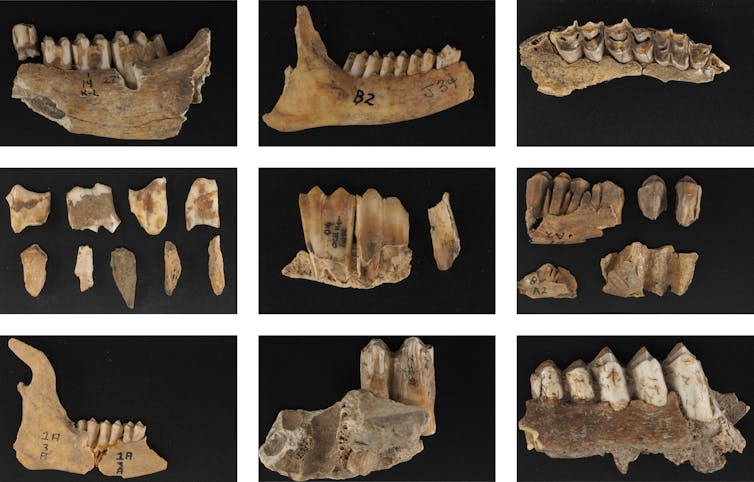
Deon de Jager, Author provided (no reuse)
We tested 144 fossils aged 1,500 to 110,000 years old, and found that DNA can be preserved for up to 50,000 years, although most of the fossils with preserved ancient DNA were younger than 11,700 years old. This age marks the transition between the Pleistocene, or the last ice age, and the Holocene, our current geological epoch, where climates are warmer.
The oldest DNA in our sample belonged to a mountain reedbuck and was found at Boomplaas Cave, in the Swartberg mountains of the Western Cape province, South Africa. It may be the oldest animal DNA to be found in Africa so far, by 30,000 years (a finding we are still confirming via radiocarbon dating).
Our findings mean two main things:
-
we can retrieve ancient DNA from the fossil remains of large mammals that are tens of thousands of years old, something considered nearly impossible until now
-
we can investigate past population dynamics of African species within the Holocene.
We thus show it is possible to genetically study African mammals that went extinct during or after the last ice age. This represents a breakthrough in African palaeontology and opens a new window into how Africa’s extinct mammals can be studied.
We also show that it is possible to investigate genetic changes that happened in animal populations during the Holocene. Data like this can serve as a baseline of genetic diversity before the major declines caused by human activities during the past two centuries. Baseline data are crucial to monitoring biodiversity change and conserving African wildlife.
DNA from animals in South African caves
In our study, we tested for DNA in teeth and bones from four antelope species (Cape grysbok, grey rhebok, reedbuck and eland), the African buffalo, and the extinct giant long-horned buffalo. The fossils were excavated from six archaeological cave sites in the Eastern Cape and Western Cape provinces of South Africa. This enabled us to investigate differences in DNA preservation among species and across sites.
We presume the bones were left in the caves by ancient humans who ate the animals. We know how old they are through radiometric dating of charcoal and other material in the layer of the cave they were found in.
Archaeologists excavated the sites between 1950 and 1995, and the fossils have since been kept at the Iziko Museums of South Africa in Cape Town. We subsampled the fossils by drilling with a dentist drill to obtain 50mg of tooth or bone powder for DNA extractions.
Our results showed no major differences in the preservation of DNA among the six species. However, we did show that some sites, like Nelson Bay Cave in Plettenberg Bay on the southern Cape coast, preserved DNA better than others. The oldest African animal DNA sequenced before our study, a blue antelope tooth about 9,300 years old, was also from Nelson Bay Cave. So were three teeth from the extinct giant long-horned buffalo, aged 12,000-21,000 years old, from which we successfully obtained ancient DNA.
But there’s a catch with ancient DNA: not all the DNA we extract belongs to the fossil. This is because the animal’s DNA degrades over time, and the DNA of microbes that decompose it and other organisms in the environment becomes more abundant. Sometimes the DNA of the people who handle the fossil also get into the mix.
Read more:
What’s next for ancient DNA studies after Nobel Prize honors groundbreaking field of paleogenomics
In our 65 African fossils that had ancient DNA, we found that on average, only 2% of the DNA we retrieved was from the target species. Fossils younger than 2,000 years old tended to have more (as much as 30%), which makes sense as there’s been less time for degradation and mixing.
Collagen as a proxy for DNA
We also evaluated how well collagen, the protein that makes up 22%-50% of vertebrate teeth and bones, is preserved in these fossils.
Collagen can be used for radiocarbon dating, to directly estimate the age of a fossil.
Read more:
Explainer: what is radiocarbon dating and how does it work?
Previous studies have shown a correlation between the preservation of collagen and that of DNA. Our analysis showed a 77% correlation, but only in some sites. Still, this is an encouraging finding as measuring collagen content is less costly than retrieving and sequencing ancient DNA.
Thus, collagen preservation can be used as a proxy for DNA preservation. This can assist researchers in selecting which fossils to target for DNA sequencing and for radiocarbon dating.
Overall, our study gives researchers who want to use ancient DNA and collagen in their work on African fossils an idea of what they can expect and what to consider when designing future studies.