



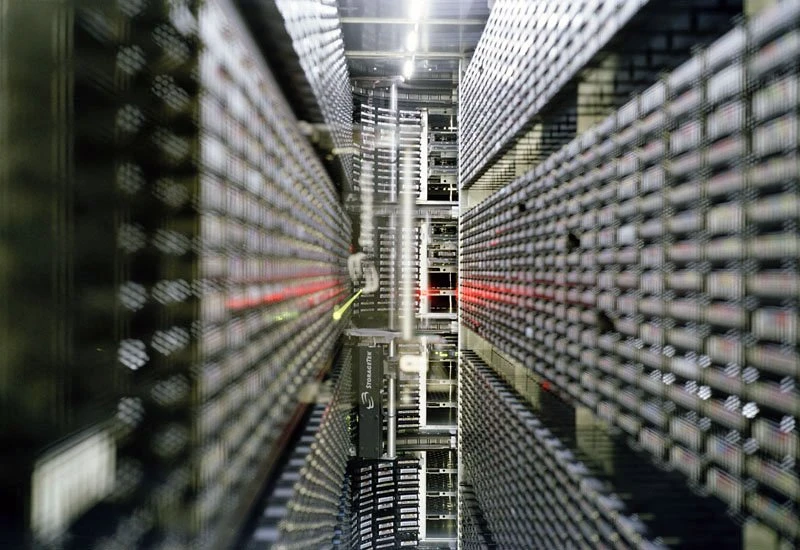
A data center. Image from under Creative Commons License CC BY-NC-ND 3.0. Copyright remains with Wim Klerkx
This post is part of Global Voices’ April 2026 Spotlight series, “Human perspectives on AI.” This series will offer insight into how AI is being used in global majority countries, how its use and implementation are affecting individual communities, what this AI experiment might mean for future generations, and more. You can support this coverage by donating here.
In Latin America, the data center boom has sparked widespread public debate and resistance, with some communities taking tech giants to court, successfully halting exploitative projects, and others forcing companies to redesign and evaluate their plans. Governments in the region, however slowly, are beginning to discuss implementing rules and regulations. In Asia — another international hotbed for data center development — this conversation is just beginning.
From tropical data centers of Malaysia, to the coal-powered plants in Kazakhstan, and drought-affected regions of India, governments are racing to attract data center investment, with few mechanisms in place to assess the impact or limit environmental and social harm. Many of these countries have no requirement for environmental impact assessments, and regulatory frameworks, where they exist at all, are years behind the pace of construction. Communities most affected are rarely consulted. This is largely why international tech giants are turning to this region — fewer regulations and less community pushback mean an easier implementation process and better bottom line.
While companies and governments continue ahead with few guardrails, experts warn that the cost could be high. In addition to the well-documented environmental and noise pollution risks, some observers have expressed concern that the current AI boom will not last, arguing that the rapid expansion of data centers will lead to an overcapacity issue, leaving these facilities to stand as empty memorials to the hype. Rapid changes in hardware and software development also mean that some of these centers will be obsolete soon after completion, raising the risk that countries in the Global South could be stuck with outdated, expensive infrastructure with no path of recourse.
As Steven Gonzalez Monserrate, ethnographic researcher of cloud infrastructures and author of the book “Cloud Ecologies,” explained in an interview with Global Voices:
What you’re seeing with artificial intelligence (AI) is really scary because they’re building data centers for AI, but AI itself isn’t profitable yet. And when you approve to build the data center, it takes a couple of years to actually build it. So they’re just hoping that by then, AI becomes profitable. But there are no signs of that happening. And so what might happen is that the data center is half built and then they abandon it, and they write it off, and it just becomes ruins. That’s very possible.
In this cross-border article, Global Voices is sharing stories from several Asian countries, exploring how the data center boom is affecting citizens, how governments are grappling with the increased development, and what communities are doing about it. See how communities in Latin America are navigating the same issue here.
South Asia
India is in the midst of rapid data center construction and expansion. Megacities like Mumbai, Chennai, Bengaluru, and Delhi are all seeing rapid structural development as global tech giants race to plant their infrastructure in one of the world’s fastest-growing digital markets. But behind the investment headlines, a more complicated picture is emerging, one where the costs of this boom are falling disproportionately on the communities least equipped to bear them.

K T Rama Rao, Minister of IT, Municipal Administration and Urban Development, Industries and Commerce, Public Enterprises, Sugar, Mines and Geology, and Non-Resident Indian Affairs of Telangana, India, speaking during the session Global Tech, Local Solutions: Artificial Intelligence at the Annual Meeting 2018 of the World Economic Forum in Davos. Image via Flickr. License CC BY-NC-SA 2.0.
Within India, most of the tension centers around one issue: Water.
A single 1 MW data center can consume around 26 million liters annually. When scaled up to a 30 MW facility, which is becoming the norm, over 2 million liters could be drawn from the ground every single day. Every one of India’s major data center hubs sits in an area already under severe water stress. In the Gautam Buddha Nagar district of Uttar Pradesh, where data centers have been clustered to form a digital corridor, groundwater extraction has exceeded 104 percent of sustainable levels. Residents in nearby Khora Colony are now paying INR 1,500 (USD 16.89) for just 500 liters of water delivered by tanker, after local borewells ran dry.

Indian residents cluster around a water tank after a drought dried up local boreholes. Screenshot from YouTube.
The land and jobs picture is no less troubling. In Tarluwada, Andhra Pradesh, farmers were offered INR 2 million (USD 24,000) per acre for land that has a market value of INR 11.5 million (USD 122,200). This huge gap has instigated allegations of coercion and active legal challenges. And when the construction dust settles, the employment payoff is modest at best: Microsoft’s facility in Mekaguda is projected to create around only 180 permanent jobs. That highlights the nature of the industry, which is highly automated and capital-intensive, raising the question of whether it is truly beneficial to local communities.
All of this is unfolding inside a regulatory vacuum. India’s national data center policy, drafted in 2020, has never been finalized. There is no mandatory environmental impact assessment for approving new facilities, and data centers currently sit outside certain pollution control board requirements for their backup power systems. The investment is moving faster than the rules meant to govern it.
Southeast Asia
Southeast Asia has long been an international destination for data hubs, but its makeup is rapidly changing. While Singapore used to lead the way in data centers in the region, in 2019, officials implemented a moratorium on data center development in a bid to protect the city’s limited land resources, water, and economic sovereignty. After a one-year pause, officials lifted the moratorium but introduced incredibly strict regulations to prioritize “green” data centers. Since the AI boom, those regulations have tightened even further.
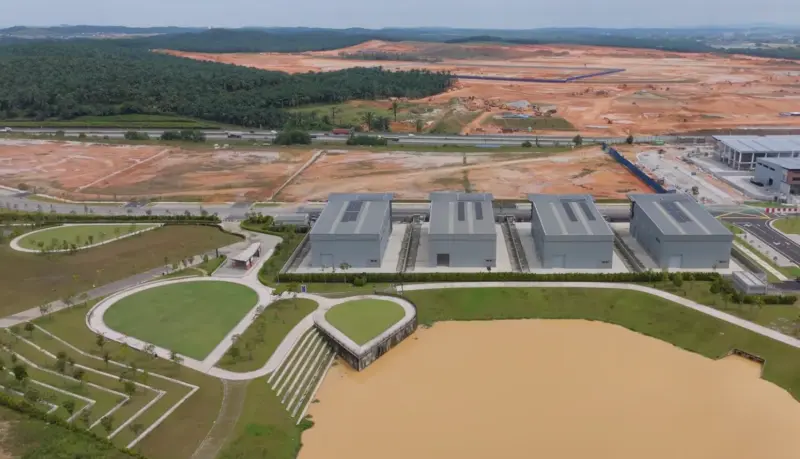
Google Data Center Malaysia at the Elmina Business Park. Screenshot from YouTube.
With Singapore spurning further data center development, much of those investments have been diverted to Malaysia, Thailand, and Indonesia.
This move comes with its own complications, largely due to the intense heat and high humidity levels in the tropics. As Steven Gonzalez explained in an interview with Global Voices:
“The interesting part about this is it’s actually a problem too, because data centers are not really designed to work well in the tropics. It’s very, very, very expensive because the electricity use is way higher due to the humidity in the air. And so they have actually invented new kinds of data center construction and technology to actually run a tropical data center there. So, that’s why Malaysia is right now kind of booming for data center construction because Singapore is capped out pretty much.”
Not everyone is pleased about the “innovation” coming to the region. In February 2026, community members in Johor, Malaysia, held the country’s first public protest against rapid data center expansion. Attendees cited pollution concerns and fears around water scarcity as the reason behind the demonstrations.
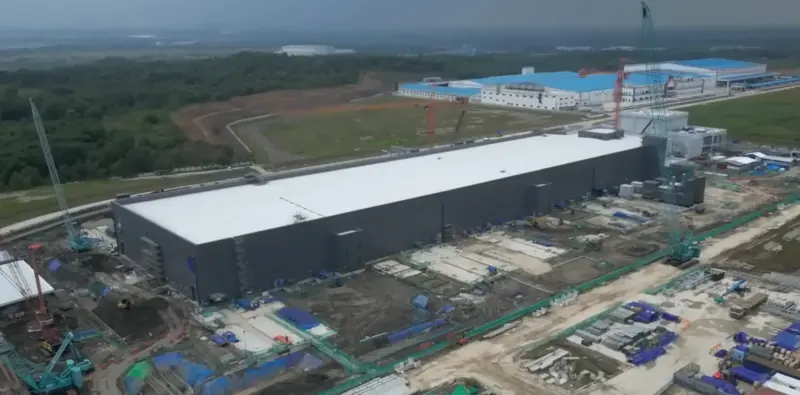
The Karawang International Industrial City in West Java, Indonesia. Screenshot from YouTube.
Indonesia is facing a similar crisis, with some arguing they have had no say in government agreements to construct data centers on community land. The centers are also raising concerns about water scarcity on the archipelago, where some islands face persistent droughts.
Another question remains about whether Southeast Asia’s infrastructure can support such massive growth. A report by Wood Mackenzie, an international energy company, estimates that the energy required to power data centers is set to quadruple within Southeast Asia from 2.6 GW to 10.7 GW between 2025 and 2035. This could put a huge strain on grids and even raise prices for local communities.
Central Asia
Central Asian states are also ramping up the construction of new data centers to capitalize on the growing demand for computing power for digital services and AI. The regional leaders, Kazakhstan and Uzbekistan, are working to attract foreign and local investment and establish themselves as digital hubs, highlighting the importance of data centers for boosting economic development. Environmental and energy concerns are seldom mentioned, given that large-scale data centers are still under construction and new to the region, and the discourse on their harm to the environment and resource depletion is absent from the mainstream public discourse.

A Google data center. Screenshot from Google Sustainability YouTube.
One example of this is the so-called Data Center Valley, a flagship data center cluster project by the Kazakh government, to be built in the city of Ekibastuz in the east. Promised to become a full-fledged international computing hub, the project is expected to rely on highly polluting coal for electricity generation and require 300 MW at maximum capacity. This certainly does not bode well for Ekibastuz residents who already struggle with air pollution due to nearby coal-powered industrial plants. The city is on the list of places with “elevated levels of [air] pollution.”
Another mega project is the Akashi Data Center near the capital Astana, the region’s first and only Tier IV data center, expected to become the region’s largest upon completion at the end of 2026, with 4,200 racks. The operators plan to build a dedicated gas-powered power plant with up to 1 GW capacity, an odd decision given that the rest of the country faces a mounting energy deficit and air pollution due to the heavy use of coal for energy production.
In neighboring Uzbekistan, the government has teamed up with the Chinese Shanghai LinkWise Data to build a hyperscale data center for AI and high computing technologies in the northwestern Karakalpakstan region. Upon its completion, the facility will reach 300 MW capacity and become one of the largest data centers in the region. It will be powered by the Takhiatash Thermal Power Plant, which uses natural gas for electricity production, although there are plans to use hydrogen, solar, and wind energy resources in the future.

A satellite view of the Aral Sea between 1989 and 2014, highlighting the extreme shrinkage. Image from Wikimedia Commons. Public Domain.
The lack of discussions of the environmental impact of this project, which requires major water and energy commitments, is baffling, given Uzbekistan’s significant energy and water shortage problems. The water shortage problem is particularly salient in Karakalpakstan, which is home to the dried-up Aral Sea and acute water shortage challenges.
Considered one of the most vulnerable regions to climate change, and with rapidly growing populations and economies, the current-day issues related to water and energy shortages in Central Asia warn against the hasty construction of large-scale data centers without proper evaluation of their long-term impact.
In each of the above contexts — Southeast Asia, South Asia, and Central Asia — governments are proceeding at a breakneck pace to welcome tech investment, regardless of how it may affect nearby communities. In Latin America, some communities fought back, and in some cases, won.
Asia’s reckoning with the data center boom is only beginning. Whether governments here will heed those lessons, or repeat the same mistakes under the banner of development and innovation, remains to be seen. What is certain is that the cost of getting it wrong will not be borne by the tech giants building these facilities, but by the people living in their shadow.