



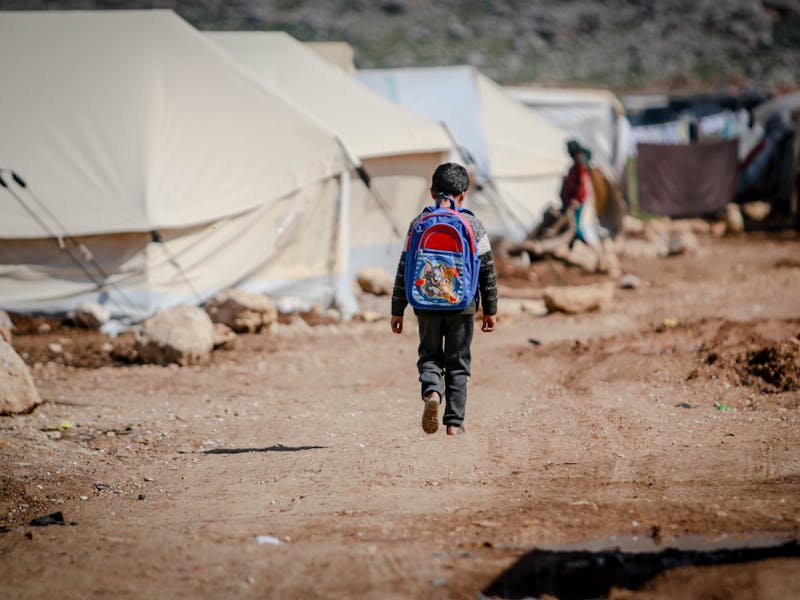
A boy at a camp in Idlib, Syria. Photo by Ahmed Akacha on Pexels. Free to use.
By Noorudeen Veetykadan
It was the end of 2023 when images from Gaza began to fill our television screens. I found myself returning to them again and again: the ruins, the sirens, the unbearable stillness of small bodies wrapped in white.
The scale of destruction was immense. But what lingered were the faces of children — some gone, others injured, many too young to understand why their world had collapsed overnight. News reports spoke in numbers — casualties, statistics — but behind those numbers were stories that refused to leave the room even after the television was switched off.
This is no longer a reality confined to conflict zones. In an age of constant connectivity, children across the world are being exposed to war in real time, through screens, conversations and the ambient anxiety of the adults around them. This article argues that such exposure is quietly reshaping childhood, even for those far removed from the battlefield.
I would often sit with my wife, discussing what we had just seen, trying to process a grief that did not belong to us, yet somehow did.
And in all of this, I missed something important.
I have two daughters. My elder one is nearly 15, old enough to understand the language of conflict. My younger one, just six, still lives in a world where questions are simple, and answers are expected to reassure. They were in the room more often than I realized — watching, listening, absorbing.
At first, their reactions were subtle. A question here, a glance there. “Why are they crying?” my younger one once asked, pointing at the screen. I offered an answer that felt safe, something incomplete, something designed to protect. But children do not just hear words; they read faces, tones and silences. What I thought I had softened, they had already understood in their own way.
Then, more recently, the distance between “there” and “here” began to collapse.
As tensions involving the United States, Israel and Iran intensified, the tone of the news shifted. It was no longer just about another place. Reports mentioned the Gulf. Alerts flashed across screens. Words like “missiles” and “drones” entered everyday conversation, not as distant vocabulary, but as possibilities.
Schools closed. The rhythm of daily life paused.
And then came the moment that altered everything: the realization that Qatar, where we live, along with other Gulf countries, could itself be at risk. The headlines I had once consumed with a degree of separation were now unfolding uncomfortably close to home.
I saw the fear before it was spoken.
My elder daughter tried to remain composed, but her questions returned, faster this time, sharper. “Will it happen here?” “Are we safe?” There was no easy way to answer without confronting a truth I myself did not fully know.
My younger one did not ask. She held on.
A sudden sound made her flinch. A notification drew her attention instantly. The sky, once just an open expanse, had become something to watch carefully as if it could change without warning.
It was then I understood what I had failed to see all along.
War does not need to reach your doorstep to enter your home. It arrives quietly, through a screen, through a headline, through conversations not meant for young ears. And by the time it feels real, it has already settled into the minds of children, shaping fears they do not yet have the words to explain.
Research in child psychology has long shown that repeated exposure to violence, whether direct or mediated, can influence how children perceive safety and stability. In today’s 24-hour media environment, where graphic images and breaking alerts are constant, the boundary between distant conflict and personal reality is increasingly blurred. What was once filtered now arrives unmediated, often without the emotional tools needed to process it.
We often measure war in terms of territory, power and political outcomes. But there is another cost, less visible and far more enduring. It is carried in the questions children begin to ask, in the silences they grow into and in the way they start to see the world, not as a place of possibility, but as something uncertain.
Childhood is meant to be a time of discovery — when the sky is just the sky, not something to fear. When loud sounds are moments of excitement, not signals of danger. When the world feels large, but safe.
For many children today, that sense of safety is being quietly eroded.
Some lose it in the direct shadow of conflict. Others lose parts of it from a distance, through repeated exposure, through unanswered questions, through a growing awareness that the world is not as secure as it once seemed.
This raises difficult questions for parents, educators and media institutions alike. How much exposure is necessary for awareness, and when does it become overwhelming? Are we equipping children to understand what they see, or simply expecting them to absorb it? In trying to stay informed, we may be underestimating how deeply these moments settle in young minds.
We cannot shield children from reality forever. Nor should we pretend that the world is untouched by conflict. But somewhere between awareness and exposure, there is a line we are failing to draw, a line between informing and overwhelming, between preparing and frightening.
Because when a child begins to fear the sky, something fundamental has already been lost.
The sky was never meant to be a source of anxiety. It was meant for clouds that change shape, for birds that cross without borders, for stars that arrive quietly at night.
Not for missiles. Not for drones.
And yet, for many children today, the sky is no longer a place of wonder, but a question mark, something they look at not with curiosity, but with caution.
And perhaps that is the most lasting damage of all — not what war destroys in the moment, but what it quietly rewrites for the future.
Because long after the noise fades, these children will remember one thing:
They learned to be afraid of the sky before they ever learned to fully understand the world beneath it.