



Beavers (Castor canadensis) are widely recognized as ecosystem engineers, building dams that reshape water flow and alter the physical structure of rivers and streams.
There is a scientific consensus on the positive impact of beaver dams, for example, in creating landscape-scale wetlands, increasing biodiversity and generating heterogeneity that benefits many species. However, during extreme rainfall, beaver dams are quickly blamed for exacerbating downstream flooding whenever they break.
Together with my colleagues, I explored the topic of beavers at the international Wood in World Rivers 5 Gaspé Conference held in June 2024. That led to the publication of an article in the journal Earth Surface Processes and Landforms.
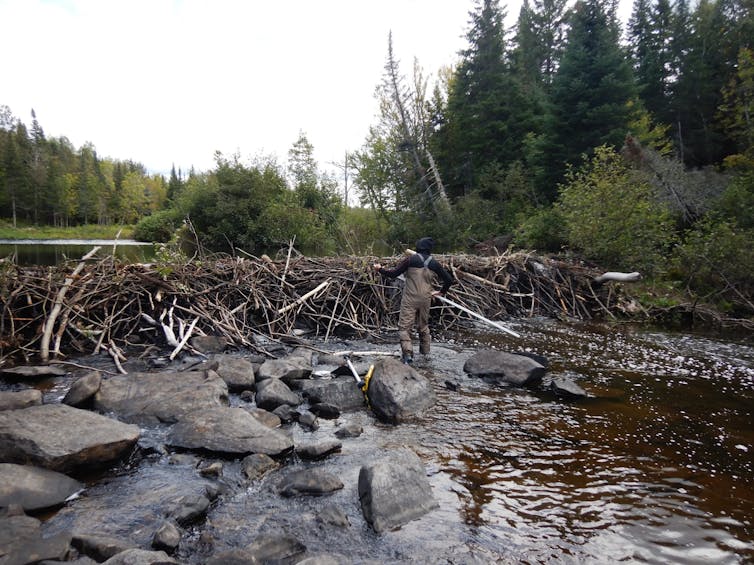
(Laboratory of Expertise and Research in Applied Geography, Université du Québec à Chicoutimi)
Real-world consequences
Beaver dams were heavily implicated in major flooding events in the Charlevoix-Est Regional County Municipality in Québec’s Charlevoix region in 2005 (Hurricane Katrina) and 2011 (Hurricane Irene). These events led to Québec Superior Court rulings in 2008 and 2017 that blamed beaver dam failures for downstream property damage.
Both parties had called experts with opposing views: the plaintiffs claimed that destroying the dam would have prevented the flooding, while the defence argued that the river would have burst its banks anyway.
The judge ruled in favour of the plaintiffs, finding that the municipality was aware of the potential danger posed by the dams and had a legal obligation to intervene to prevent the risk of flooding, in accordance with Section 105] of the act pertaining to municipal powers.
This section stipulates:
“If informed of the presence in a watercourse of an obstacle that threatens the safety of persons or property, a regional county municipality must carry out the work required to restore normal water flow.”
Dead wood and beaver dams constitute an “obstacle” under these provisions.
Read more:
Le castor, cet ingénieur méconnu de la forêt boréale
In short, because beaver dams constitute a threat, they should be destroyed as a preventive measure. But what scientific evidence supports these claims?
Modelling tools exist that allow us to fully understand the downstream impacts of breaches in human-made dams, such as those belonging to Hydro-Québec, for example. It is precisely these hydraulic modelling tools that the engineer hired by the Québec municipality, Jean Gauthier, used in the report he submitted to the court in 2008. Gauthier was also present at the second trial in 2017.
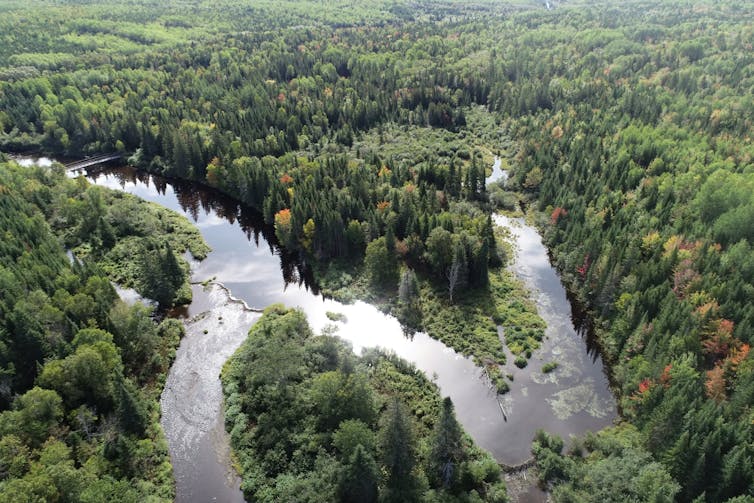
(Laboratory of Expertise and Research in Applied Geography, Université du Québec à Chicoutimi)
A new simulation
Since the judge had questioned Gauthier’s estimate of the volume of water upstream of the dam, we decided to contact the engineer to ask him to carry out further numerical simulations using the most recent tools and data available.
To assess the impact of the beaver dam on the water level at a bridge in the municipality — Chemin Port-au-Persil — we used a model that simulated the flood resulting from the August 2011 rainfall.
We carried out simulations with and without a dam breach. To assess the worst-case scenario, we assumed that the dam would breach at the peak of the flood. We also assumed that the breach — the opening created in the dam — would form in just 10 minutes. That’s a very short time frame, comparable to that of a concrete dam, in order to measure the maximum possible impact downstream.
Since the judge had questioned the estimate of the volume of water behind the dam, this was deliberately increased to test an extreme scenario. It was quadrupled (10,000 cubic metres) compared to the volume initially estimated on site (2,500 cubic metres). Finally, a dam height one metre higher than that measured in the field (3.15 metres instead of 2.15 metres) was also
tested.
Read more:
Beavers can turn streams into carbon stores – we measured how much
Dams not to blame
The results of our modelling indicated that, even with a fourfold increase in water volume, the impact on the water level at the bridge was very low. That confirmed that the damage caused to the lodge could not be attributed to the beaver dam breaking.
The simulations also highlight that it is the height of the dam, rather than its retention volume, that controls the propagation of flood waves downstream.
In reality, other natural phenomena linked to the torrential floods that occurred are likely responsible for the damage in 2005 and 2011. These include landslides and the transport of sediment and timber resulting from the erosion of the riverbed and banks observed along the Port-au-Persil River in 2011.
Furthermore, the narrowness of the Port-au-Persil bridge may have contributed to the damage caused by the floods. The bridge was rebuilt in 2023.
Read more:
Aging bridges are crumbling. Here’s how new technologies can help detect danger earlier
The importance of rigorous assessments
Our findings challenge the negative perceptions of beaver dams and highlight the importance of rigorous scientific assessments in civil liability cases relating to flooding.
The legal implications of Section 105 of Québec’s Municipal Powers Act, as well as the case law relating to the flooding events in Quebec in 2005 and 2011 — which holds regional county municipalities are liable for damage caused by flooding due to “obstacles” in rivers — expose beaver dams to widespread and unnecessary demolition.
Instead, evidence-based management practices and public awareness campaigns should be promoted to recognize the ecological benefits of beavers while addressing concerns regarding the flood risks they pose.