



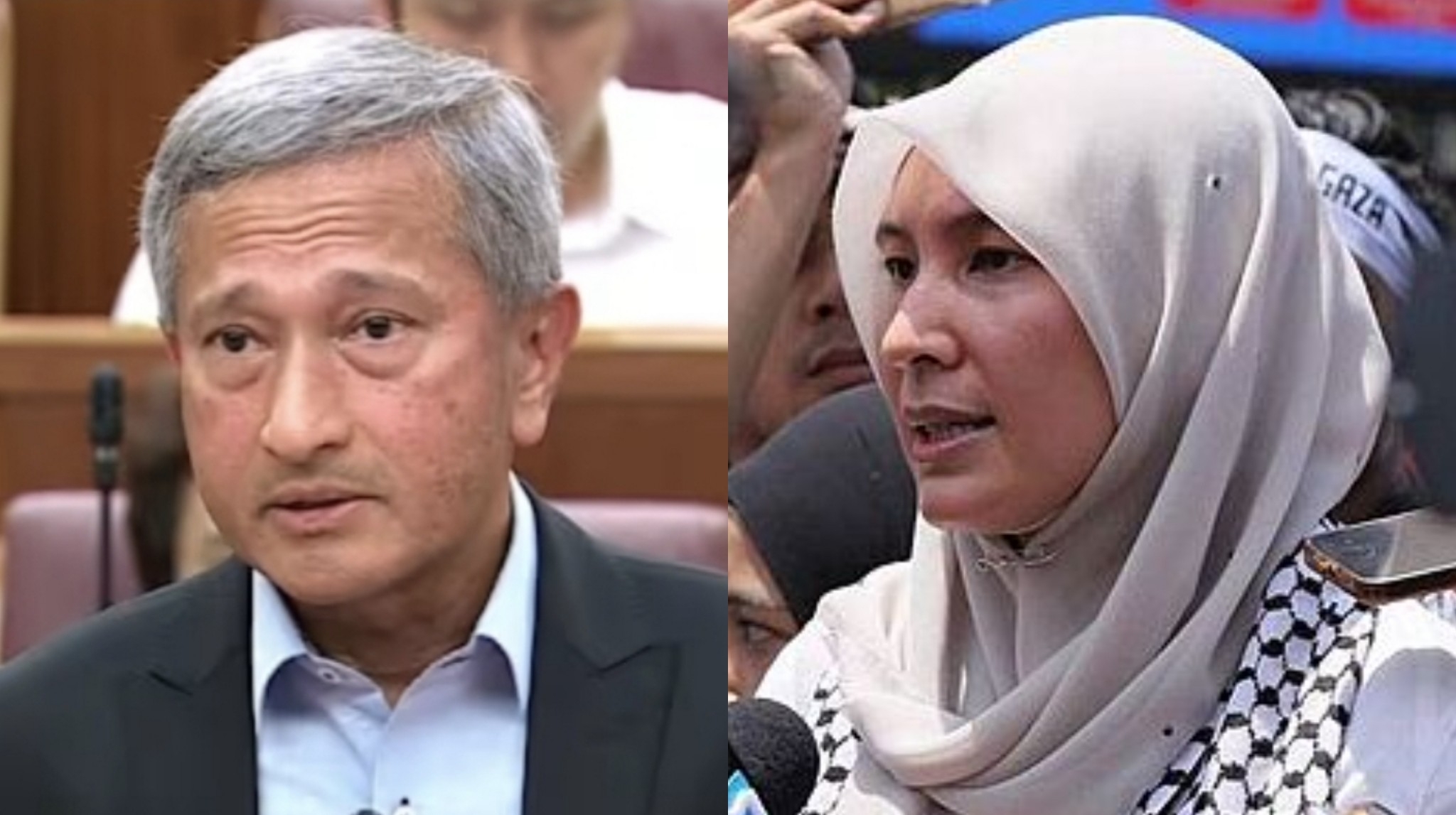
SINGAPORE: Malaysia has issued a statement raising concerns about recent parliamentary remarks by Singapore Foreign Minister Vivian Balakrishnan, with Parti Keadilan Rakyat (PKR) Deputy President Nurul Izzah Anwar criticising what she described as a “narrow strategic posture” in Singapore’s approach to tensions involving Iran.
In a strongly worded statement released on Wednesday (8 Apr), Ms Nurul Izzah said Dr Balakrishnan’s comments on Singapore’s refusal to engage Iran over safe passage through the Strait of Hormuz were “both revealing and regrettable,” arguing that they reflected alignment with external powers rather than a commitment to regional responsibility or international law.
“Iran is the target of war crimes by the United States and Israel, with huge losses of civilian lives and infrastructure,” she said, adding that Tehran’s control of the strait was “an attempt to seek a durable peace.”
Ms Nurul Izzah, who is the daughter of Malaysian Prime Minister Anwar Ibrahim, emphasised that Malaysia has consistently upheld diplomacy as a central pillar of its foreign policy. She added that her father’s approach on the issue was aimed at safeguarding regional stability, energy security, and the broader interests of Southeast Asia.
“To suggest otherwise, even implicitly, is to dismiss the very tools that have long preserved peace in our region,” she asserted.
Ms Nurul Izzah also took issue with what she described as “undertones” in Dr Balakrishnan’s position, arguing that it appeared less about neutrality and more about “echoing the strategic preferences of external powers, whose interests do not always align with those of our region.”
Such an approach, she warned, risked undermining ASEAN’s longstanding commitment to independent and balanced diplomacy.
“Malaysia will not be lectured on the merits of engagement,” she said, “We choose dialogue because history has shown that disengagement invites escalation, not stability. We choose to act because leadership demands more than cautious distance.”
While acknowledging that Dr Balakrishnan was entitled to his views, Ms Nurul Izzah urged him to recognise that “quiet acquiescence to great power narratives and genocidal entities is not the same as principled neutrality.”
“In moments of global tension, the region deserves voices that build bridges, not reinforce divides,” she added.
Malaysia, she said, would continue to pursue diplomacy “with clarity, conviction, and independence.”
Dr Balakrishnan had said on Tuesday (7 Apr) that Singapore would not enter into discussions with Iran over transit through the Strait of Hormuz as a matter of principle as doing so would run counter to established international maritime law under the United Nations Convention on the Law of the Sea.
He told Parliament, “There is a right of transit passage, it’s not a privilege to be granted by the bordering state. It’s not a licence to be subjugated at all. It is not a toll to be paid. It is a right of all nations’ ships to traverse.”
The minister noted that Singapore views this right as part of customary international law.
Dr Balakrishnan also revealed on Tuesday that he has not spoken to his Iranian counterpart Abbas Araghchi since the war broke out but said: “I’m sure I will engage him in the near future.”
He added, “But as a matter of principle, and not because we’re taking sides, I cannot engage in negotiations for safe passage of ships or negotiate on toll rates.”
