



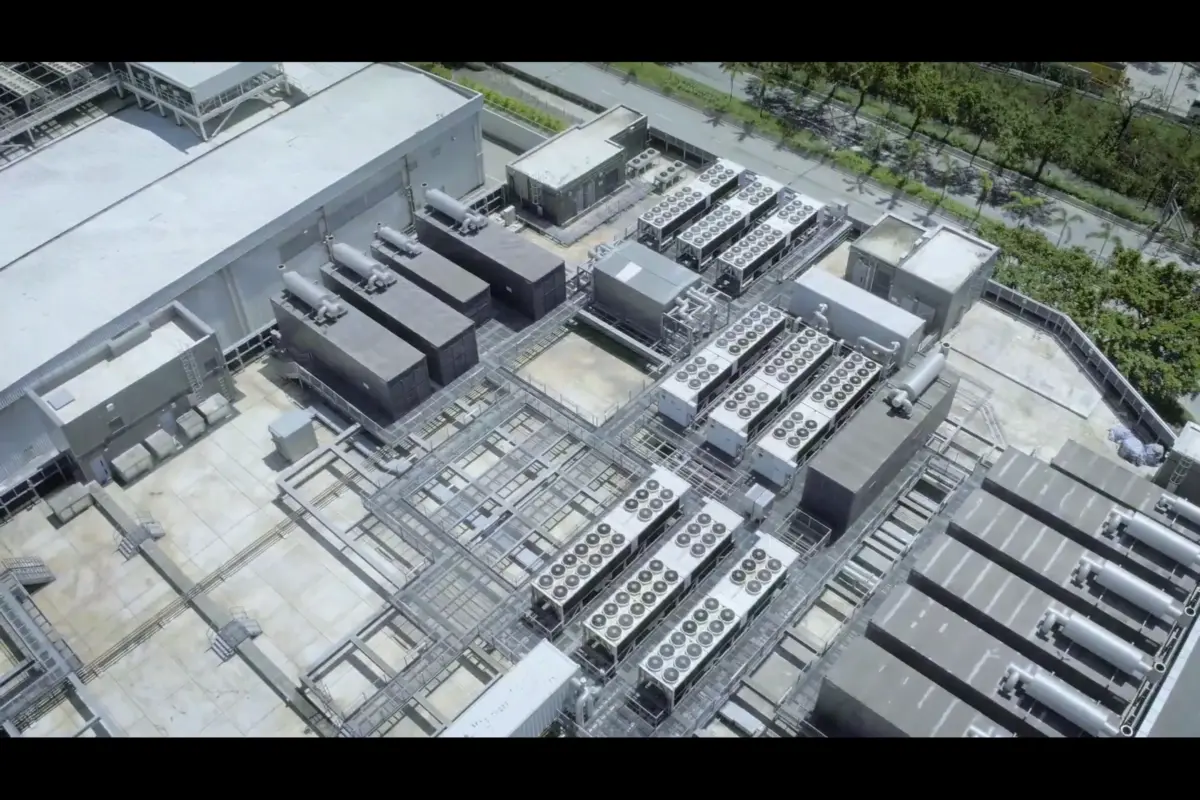
HK’s data centre at Tseung Kwan O. Screenshot from Digital Reality’s YouTube Channel.
This article was written by Tom Grundy and first published in Hong Kong Free Press on June 8, 2026. An edited version is republished on Global Voices under a content partnership agreement.
A new UN study has named Hong Kong’s data centres as some of the most carbon-intensive in the world, blaming the city’s heavy dependence on a fossil-fuel-powered energy grid.
The report, titled “Environmental Cost of AI’s Energy Use,” examined the global carbon, land and water impacts of the infrastructure powering AI, saying that by 2030, data centres could consume 945 terawatt-hours of energy.
That is “nearly triple the combined annual electricity use of Pakistan, Bangladesh, and Nigeria, countries collectively home to more than 650 million people,” according to a UN press release.
“Indonesia, India, and Hong Kong (SAR) are among the most carbon-intensive grids with carbon footprints 62 percent, 51 percent, and 43 percent higher than the global average, respectively. Poland and Mainland China rank lower with carbon intensities at 30 percent and 21 percent higher than the global average,” the UN University’s Institute for Water, Environment and Health said in a report on Wednesday.
In comparison, the carbon electricity footprint of countries with similar standards of living, such as the US, Germany, and Italy is 18 percent, 24 percent, and 32 percent below the global average, respectively.
Energy in Hong Kong is 67 percent derived from fossil fuels, 32 percent from nuclear and just 1 percent from renewables, according to the report.
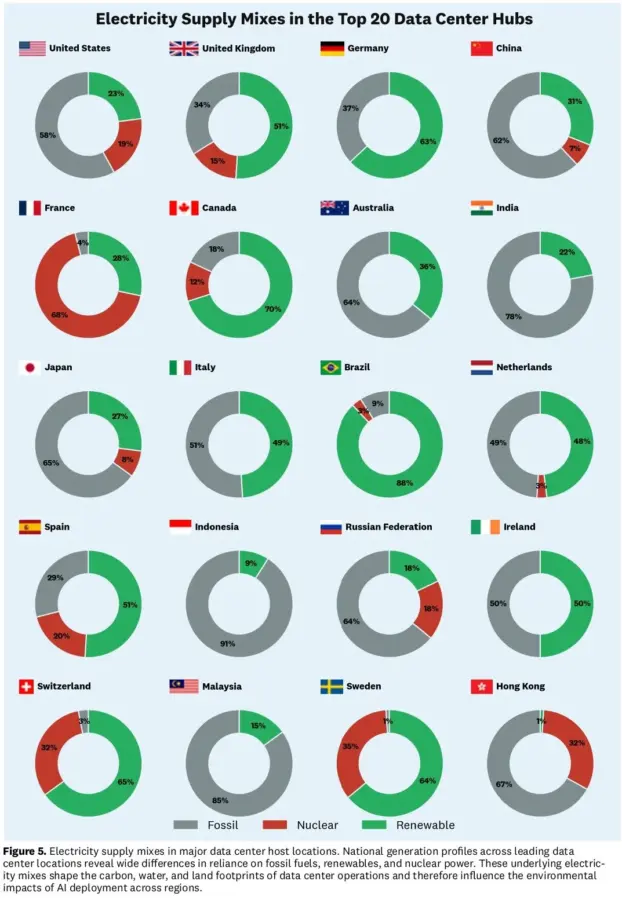
Energy sources for countries and territories worldwide. Photo: UN via HKFP. Used with permission.
There is also a water footprint for cooling heat-intensive data centres, as well as a land footprint. “AI-related water consumption could equal the basic annual domestic needs of 1.3 billion people by the end of the decade, while its land footprint may exceed 14,500 square kilometres — roughly twice the size of the Jakarta metropolitan area,” the UN said.
However, Hong Kong was ranked among the lightest for water and land consumption, mostly because its energy mix does not rely on renewable energy sources, which require large amounts of land.
As a trade and logistics hub with around 300 internet service providers, Hong Kong remains a prime location for data centres. Its telecommunication networks connect to 12 external submarine optical fibre cable systems, with more under construction, according to the city’s Digital Policy Office.
The government is building a new 110,00 square metre data facility in Sandy Ridge, 90 per cent of which will be dedicated to data centres, according to a government press release in March.
Daily AI use, not training
The UN report said that day-to-day use of AI models accounted for around 80 to 90 percent of total energy demand, as opposed to just model training. It cited the case of ChatGPT, which was processing around 2.5 billion prompts per day, with image generation requiring a thousand times more energy than a simple text query.
“China’s DeepSeek, launched in January 2025, attracted more than 20 million daily active users within three weeks, and had about 125 million monthly active users by mid-2025,” the report said.