



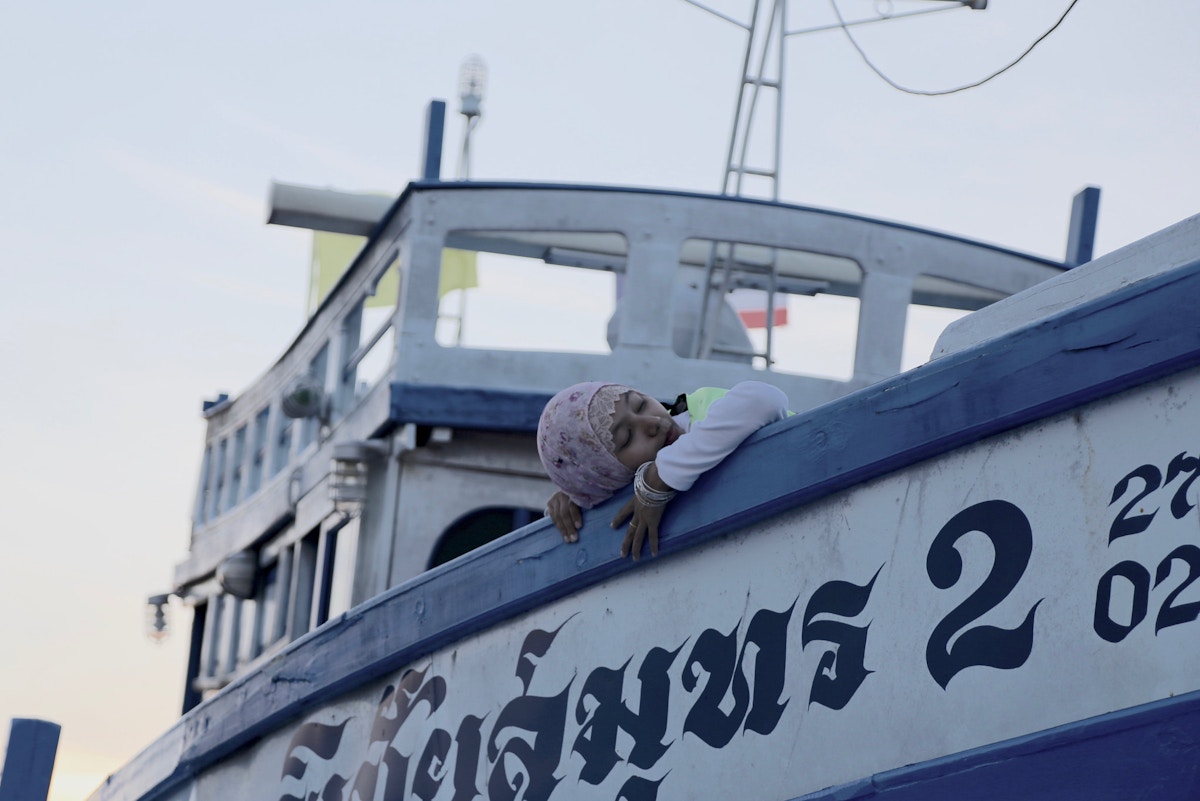
People sheltered and waited. The inability of rescue services to reach people in these heavily inundated, lower-lying areas has been widely reported. Many of the rescuers came from outside Hat Yai, but even for locals, navigation must have been difficult, with many reference points underwater.
The strong currents made it additionally difficult to navigate. Fortunately, for many in the shared spaces of neighbours’ and friends’ higher floors, there was also access to gas stoves for cooking, though meals consisted almost entirely of instant noodles.
Collecting rainwater gave them access to drinking water. But there were no working toilets, so they had to defecate in plastic bags that they then threw into the water, or did so directly in the water. Inevitably, the water, thick and muddy, also stank.
The scale of loss is difficult to comprehend. Many people lost absolutely everything: all of their possessions, clothes, household electrical goods, fridges, TVs. Cars and motorbikes that most people buy paid on credit and are essential for their livelihoods were submerged.
Those who were lucky enough or could afford first-class comprehensive insurance will get compensation, but the process is slow. And for those who had not completed payments, the compensation will not be enough. The single father spent 30,000 baht (US$950) repairing his car — a whole month’s salary. His children lost all their possessions: toys, schoolbooks and clothes.
The government has provided compensation of 9,000 baht (US$285) for each household. But only registered residents are eligible. With all documentation also lost in the flood, for many accessing compensation meant going to the village headman to get a letter of support.
Alongside this intense loss, the city is gradually trying to recover, reinvesting and borrowing money to repair houses and shops. What cannot be salvaged is piled up on the street to be taken to the dumps and then to the landfill sites.
With all the rubbish mixed together, the longer-term environmental and public health consequences of such waste disposal can only be guessed at. Cleaning his wooden benches, Khun Wichit remained remarkably cheerful, and in line with a common sentiment, considered himself one of the lucky ones, very much aware that others were far worse off.
The recovery is hard, both financially and emotionally. Khun Nimit has lived in Hat Yai for 30 years and runs a seamstress and laundry business. She lost everything in the flood: all her personal belongings as well as her stock, shop fridges and six washing machines.
She has managed to replace the washing machines and fridges — a huge investment and also a risk, very much aware that another flood in the near future is a strong possibility.
Further down the road, another shopkeeper who had only recently returned from Bangkok to live in Hat Yai told me that she had also lost everything. And while she had managed to restock the basic drinks and snacks for her shop, the stress was clear on her face and in her voice. “I can’t go through this again,” she said.
Khun Adi is the third-generation owner of a Chinese pharmacy that has been in Hat Yai for more than 80 years. The flood had destroyed all his stock, leaving him to clean up gradually, painstakingly removing all the storage drawers that are characteristic of traditional Chinese pharmacies, washing them twice, drying them with an electric fan and then disinfecting them.
With still a long way to go, he said he’s also conflicted about whether it’s worth continuing. At 60 years old, he said he’s not sure but also feels that he doesn’t want to end a family legacy in this way.
Some stock is more easily salvaged than others. Shops selling spare parts for cars, anything that could be cleaned and used was being sorted, piled into large plastic crates and hosed down in the street, and then put out to dry on plastic sheets by the side of the road.
For Khun Banyat, this was a lengthy process that he was taking slowly. Surrounded by shelves to the ceiling, just below the floodwater mark, that he hadn’t even touched yet, it would all take time. Whether it was all worth it was not clear, but this is a situation that provides few options.
A shop selling electrical goods had most of the stock destroyed, with the fixtures and fittings also rotting. It had been hit both by floodwaters up to the ceiling of the first floor, and then a short circuit sparked a fire that finished off the upper floors. Even so, Khun Orwae, standing on rotten wood and cardboard boxes, was very carefully and slowly sorting through any remaining stock looking for anything that could be saved.
As individuals across the city wonder whether recovery is possible or viable, these are questions that the city of Hat Yai must also confront. Decades of poorly planned urban expansion have filled the floodplain and blocked natural flow, ignoring both expert advice and the blindingly obvious.
The wider Hat Yai urban region covers around 1,200 square kilometres (460 square miles), incorporating five municipalities with ambitions of becoming the second-largest metropolitan region in the country after Bangkok. There are difficult questions as to the extent that recovery is possible, and how viable the city might be if the future holds more frequent and intensive flooding events.
This story was published with permission from Mongabay.com.