



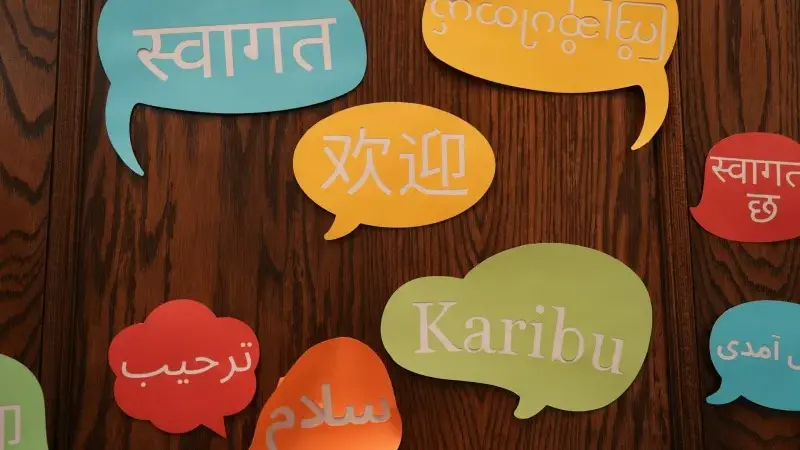
This post is part of Global Voices’ April 2026 Spotlight series, “Human perspectives on AI.” This series will offer insight into how AI is being used in global majority countries, how its use and implementation are affecting individual communities, what this AI experiment might mean for future generations, and more. You can support this coverage by donating here.
Companies behind products powered by artificial intelligence (AI) have packaged and sold them as a way for consumers to get ahead. The reality is that countless would-be customers outside the global north are being left behind.
A 2025 paper published by the Stanford Institute for Human-Centered Artificial Intelligence (HAI) noted that many popular large language models (LLMs) often fail to perform in languages other than English. Researchers drew attention to how LLMs available to the public, including those developed in part by the likes of Google and Meta, generate responses that are ill-suited to users in the global majority. As a result, these individuals must make do with AI tools that are biased and unreliable, lending credence to the notion that prominent firms view their needs as an afterthought.
Speakers of low-resource languages, referring to those that do not have sufficient data to properly train AI-based solutions, have been unable to reap the rewards of this innovation. The predominance of English language content online has significantly shaped the development of tools currently on the market, which in turn has created a barrier to access for non-speakers interested in AI across the globe.
Applications enhanced by AI also produce outputs reflecting the norms and values of a select few in the international community; attempts to address this issue by generating low-resource language data have, at times, done more harm than good. If the status quo stays unchanged, communities of non-English speakers will continue to lose ground in the race to unlock AI’s potential.
Perpetuating digital exclusion
Inadequate data in low-resource languages is not just a concern for AI engineers. Ordinary people who are part of the global majority will miss out on the technology’s myriad benefits because of this glaring gap. The New York Times highlighted that the AI industry’s concentration in wealthier countries, such as the United States, has exacerbated this problem. The existing infrastructure in hubs like Silicon Valley, coupled with the ample data companies in these areas have at their disposal, has tilted the scales in the global north’s favor. Consequently, the millions who speak languages like Kurdish and Swahili are effectively deprioritized, along with the sizable markets they represent. Lacking the resources of their counterparts, non-English speakers may remain overlooked by AI-focused firms well into the future.
The implications of this language disparity are far-reaching. While those in the English-speaking world have grown accustomed to using AI for a variety of tasks, individuals from low-resource language communities have not been afforded the same opportunity. As Wired pointed out, users in the global majority may find that turning to an LLM like ChatGPT for assistance provides answers that are unhelpful at best and worthless at worst. Requesting that the model compose an email in Tamil, for instance, may lead to a muddled, error-filled draft in English. These users may conclude that flawed AI tools are more trouble than they are worth. As AI becomes more ubiquitous across sectors and disciplines, non-English speakers may be thrust into navigating an increasingly interconnected and monolingual economy.
Marginalizing diverse cultures
AI’s bias for English also impacts low-resource language communities in ways that go beyond dollars and cents. Specifically, the worldview revealed in responses churned out by widely used AI tools mirrors that of English speakers located in the global north. The Atlantic called attention to this pattern, noting that it exemplifies how beliefs from well-resourced countries become seen as universal. Non-English perspectives are cut out because of their minimal representation in training data fed to AI solutions. Individuals from these communities may feel shortchanged by notable AI developers, especially in light of their promises that the technology will be an asset to humanity. Although tools made by these industry titans will only grow in sophistication, the attitudes reflected in their outputs will likely stay the same.
Some in the AI space have sought to correct this imbalance by creating more digital material in low-resource languages. Results from these efforts have been far from ideal. The MIT Technology Review examined how much of this content, which is scraped from the web to improve products like LLMs, is rife with errors. This is because certain sites used to upgrade an AI’s multilingual capabilities are themselves filled with machine-translated mistakes. In some cases, well-intentioned individuals looking to narrow the language gap are behind them. Yet many lack the expertise needed to assess whether their work is accurate. Their content remains on the web unaltered, becoming data that AI uses to improve its “fluency.” At this stage, low-resource language communities may determine that the damage is done.
Changing the conversation
Despite these concerns, AI firms in the global north are moving at full speed to dominate this lucrative industry. It is worth slowing down to consider the broader consequences of their actions. For instance, low-resource language communities have been seemingly neglected by product developers, placing them at a disadvantage compared to English speakers. Reports from the sector also show how a cultural hierarchy has emerged that privileges those in the English-speaking world, and how dismantling this burgeoning system must be pursued with thoughtfulness and intention. Taken together, these trends underscore how the “move fast, break things” ethos, which defined the tech sector for years, is alive and well in the age of AI. Both then and now, non-English-speaking populations will deal with the repercussions.
Steps can be taken to level the playing field. It starts with working alongside communities who have been sidelined in the sprint to unleash AI. Major developers must seek out collaborative partnerships with low-resource language communities to address this emerging inequality. Integrating inputs from these populations when building solutions like LLMs, all while reviewing outputs to ensure they are both accurate and authentic, should be at the top of the agenda for companies looking to make a difference. Furthermore, they could also join forces with grassroots AI leaders determined to create tools that are more attuned to the needs of low-resource language speakers. By taking this culturally sensitive approach, AI can be developed and refined in ways that uplift the many, not just the few.