



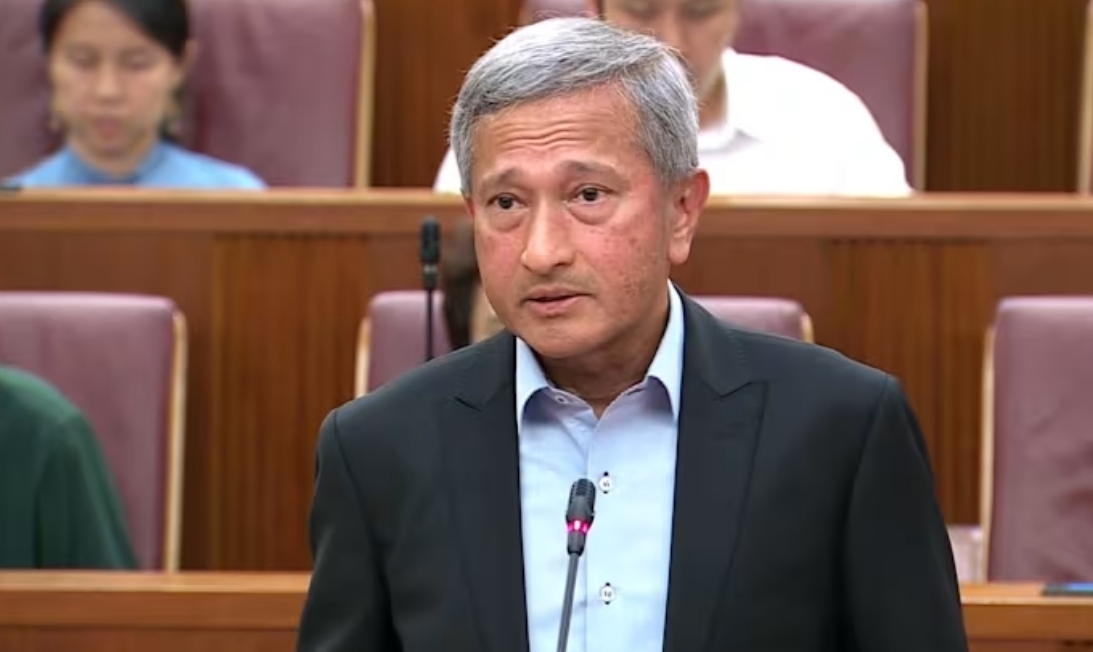
SINGAPORE: Foreign Affairs Minister Vivian Balakrishnan has come under scrutiny online following remarks in Parliament that he has not contacted his Iranian counterpart, Abbas Araghchi, since the outbreak of the ongoing conflict in the Middle East.
Speaking in Parliament on Tuesday (7 Apr), Dr Balakrishnan asserted that Singapore would not enter into discussions with Iran over transit through the Strait of Hormuz as a matter of principle, as doing so would run counter to established international maritime law under the United Nations Convention on the Law of the Sea.
He said, “There is a right of transit passage; it’s not a privilege to be granted by the bordering state. It’s not a licence to be subjugated at all. It is not a toll to be paid. It is a right of all nations’ ships to traverse.”
Noting that Singapore views this right as part of customary international law, the minister said, “…as a matter of principle, and not because we’re taking sides, I cannot engage in negotiations for safe passage of ships or negotiate on toll rates.”
While many Singaporeans online supported Dr Balakrishnan’s approach as Singapore’s role as a maritime hub depends on defending rights under international law, one part of the minister’s speech raised eyebrows.
Dr Balakrishnan told Parliament that he had only spoken to the Iranian Foreign Minister before the war. Revealing that he had not spoken to his Iranian counterpart since the war broke out but said: “I’m sure I will engage him in the near future.”
He did not reveal when this engagement would take place.
The disclosure has raised questions, given the extent of Singapore’s exposure in the Gulf. Shipping data indicates that about 29 Singapore-linked commercial vessels, including crude tankers and dry bulk carriers, are currently stranded in or around the Gulf following the disruption to traffic through Hormuz. This figure does not account for additional Singapore-flagged container ships and offshore support vessels believed to be loitering near the strait.
Against this backdrop, some Singaporeans have questioned why direct communication with Tehran had yet to take place.
Developments involving other countries have further fuelled the debate. The CMA CGM Kribi, a Malta-flagged vessel owned by a French company, recently became the first Western European-linked ship to pass through Hormuz since the conflict began, after Paris signalled its preference for a diplomatic resolution to reopening the strait. While no official details have been released on any toll payments, observers noted that France maintained open communication channels with Tehran.
Closer to home, Malaysian Prime Minister Anwar Ibrahim has said Malaysia secured assurances from Iran that its vessels would be allowed safe passage through Hormuz without paying tolls. Similarly, South Korea has engaged Iran at least thrice since the conflict began and is reportedly preparing to send a special envoy to address the situation involving its ships and crew in the area.
Online, some Singaporeans have drawn comparisons with these approaches, arguing that upholding international legal principles does not preclude active diplomatic engagement. They contend that direct communication could help safeguard Singapore’s maritime interests without compromising its legal position.
Others have raised more pointed questions about timing, asking why contact had not been made before the parliamentary statement and whether the call has taken place since.