



The Iranian Revolutionary Guard Corps (IRGC) has long exerted a strong, often underestimated power in the Middle East. With around 190,000 members, plus an estimated 450,000 reserves in the Basij paramilitary, the largest component of Iran’s Armed Forces also controls much of the country’s politics, intelligence and economy.
After an Israeli airstrike assassinated the Islamic Republic’s Supreme Leader Ayatollah Ali Khamenei on February 28, US President Donald Trump called on the IRGC to lay down its arms in exchange for immunity. IRGC forces refused the offer, and with many more of its leaders killed over the last month, it shows no sign of giving up.
As US ground forces deploy to the Middle East, it is imperative to understand that – despite a month of widespread US-Israeli bombing, damaged infrastructure, internal fractures and decimated leadership – the IRGC will likely resist any invasion of Iranian territory with tenacity. Its history demonstrates why.
Read more:
Trump underestimated Iran’s resilience. Now there is only one way out of the war
From militia to frontline force
The IRGC originally emerged in the 1979 revolution from the ad hoc street militias made up of students loyal to Ayatollah Ruhollah Khomeini’s vision of an Islamic Republic. It was opposed to the factions that sought to create a secular republic after the overthrow of the monarchy, and sought to be a national guard to protect the nascent Islamic revolutionary government.
Also known as the Pasdaran-e Enghelab, “Guardians of the Revolution”, it soon evolved into a praetorian guard for the country’s supreme leader.
In the force’s earliest days it prevented a counter-revolution by the Artesh, the standing military under the Shah. The IRGC also fought street battles with rival revolutionary forces, including secular leftists and rival Islamist militias.
With Iraq’s invasion of Iran in 1980, the IRGC emerged as a frontline conventional combat force in tandem with the national military. They repelled Saddam Hussein’s attack by 1982, though the war continued for another 6 years. Many current IRGC commanders were young soldiers or officers at the time, and experienced firsthand how Iraq deployed chemical weapons against them while the West remained silent.
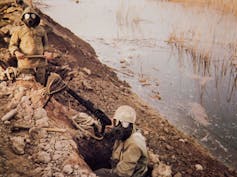
Mahmoud Badrfar
The IRGC also became a counter-insurgency force when Saddam Hussein supported Iran Kurdish rebels in 1980. It has suppressed various internal ethnic rebellions, ranging from a Kurdish revolt in the northwest that began in the 1980s to a Baloch insurgency in the southeast in the 2000s.
Trump’s recent attempts to foment Kurdish revolts will therefore likely meet with profound wrath from IRGC commanders, who have been fighting these ethnic rebel groups for decades.
Lessons from proxies
Through its regional proxies, the IRGC already has extensive experience of protracted wars of attrition against the US and Israel.
In 1982, the IRGC created a foreign expeditionary force, known as the Quds Force. Named after the Arabic for Jerusalem, the Quds supported the creation of Hezbollah in Lebanon in response to Israel’s invasion in that year to expel the Palestine Liberation Organization.
From that point onward, the IRGC was able to confront Israel via its proxy forces. Over 18 years, Hezbollah used tactics such as suicide car bombs to wear down occupying Israeli forces, who withdrew from southern Lebanon in 2000. The operation was widely seen as a military failure for Israel.
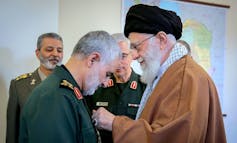
Khamenei.ir, CC BY-NC
These tactics were repeated after the 2003 US invasion of Iraq, when Quds-backed proxy Shi’a militias, such as Kataib Hezbollah, targeted the US military deployed there with improvised explosive devices. The US withdrew from Iraq in 2011, desperate to extricate itself from a “forever war”.
The Quds’ proxies in Lebanon and Iraq provided lessons that the IRGC will surely seek to replicate in the event of a US invasion.
Many of these tactics were designed to wear down an occupying force, and will not be enough to thwart an immediate, high-intensity ground invasion. But if the US fails to achieve its (currently unclear) goals, it could find itself in yet another prolonged occupation and low-intensity war. If it does, the IRGC’s well-honed attrition tactics will be deployed extensively.
Read more:
How active have Iran’s proxy groups been since the start of the war?
Iran, the US and the “Axis of Evil”
After decades of bilateral tensions, the 9/11 attacks in 2001 forced the US and Iran into a brief alliance against the Taliban in Afghanistan. Iran’s regime even reached out to the US in late 2001, offering help to fallen pilots who landed on Iranian soil while combating their mutual enemy.
But in January 2002, George W Bush placed Iran alongside Iraq and North Korea in the now-infamous “Axis of Evil”, making them a target in the US’ War on Terror. For Iran, this marked a abrupt shift in public perceptions of the US.
Read more:
Decades of hostility between Iran and the US were preceded by a little-remembered century-long friendship
The reformist president Mohammad Khatami’s efforts at rapprochement ended. Three years later, the regime supported the rise of Mahmoud Ahmadinejad, a hardliner who, along with the Supreme Leader, invested in both the expansion of the nuclear program and the IRGC. The IRGC has since evolved to assume multiple security functions in the Islamic Republic.
The only subsequent period of detente between the IRGC and the US was when the Quds Force fought against the Islamic State in 2014 in Iraq, in tandem with US air support. This cooperation occurred during the Obama administration, and a year later, the US entered a nuclear deal with Iran, from which Trump withdrew just two years later in 2017.
When IRGC bases were hit by ISIS terrorist strikes in early February 2019, it therefore viewed the attacks as the result of covert US actions. It blamed the US and Israel, in addition to a rise in Balochi and Kurdish subversion.
In the IRGC’s narrative, the Trump administration’s current war is part of a systemic American effort since the 1980s to attack the IRGC through proxies or economic warfare in order to weaken the Islamic Republic. For them, this is a conflict that has endured since the Iranian Revolution in 1979.
Read more:
Iran and the US have been at war for decades – and there’s no end in sight
Protecting power
The IRGC has been, without a doubt, weakened by the past month of US-Israeli aerial attacks. But its history demonstrates its pattern of officers who have a sense of a distinct corporate identity, and who will defend their institutional power even if their leadership is killed.
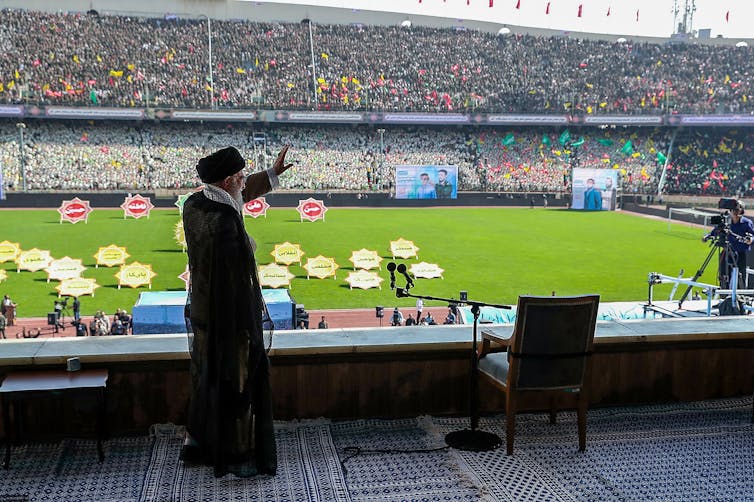
By Khamenei.ir, CC BY-NC
This explains why, after Khamenei’s death, the IRGC rallied behind his son Mojtaba to keep its power intact. While some Iranians celebrated and others mourned Khamenei’s death, the IRGC presented a united front in backing his regime. If Iran’s political system fell apart, the IRGC’s in-group status would be lost.
The IRGC has also evolved to operate as a business network. With holdings in the service sector, ranging from media to construction, it controls at least 20% percent of the economy. Given how some IRGC leaders have benefited from corrupt practices in managing these networks, they would fear being held accountable and tried by a new political order, and will not countenance the idea of surrender.
What this network of privilege represents is, ultimately, a deep state. The IRGC is not just an army, but a separate, autonomous and vast military institution, one that has managed to retain its power after Khamenei’s assassination. If the events of history – and of the conflict thus far – are anything to go by, it will fight to the bitter end rather than capitulate.

A weekly e-mail in English featuring expertise from scholars and researchers. It provides an introduction to the diversity of research coming out of the continent and considers some of the key issues facing European countries. Get the newsletter!