



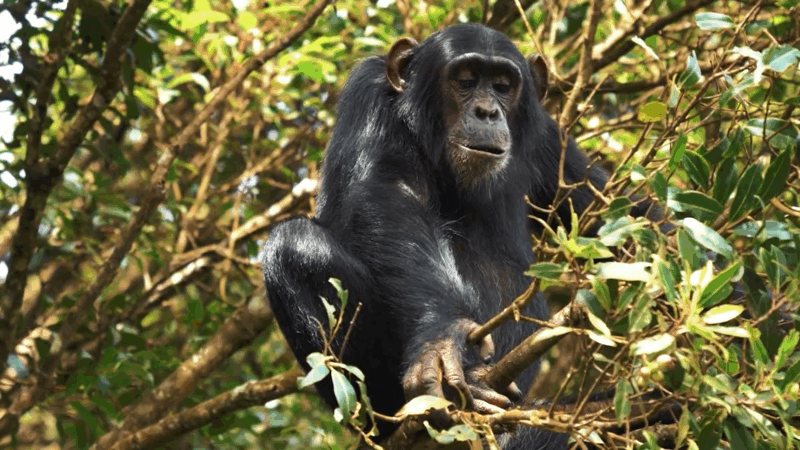
On rencontrait des chimpanzés, des gorilles, des phacochères quand la forêt était encore dense, mais maintenant, ils ont disparu. On peut traverser le secteur Rwegura du parc national de Kibira sans rencontrer un seul chimpanzé.
When the forest was still dense, there were chimpanzees, gorillas, and warthogs, but now, they have disappeared. You can go through the Rwegura area of Kibira National Park without seeing a single chimpanzee.
Today, chimpanzees are rare throughout the Kibira National Park. Pascal, who lives close to the park, said:
La dernière fois que j’ai vu un chimpanzé dans le parc de Kibira, c’était en 2018. Depuis, nous les rencontrons occasionnellement.
The last time I saw a chimpanzee in Kibira National Park was in 2018. Since then, we have seen them occasionally.
According to some studies, the park is currently home to more than 200 chimpanzees, compared to around 500 before its deforestation.
In October 2019, the Third National Communication on Climate Change raised the alarm on the loss of this chimpanzee habitat between 2009 and 2019. Kibira lost an estimated 10,000 to 12,000 hectares of tree cover. Six years after the announcement about the threat to the park, the exact deforestation levels remain unknown.
In the scientific article, “Chimpanzee (Pan troglodytes schweinfurthii) Population Density and Abundance in Kibira National Park, Burundi,” which the University of Liège published in 2013, Dismas Hakizimana, a researcher and lecturer at the University of Burundi, and Marie-Claude Huynen, a researcher and lecturer at the University of Liège, reported:
Leur habitat étant menacé, certains chimpanzés y ont laissé la vie et les rescapés ont déserté les secteurs de Kibira notamment Rwegura, Teza et Musigati. Ils se sont réfugiés dans le secteur Mabayi directement contigu au Parc National de Nyungwe/National Nyungwe Park (NNP) au Rwanda où ils recherchent la sécurité alimentaire et physique.
With their habitat under threat, some chimpanzees lost their lives, and the survivors abandoned the Kibira areas, especially Rwegura, Teza, and Musigati. They sought refuge in the Mabayi area directly adjacent to Nyungwe National Park (NNP) in Rwanda, where they seek food and physical security.
Harmful human presence
The Burundi Tea Office plantation, located in the high plateaus of this region, employs more than 1,000 salaried workers and 7,500 to 8,000 day laborers who work plucking green leaves from tea bushes, factory operations, tea-plantation maintenance, communication, and woodland exploitation. Léonidas Nzigiyimpa, an ecologist, observed:
Ces ouvriers produisent un grand bruit sonore nuisant à l’habitat des chimpanzés, espèce phare de Kibira. Ils jettent les restes des nourritures, les sachets… En gros, ils polluent l’habitat des chimpanzés.
These workers make loud noises that adversely affect the habitats of chimpanzees, the flagship species of Kibira. They throw away food leftovers and plastic bags, essentially polluting the chimpanzees’ habitat.
While tending to the fields, some workers enter the park illegally. Nzigiyimpa highlights:
Les entrées et sorties ne sont pas régulées et restent largement incontrôlées. Ils cueillent la nourriture des chimpanzés, notamment les fraises sauvages.
The entrances and exits are unregulated and remain largely uncontrolled. They pick the chimpanzees’ food, especially wild strawberries.
Berchmans Hatungimana, Director General of the Burundian Office for the Protection of the Environment, takes a similar perspective.
On the side of Highway One, which runs alongside the national park, local people sell edible wild fruits, like strawberries, to make ends meet. Pascal, quoted above, also stated:
Nous avions atteint un stade où nous cueillions des fruits qui ne sont pas mûrs. Nous les conservions dans un lieu sûr et attendions qu’ils soient mûrs. Maintenant, ce commerce est quasi-inexistant. Les fraises sauvages ont presque disparu. Même les arbousiers ne portent plus leurs fruits.
We had reached a stage where we were buying fruit that wasn’t ripe. We kept it in a safe place and waited for it to ripen. Now, this trade is virtually non-existent. Wild strawberries have all but disappeared. Even the strawberry trees no longer bear fruit.
The ecologist Nzigiyimpa denounces the fact that locals also hunt and set traps to catch animals in the park. According to Professor Richard Habonayo, a lecturer at the University of Burundi, these circumstances make chimpanzees fear the presence of humans and keep their distance.
Given this information, Berchmans Hatungimana said:
Nous avons des employés qui gardent le parc de Kibira 24 heures sur 24 pendant toute l’année. S’il advient qu’un ouvrier entre illégalement dans le parc et outrepasse les lois de la protection du parc, il est arrêté et livré à la société qui l’emploie pour qu’il soit puni conformément à la loi.
We have workers who guard Kibira National Park 24 hours a day, year-round. If a worker enters the park illegally and violates the park’s protection law, they are arrested and handed over to their employer for punishment in accordance with the law.
According to a study by the NGO Conservation and Community Change (3C), the number of traps has increased as the development work has escalated and the population around the park has also grown. Léonidas Nzigiyimpa, the legal representative, explains:
Outre les activités humaines, les plantations de thé constituent une barrière pour les chimpanzés dans leurs mouvements quotidiens de recherche de nourriture, car elles sont serrées et enchevêtrées. Elles coupent également la communication entre elles (différentes familles de chimpanzé) et limitent les femelles à retrouver les mâles issus d’une autre famille afin de s’accoupler et de se reproduire. Or, la reproduction des chimpanzés est lente. Cela limite la multiplication de la population des chimpanzés et contribue à réduire les effectifs.
Besides human activities, tea plantations pose a barrier to chimpanzees’ daily foraging, as they are fenced and enclosed. They also disrupt communication between different chimpanzee families and prevent females from finding males from another family to mate and reproduce. However, chimpanzee reproduction is slow, limiting the chimpanzee population growth and reducing their numbers.
Nzigiyimpa states that chimpanzees are forest builders and help maintain the ecological balance. He warns that if chimpanzees disappear, other types of vegetation will follow.
Involving local communities
According to Professor Habonayo, poverty is one of the factors driving the local communities to exploit forest resources, especially the Batwa community, which has a strong presence in the Great Lakes region.
To improve their living conditions and no longer rely on the forests for their survival, the government must implement revenue-generating projects for local communities.
What’s more, Habonayo recommends investing in training and developing local skills in forest resource management. He maintains:
Il est impossible de protéger le parc de Kibira sans associer les communautés locales. On doit leur faire comprendre qu’elles ont une grande place dans la protection de sa biodiversité, qu’elle soit faunique ou florique.
It is impossible to protect Kibira National Park without involving local communities. We must make them understand they play a significant role in protecting its biodiversity, whether fauna or flora.