



At this point in NASA’s human spaceflight story, researchers have a substantial amount of material – documents, artifacts and images – with which to tell the stories of past flights to space. But with NASA’s Artemis II mission around the Moon now in the books, we’re getting a refreshed look at space.
And the digital photographs transmitted back to Earth – even mid-mission – tell a modern story of the crew’s experience. Entire generations born after Apollo 17’s last close-up looks at the Moon in 1972 may hardly believe the reality of Artemis II in the age of AI-generated deep fakes. But this mission was real, and four humans can tell the tale of their adventure using the photographs safely stored on memory cards now in NASA’s hands.
As a space historian and curator well-versed in the visual culture of human spaceflight, I’ve long anticipated seeing the photographs of a return to the Moon.
Post-Apollo, images of space travel were characterized by launching space shuttles, Erector Set-like space stations and Mars rovers crossing a dusty landscape. While the Artemis II photos have timeless, classic elements similar to the Apollo photos, better photographic tools give them a clean, crisp vibe. Space travel now looks more like many people may imagine it’s supposed to look: grand, adventurous, audacious, sublime.
As part of Gen X, I have no personal memory of Apollo. Like many born after NASA’s first slate of lunar missions, my memories of space include visuals like the ill-fated Challenger launch; Mercury program astronaut John Glenn’s return to orbit in a space shuttle in 1998, at age 77; and seeing photos of deep space from the Hubble Space telescope. But these events didn’t include humans on or near the Moon, and many people around my age are thirsty for their own lunar memories to share.
Thanks to the internet and social media, which allow people to access images at a greater speed and volume than ever before, photographs from the Artemis II crew became almost instantly iconic. They were also compared to what came before, as they fit within a mental catalog of exploration photography that’s far older than humans’ earliest attempts at space travel.
NASA
Planning and taking photos
Artemis II crew members Reid Wiseman, Victor Glover, Christina Koch and Jeremy Hansen had weeks’ worth of photography training with a slew of Nikon digital cameras and iPhones. Taking photos with the device so many people have in their pockets is leaps and bounds beyond photography equipment used during Apollo 17 – even the 1960s-era 35mm camera.
NASA’s preference for using the Nikon D5 on the International Space Station has extended to Artemis II. This camera performs well, and NASA likes tried and true reliability when astronauts travel to space.
NASA took a decidedly different path when planning for images of the Moon with Artemis, compared to Apollo. First, the Orion spacecraft used on Artemis is bigger, and it has double the number of windows and cameras inside. Five of Orion’s six windows had live-streaming video cameras capturing the lunar flyby.
Because of their wide swing around the Moon at a distance greater than any Apollo flight, this crew could see more of the Moon in a single glance.
Artemis’ crew trained intensively with geologists and other scientists to be on the lookout for more prospective landing sites for future missions, craters and just interesting events or features. People watching live online could hear their descriptions of what they saw. The conversation between the astronauts on the Orion capsule and the Artemis Science Team was also broadcast.
Exciting new photos
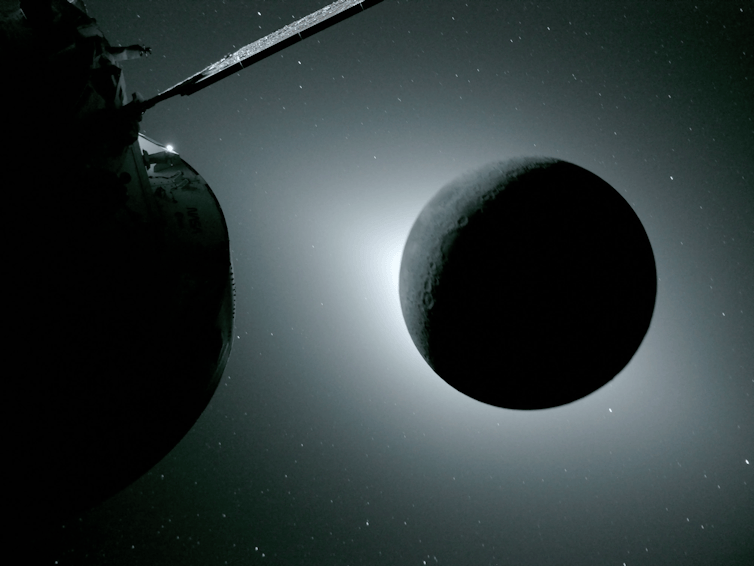
Based on the launch date and the position of the Moon, the crew was prepared for unique angles like Earthset – similar to sunset – and a solar eclipse.
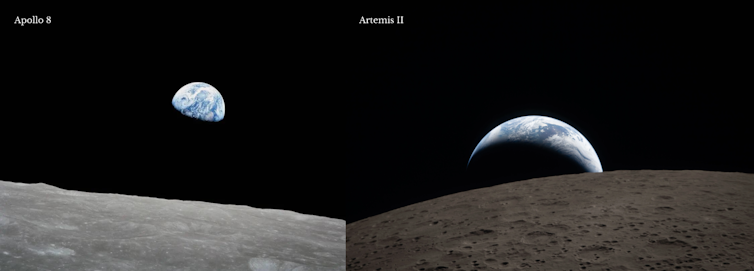
NASA
Earthrise – like sunrise – was made familiar by Apollo 8. But it wasn’t visible in the same way for Artemis II due to the Moon’s darkness in its current phase. So, while denied a chance to compare an Earthrise of today with that of 1968, another moment early in the mission provided what might be an even more spectacular visual alignment with memories of Apollo.
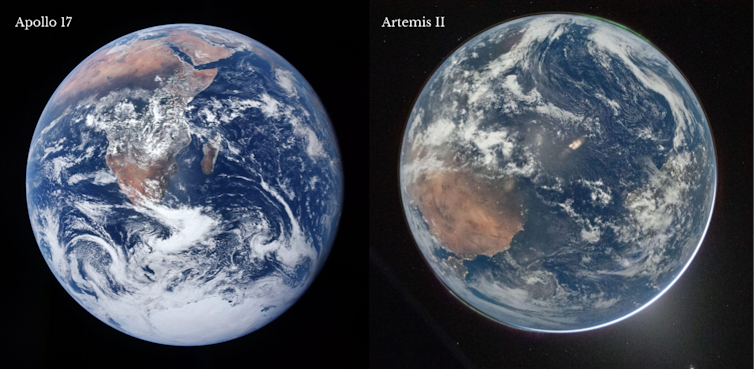
In 1972, as the crew of Apollo 17 began their journey to the Moon, geologist Harrison Schmitt captured a series of images of the fully lit disc of Earth at around five hours after the start of the mission. This photo became an icon within a series of iconic photographs of the Space Age, and probably the entire 20th century. It was even featured in Al Gore’s film “An Inconvenient Truth.”
NASA
That was Earth 1972, and now we have Earth 2026 – both serving as documents of singular moments in Earth’s long history. This new photograph shows Earth – lit by the Moon’s glow, not the Sun, as with the Apollo 17 photo – in the black void of space, the thin sliver of our atmosphere shielding life, and generating polar aurorae.
Schmitt’s “Blue Marble” spent over five decades as one of the most-viewed photographs in history. And while people back on Earth saw the new Artemis version within hours of capture, it might get less public recognition in an age of photo manipulation and high-tech wizardry.
These first few images from Artemis II are just the tip of the imagery iceberg, though. Modern memory cards have a capacity that will allow the number of digital images from Artemis II to far surpass the nearly 4,000 photos captured during Apollo 17.
In the weeks and months to come, as mission images fill online databases, Artemis II’s significance as a fresh new vision for human space exploration will continue to grow, building on the lessons of Apollo.