



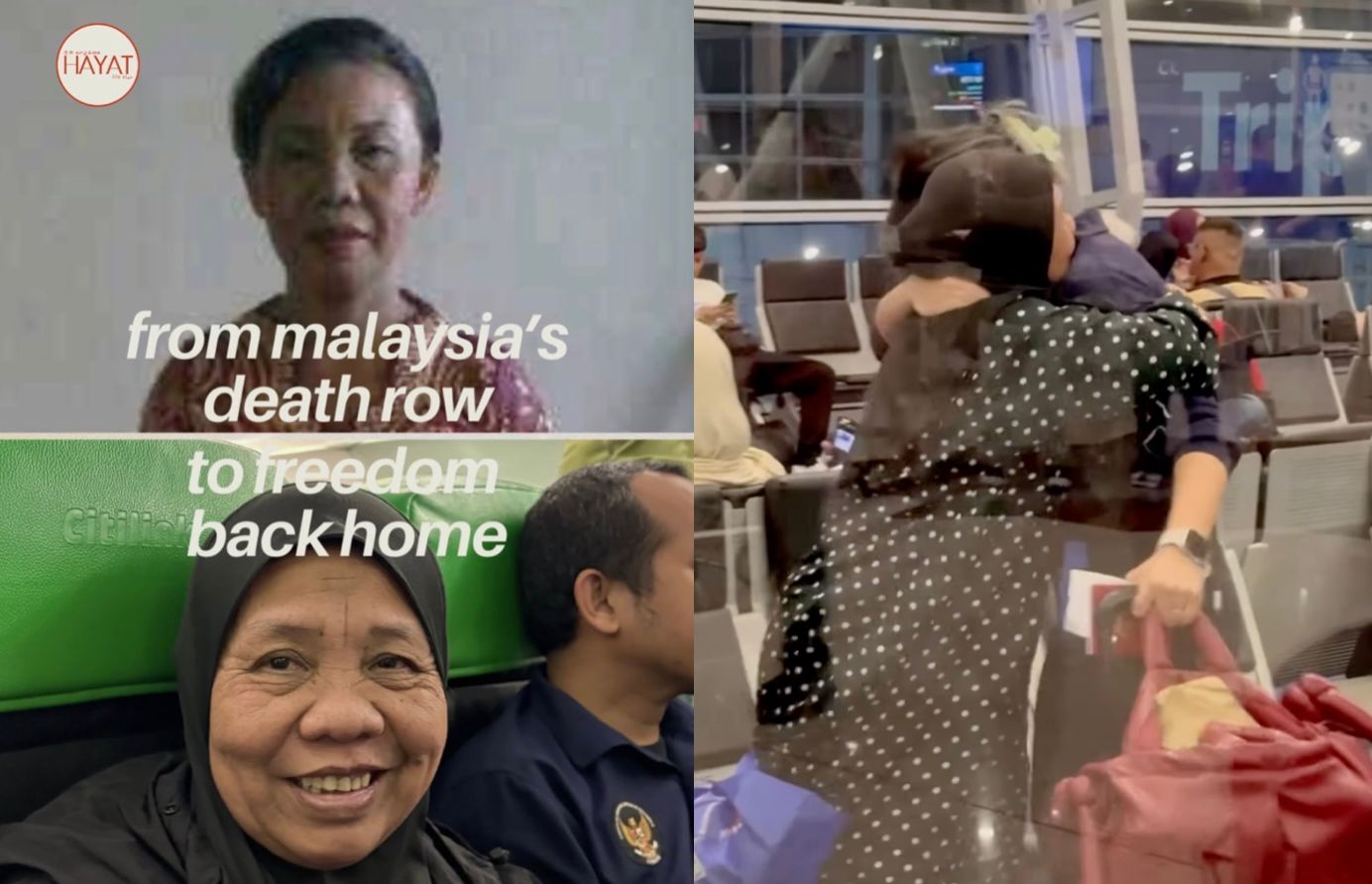
JAKARTA: A 66-year-old woman who had spent almost a decade and a half on death row in Malaysia was allowed to go home to Indonesia, arriving in Jakarta on Thursday (April 2).
A Kuala Lumpur-based group that carries out prison visits, HAYAT, took up the cause of Ani Anggraeni, who was known by her real name, Asih, until her name was changed by the people who hired her and used her to transport drugs in 2011.
In 2012, Asih was sentenced to death for drug trafficking. However, with Malaysia abolishing the mandatory death penalty in 2023, she was given a 30-year prison sentence, which she served until she met members of HAYAT, who aided her in appealing for clemency in September. The governor of Penang granted it on March 9, and the grandmother of four, who is a cancer survivor, finally returned home.
Asih’s story
In 2011, the Indonesian woman, then aged 51, was offered a job as a caregiver in Malaysia by a woman who called herself Duwi, who said Asih would be getting a high salary and that she would take care of her travel arrangements and accommodations. Duwi took care of obtaining a passport for her, but had her name put as “Ani Anggraeni’’ instead of her real name, something Asih was unaware of.
Asih, who had never travelled outside Indonesia, believed and followed everything Duwi told her.
To her surprise, when she arrived in Malaysia, Duwi asked her to go to Vietnam to retrieve a suitcase. Feeling that she had no choice, she agreed. Asih was then instructed to bring the suitcase to Penang, allegedly to the home of one of her relatives.
When Asih flew into Penang Airport on June 21, 2011, 3,865.2 g of methamphetamine was discovered in the suitcase that Duwi asked her to pick up. She was given the death sentence under Section 39B(1)(a) of the Dangerous Drugs Act 1952 for drug trafficking.
Because of the change in Malaysian law, on May 29, 2024, the Putrajaya Federal Court approved her application for resentencing, and she was given 30 years’ jail, which meant she would have stayed in jail in Malaysia until June 2031.
HAYAT steps in
In 2024, members from HAYAT, who regularly visit people in Malaysia’s prisons, met Asih and determined that she had been exploited by drug traffickers. Even Duwi’s change of name on her passport is part of their modus operandi, the group said in a statement, one intended to deceive immigration officers.
HAYAT then coordinated with the Community Legal Aid Institute in Jakarta not only to assist Asih with her case but also to help look for her family, with whom she had lost contact in 2017 when her daughter’s phone was misplaced.
The groups were able to track her family down, and on September 19, 2025, family members were able to visit her in jail for the first time in many years for a precious half hour.
HAYAT has pointed out, however, that there are eight other women in situations similar to Asih’s.
“Her case transcends a conventional capital drug charge. It is a profound narrative of deception, exploitation, and systemic vulnerability. It highlights the insidious ways women are ensnared by human #trafficking syndicates, manipulated into illicit operations without ever fully comprehending the reality of their circumstances.
Asih’s ordeal serves as a stark revelation: numerous women entangled in similar cross-border drug cases are not the masterminds. They are victims of a flawed system that has failed to protect them,” the group wrote. /TISG
Read also: Australian love scam victim who faced death penalty in Malaysia freed