



In Madeline Cash’s debut novel – lauded by Lena Dunham and already optioned for a limited series – the Flynns, like all unhappy families, are unhappy in their own way.
Bud and Catherine have just opened their marriage – reluctantly, on Bud’s part. Catherine is a day-drinking stay-at-home mom who longs for the rock star she thought she’d married. Bud is an accounts manager for the town’s main industry: Alabaster Harbor™, a port owned by an infamous billionaire tech magnate (the novel’s mysterious, white-toothed antagonist).
Then there are the girls. Bud and Catherine’s trio of school-aged daughters are in various states of crisis, if not criminality: Harper, 12, a “troublemaker with no origin myth”; Louise, 15, “afflicted middle child”; and Abigail, 17, “unquestionably pretty enough to be a recurring character on a Christian soap opera”.
Throw in a local priest, add a side serving of conspiracy, and you have an unusual setup for a family novel. Yet Lost Lambs – inspired by Jonathan Franzen’s The Corrections and a slew of hard-boiled detective novels – somehow pulls it off.
Review: Lost Lambs by Madeline Cash (Doubleday)
Cash, 29 years old, is founder and co-editor of the “subversive” feminist zine Forever Magazine, author of a 2023 short-story collection, and a regular contributor to the likes of Granta and The Paris Review.
Unsurprisingly, the vagaries of girlhood – a time when young women are so often porous but powerless – are central to the novel’s suburban ecosystem. Lost Lambs is rife with unease. Its themes are manifold. Sibling rivalry. Online grooming. The stagnation of intimate relationships. Crises of faith. The prevalence of both PTSD and sugary self-help fixes. The overwhelm and uncertainty of young love.
All of this chaos somehow finds its place in a narrative both timeless and specific to this moment: where work feels increasingly meaningless, information overload leads to ennui and truth is often stranger than fiction.

Penguin Random House
Being right or being happy
The story begins with insects – an infestation of gnats in the town’s Catholic church – and ends with a scourge of a different (blood-sucking) kind. In between, each of the Flynns is lost, searching for answers to life’s big questions. Who am I? What makes me special? Which institutions can we trust?
But other urgent questions begin percolating too. Why does the port’s cargo log feature so many “consistent inconsistencies”? What’s really going on in that mansion on the edge of town?
Something sinister is brewing. And Harper knows it. At the heart of her suspicions lurks Bud’s boss, Paul Alabaster, a super-rich nepo baby obsessed with youth and longevity.
“Do you want to be right or do you want to be happy?” Bud asks eventually, responding to Harper’s increasingly elaborate theories about the port’s “missing” cargo and Alabaster’s presence in the town. Here we meet one of the book’s most pervasive themes: that knowing too much can only result in anguish. (Or, as a hired investigator puts it: “It’s like a scary movie, right? If you go down to the basement […] you’ll find somethin’ horrible.”)
“Being right brings me happiness,” the ever-precocious Harper retorts.
But is there – the novel asks – any such thing as “right” or “happy”?
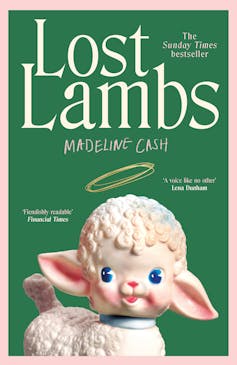
Lost Lambs is a slippery novel to characterise. One Goodreads reviewer describes it as if “Wes Anderson wrote Little Women”. Another as though “The Royal [Tenenbaums] and Eyes Wide Shut had a baby”. For me, it’s more like Breaking Bad meets My Family and Other Animals or – stay with me – Franz Kafka meets David Sedaris.
The book – sometimes laugh-out-loud funny – melds traditional tropes and techniques with the more experimental and absurd. Its multi-voiced narrative ranges effortlessly between the story’s extended cast of characters, fusing an omniscient and limited perspective that transcends the typical pitfalls of head-hopping between characters.
Cash incorporates rampant wordplay, with quirky asides almost always culminating in clever callbacks. (That outbreak of gnats at the local parish, as one example, quite literally corrupts the book’s spellings, a visual gag that’s “gnaturally” but pleasurably distracting.) Metaphors – biblical or otherwise – abound.
The truth is funny
In a sense, the book is metaphor, or meta narrative. Cash plays conspicuously on the capacity for fiction to be the lie that tells the truth. As Lost Lambs’ antagonist – the small, smarmy Alabaster – remarks in the novel’s closing act, “The truth is funny!” Perhaps labouring the point, he goes on to explain:
The real point of the joke is merely that the most important realities are often the ones that are the hardest to see and talk about. So we have to find new ways of doing so. Understand?
And of course we do. Cash is unwavering in her bid to embed sometimes devastating truths in the novel’s deft prose, garrulous dialogue and occasional refrains of anti-woke theology.
This technique comes to the fore at the novel’s midpoint, when the town’s tech titan tells Bud: “Control what people do and you’re a king. Control what people think and you’re a god.”
The truism’s menacing intensity is almost immediately defused:
Bud saw his host before him a very powerful man with very profound daddy issues. As a child, Bud had often tried to picture the human incarnation of God. It looked nothing like Paul Alabaster.
In a similar moment of whiplash, I laughed then felt sheepish reading about Catherine’s dalliances with the next-door neighbour: she’d “briefly wondered, as all women do their first time alone with a man, if he was going to murder her”.
My favourite moment, though, occurs when a retired GI Joe offers a snippet of so-wrong-it’s-right life advice that would never turn up in a TED talk:
Shove that shit down. So deep down it’s out of sight. Don’t spend another moment on it. Make it go from a reality to a memory to a feeling you sometimes get on winter days. Then let that feeling drive you to do somethin’ great.
These tongue-in-cheek elements layered with the philosophical often feel like the literary equivalent of a bunch of raccoons dressed in a trench coat. Yet the reader is always in on the joke.
A voice of a generation
Ultimately, Lost Lambs finds a comforting and credible resolution, where acknowledging what’s true and finding happiness (in a manner of speaking) is rendered possible only by forsaking the trappings of a more airbrushed reality.
If anything, it’s a story about interconnectedness – even hyperconnectedness – and the less photogenic ways family and community can reclaim and redeem the wayward individual.
Most of all, Lost Lambs is a striking example of literary risk-taking yielding unexpected reward. It’s through levity, and Cash’s inventive approach to storytelling, that the novel can so easily integrate and interrogate its darker matter – be it susceptibility to extremist ideologies, our society’s unwavering obsession with youth and beauty, or the crookedness of the cops.
Perhaps it’s less a family novel than it is the natural successor of the millennial novel, in which authors habitually “explore the oppressive anxieties of living in a world where it feels like everything is stacked against you”, as Julia Rittenberg suggests on Book Riot.
Whichever way you look at it, Lost Lambs is tender, wry and original: a new way of seeing and talking about the important realities hidden in plain sight.
Recalling an iconic line from Dunham’s Girls, I can safely say that while Cash may not be the voice of a generation, she’s certainly a voice – and a promising one to watch at that.