



This article was produced in partnership with Type Investigations.
Inside a law enforcement command center in Ciudad Juárez, a police officer scrolled across a map on her touch-screen computer. As she used her fingers to navigate through the Mexican state of Chihuahua, where Juárez is located, different colored bubbles lit up. “That one is a camera,” the analyst explained, pointing at a circle. “We can just click it and see the live view.”
“Look,” an analyst next to her said, demonstrating how the technology works. They zoomed in on a camera feed inside the women’s unit of a state prison. On screen, the camera focused on a group of women sitting around a table — the details of their playing cards clearly visible.
For decades, Juárez, which sits just across the border from El Paso, Texas, has been considered one of the most dangerous cities in the world. For years, rival gangs and drug cartels have battled for control of the city. To combat the violence, Mexican authorities have engaged in an ongoing fight against criminal groups in the area using surveillance technology.
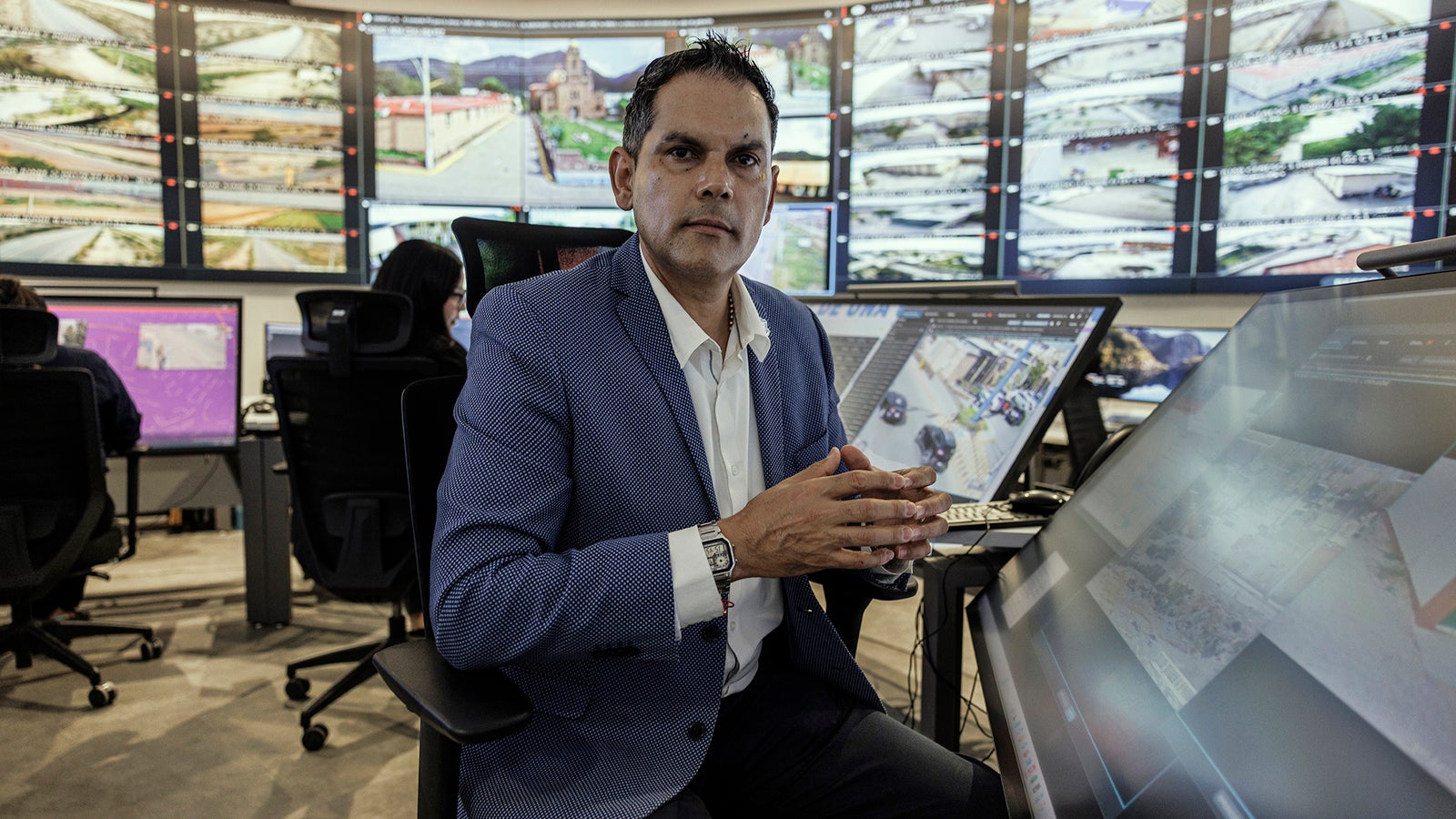
This command center is key to Chihuahua’s growing surveillance network, Gilberto Loya Chávez, the state’s square-jawed and charismatic secretary of public security, said during a tour of the facility last October. Behind him, large screens blasted live camera feeds from throughout the state, as more than a dozen analysts typed away on computers.
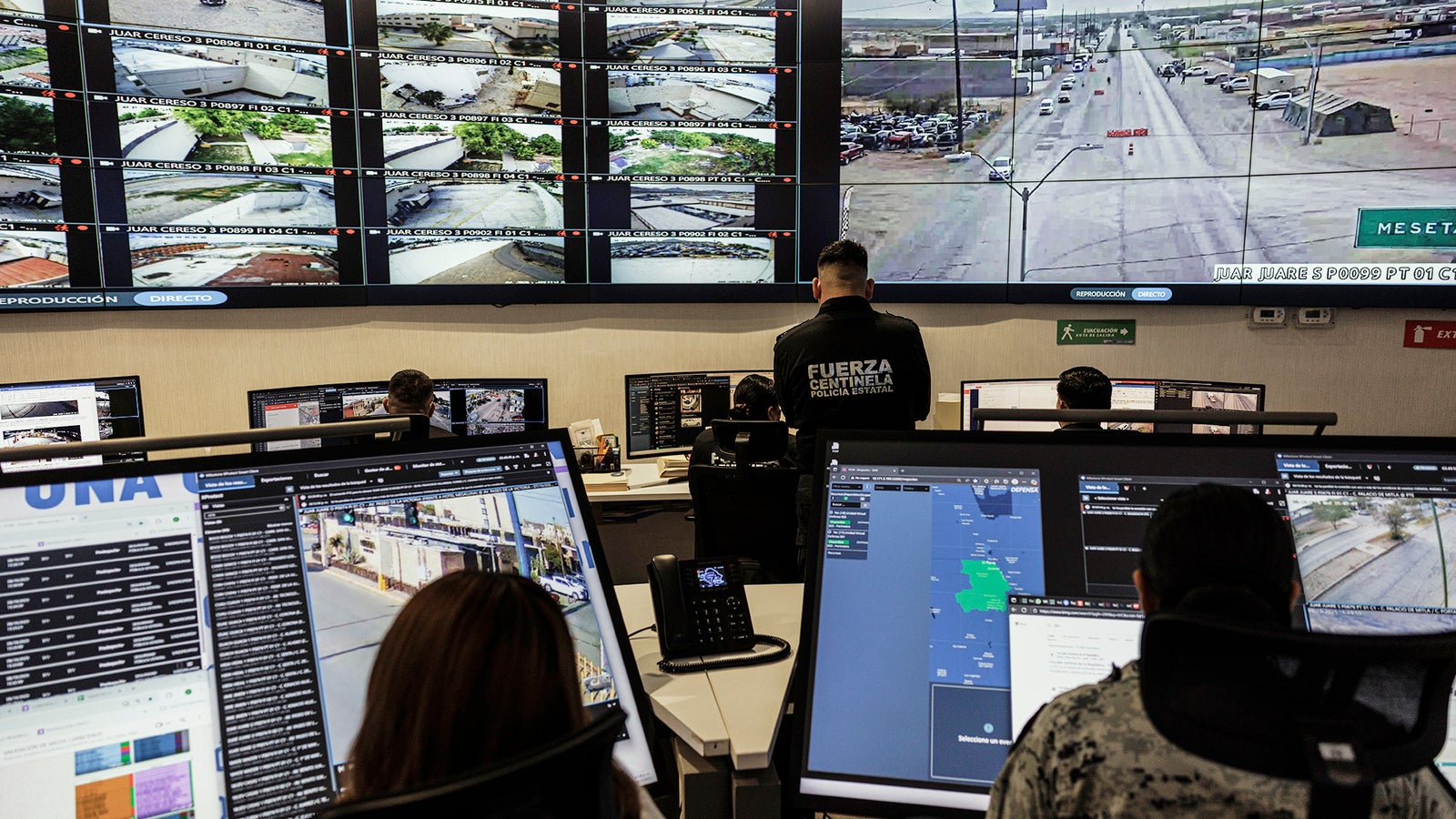
Adriana Zehbrauskas for Rest of World
The command center’s operations are powered by a state-of-the-art surveillance system called the Plataforma Centinela (“sentinel platform”), which brings together thousands of cameras, license plate readers, drones, helicopters, public panic buttons, and other intelligence-gathering technology to enable authorities to keep watch over vast swaths of the state. The system is supercharged by artificial intelligence, Loya said, allowing officials to identify hot spots where crime may occur, quickly track down suspects, and dispatch law enforcement officers. “It accelerates our investigations,” Loya told Rest of World and Type Investigations.
He and his team listed their successes: Officers surveilled an alleged high-ranking drug trafficker wanted by the FBI, leading to his arrest, and they tracked down a young man who threw Molotov cocktails in a movie theater after the system’s surveillance drones identified him using facial recognition software. Last year, the Centinela platform earned an award from the World Police Summit in Dubai for its use of advanced technology and AI.
The platform is also deployed at the U.S.-Mexico border. In April 2022, Texas Governor Greg Abbott and Chihuahua Governor María Eugenia Campos Galván signed a memorandum of understanding giving Texas access to the reams of surveillance data that Chihuahua is collecting. The intelligence-sharing agreement “means that the state of Texas will have eyes on this side of the border,” Galván said at the time. During our visit to the command center, Mexican officials also said that they share certain data with U.S. agencies, including Customs and Border Protection and the FBI.
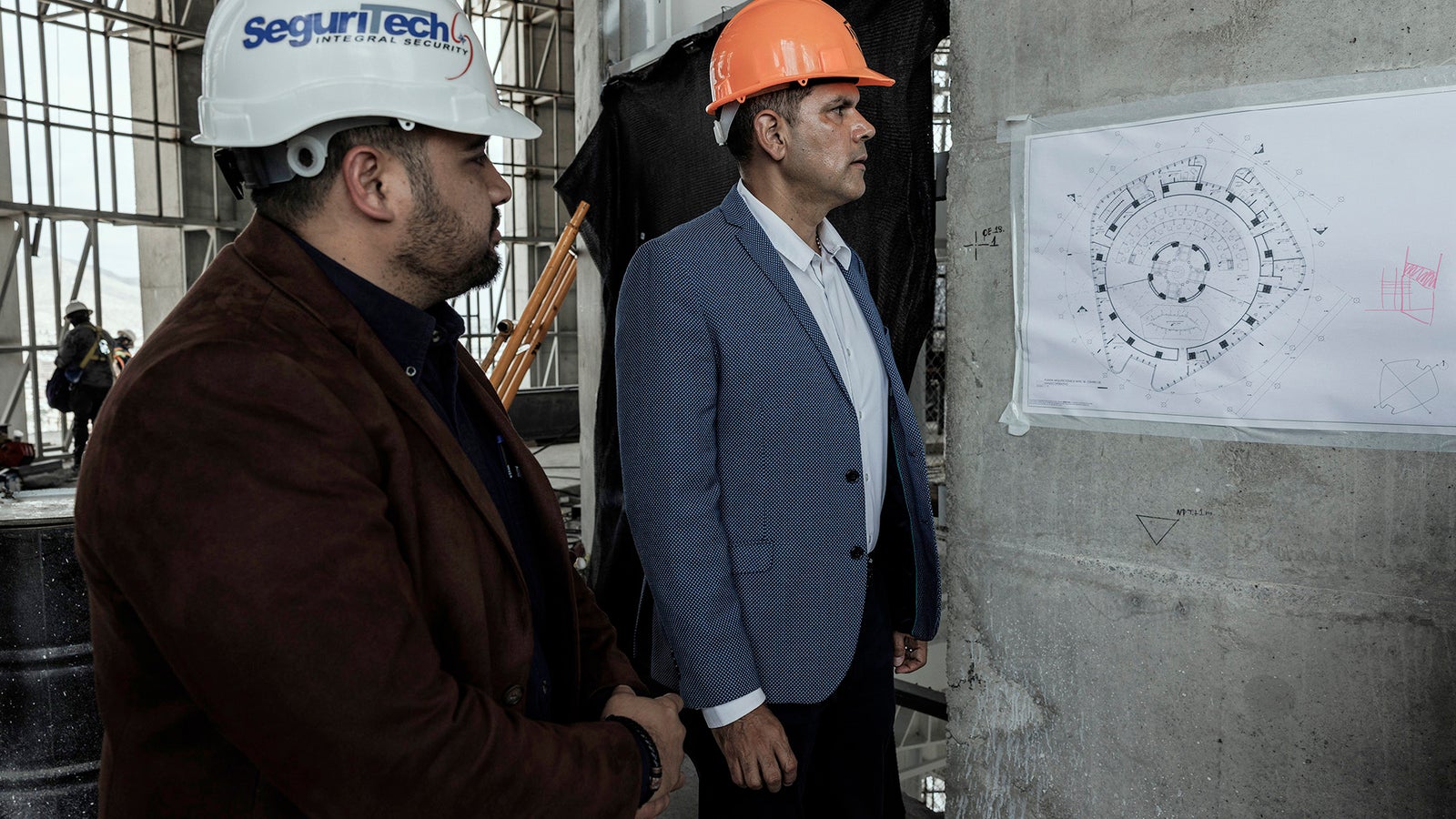
Soon, this command center will relocate to an even more impressive facility: A 20-floor tower is currently being built in downtown Juárez. Dubbed Torre Centinela (“sentinel tower”), it will become the new central hub for Chihuahua’s wide-ranging surveillance network.

Adriana Zehbrauskas for Rest of World
Loya brought us to the top of the partly-built tower, which looms over Juárez and can be seen from downtown El Paso. He described the facility’s final form: The command center will sit above a block of offices and server rooms, and ultimately occupy up to four floors. These will be used for emergency dispatch services, tactical analysis, cyberintelligence, and inter-agency collaborations. “I wanted it in downtown Juárez,” Loya said. “Juárez is the city with the most reported crime in the state. So the goal was to install ourselves where the problem exists.”
Construction of the tower is expected to be completed soon, with operations beginning this April, according to a Chihuahua government source.
Civil liberties groups have raised concerns that the scale of the surveillance operation will create privacy issues: Everyday citizens will be tracked, without necessarily reducing gang-related violence. Some have warned that the data-sharing agreement between Chihuahua and Texas could be used to detain and deport migrants, as well as combat drug smugglers and human traffickers. The site has drawn protests from local human rights activists, as reported by the Texas Observer.
The company responsible for the Plataforma Centinela project, as well as the new tower, is a little-known technology firm that has quietly grown into a surveillance powerhouse in Latin America. Over the past three decades, Grupo Seguritech has evolved from a small company selling home alarms into a sprawling network of firms that are deeply involved in projects across the region. The company has signed contracts with nearly every state in Mexico, as well as with Colombia. It has established entities in Brazil, Colombia, and the United States, and is reported to have had dealings in Ecuador, El Salvador, China, and Israel.
The true scope of Seguritech’s operations, however, has never been fully examined. Through a review of thousands of pages of public records and government contracts, Rest of World and Type Investigations identified at least 31 companies operating under the umbrella of Grupo Seguritech, or registered as Seguritech entities abroad.
This collection of companies has been awarded at least 63 government surveillance contracts in Mexico since 2012, totaling more than 21.8 billion pesos ($1.27 billion), unadjusted for inflation, the documents reveal. In a statement, the company said it has constructed or managed more than 188 command centers throughout Mexico, including local dispatch centers and state-federal command centers like Centinela. The company also said that it is currently operating in 26 of Mexico’s 32 states.
Adriana Zehbrauskas for Rest of World
The full scale of Seguritech’s operations is difficult to pin down: Some states and federal agencies in Mexico declined to release records related to the company, on the basis that doing so could threaten national security. In the U.S., federal agencies did not provide records related to contracts they may have with Seguritech. Customs and Border Protection claimed the request was too broad, and the Bureau of Alcohol, Tobacco, Firearms and Explosives did not respond to queries. The Texas Department of Public Safety and New Mexico Department of Public Safety said they did not find any records that matched a search for contracts.
Ana Gaitán, a human rights lawyer with the Mexican digital and privacy rights group Network in Defense of Digital Rights, said that understanding the web of companies behind state surveillance projects is crucial for accountability. “Identifying clearly who the suppliers of these tools are, and the way in which they commercialize them, can give a clearer picture of how the market functions and works for future opportunities to hold them responsible,” she said.
Seguritech did not make representatives of the company available for this story, but did provide a statement in response to questions.
“With three decades of experience, a strong presence in the national market and a clear path for regional expansion, Grupo Seguritech continues being the trusted partner for those responsible for protecting people, institutions and critical infrastructure,” the company said.
Seguritech’s development of a sprawling, cross-border surveillance operation is a feat for a Mexican company in a global market dominated by the United States, China, and Europe. Mexico is now home to the second-largest security market in Latin America, which itself has one of the fastest-growing security industries in the world.
Throughout the region, local companies lead the deployment of facial recognition technology, according to a recent report by AlSur, a consortium of civil society groups in Latin America. And while foreign companies make up a large part of Mexico’s more-than-$1.8 billion security technology market, according to a 2025 report by the Security Industry Association, local firms like Seguritech dominate the relationships-driven government sector.
As the company expands outside Mexico’s borders, including into the U.S., it’s sending a strong signal that Mexico’s surveillance industry is ready for the international stage.
“We’re a company with more than 20 years in the country,” Ariel Zeev Picker Schatz, Grupo Seguritech’s founder and CEO, said during a TV appearance almost a decade ago. “Mexican — 100% Mexican.”
Mexico’s drug war, launched in 2006, radically transformed the country’s surveillance industry. Driven by then-president Felipe Calderón and security minister Genaro García Luna, the country’s police and military forces joined a collective effort to eradicate organized crime groups throughout the country. Government agencies invested heavily in surveillance technology, touting it as an antidote to crime.
This effort has led to the construction of hundreds of sophisticated command centers throughout Mexico, connecting local, regional, and federal law enforcement agencies and integrating intelligence gathering with public emergency services. In Chihuahua, for example, there are 13 regional command centers that all feed into the central command center in Juárez. Police control the country’s far-reaching surveillance camera network — one device for every eight people, according to one estimate — from these centers. The centers even gather live feeds from private security cameras.
“There is active participation by the citizenry, where they connect their private security devices to the command centers run by the state,” said Karina Nohemi Martínez Meza, a researcher with the Institute of Legal Sciences at Veracruzana University, who studies surveillance in Mexico. “Like an electronic eye.”
-
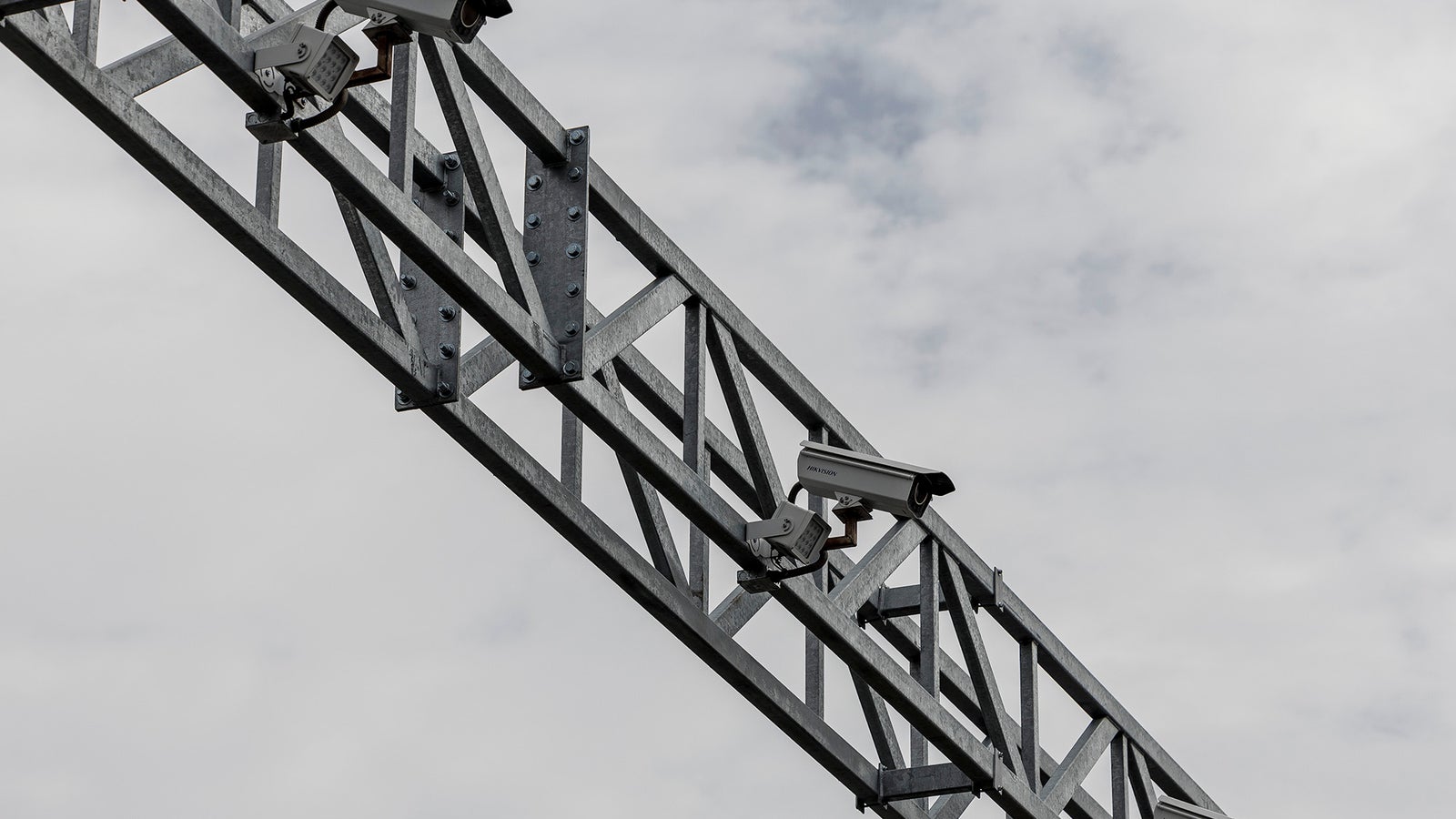
Surveillance cameras over a main intersection in Ciudad Juarez, Chihuahua. -
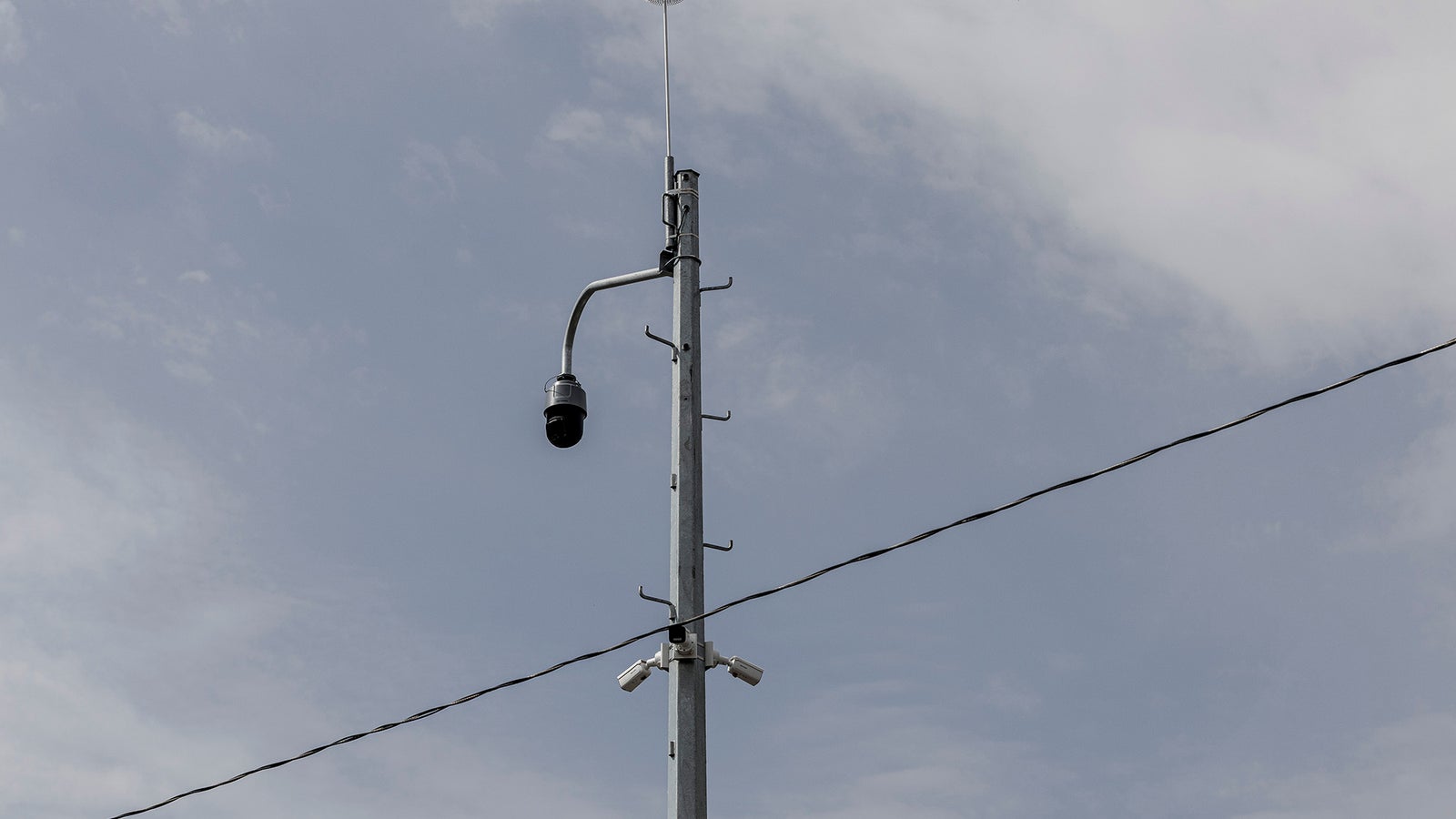
One of hundreds of “Intelligence Monitoring Points” in Ciudad Juarez, Chihuahua, which include surveillance cameras and panic buttons.
Adriana Zehbrauskas for Rest of World
Many of these centers, including several that Grupo Seguritech developed and built, are known as C5s, named for the five C’s in their name: Centers of Command, Control, Computing, Communication, and Citizen Contact. Plataforma Centinela in Chihuahua is the first C7 center, adding “quality [calidad] and communication, with artificial intelligence” to its title.
Mexico’s expanding surveillance apparatus has been implicated in several abuses over the years, including the disappearance of 43 students in 2014. That event, in which police monitored the students’ movements and then allegedly handed them over to criminal groups, marked a significant turning point for the Mexican drug war. Mexico’s government was also the first purchaser of NSO Group’s Pegasus spyware, which it used to target human rights activists and journalists, a number of investigations have found.
Today, Mexico is the second-biggest market for security technology in Latin America, just behind Brazil, according to Niall Jenkins, a researcher at the consulting firm Omdia. Latin America represents 5% of the global market for security equipment and services such as video surveillance, according to a 2024 Security Industry Association report.
The Mexican government issued at least 80 contracts valued at $14.4 million for surveillance devices and software between 2018 and 2021, according to a report by Connectas, a Latin American investigative outlet.
The privacy group Surveillance Watch has found that 68 foreign companies currently supply surveillance technology to Mexico, for everything from tracking migrants to camera, data, and phone surveillance systems. A Latin American industry group registry lists at least 160 Mexican companies that offer security technology services.
These include companies like Excelencia en Comunicaciones y Tecnología, Technology Systems and Logistics de México, Eclecsis Sinergia y Tecnología, and SystemTech Sistemas, which focus on providing security cameras and other equipment. Grupo Kabat and Jomtel Telecomunicaciones have constructed and operate a number of police command centers in Mexico at the state and municipal level.
However, within the constellation of Mexican security firms, Seguritech stands out as one of the largest and most powerful companies of its kind.
Grupo Seguritech was founded in Mexico City in 1995 by father-son duo Shimon and Ariel Picker as a small company selling alarm systems for homes.
The company’s first foray into government work was installing a network of municipal security cameras, according to Seguritech’s website. By 2004, the company had installed its first video surveillance center. And in 2013, it designed Mexico’s first C5 command center.
Today, Grupo Seguritech does work in a variety of fields. It has established prison surveillance systems and provided drones and tactical vehicles to government partners. It received a government contract for meteorological radars, and built an aerospace division called SeguriSpace that launched 18 satellites into orbit for meteorology work.
Seguritech’s bread and butter, though, is its top-to-bottom surveillance packages, which it helped pioneer in Mexico. Government contracts obtained via public records requests show that alongside constructing command centers, the company and its subsidiaries design intelligence gathering and sharing systems, procuring the necessary equipment — cameras, drones, license plate readers, and computer software — or supplying their own equipment.
“We look for the best practices and technologies and we integrate them,” Picker had said in a TV interview from about a decade ago. “So we look for the best video camera system with the best software, the best turnstiles, the best software for access control, the best fiber, the best installation practices.”
Grupo Seguritech does not list all of its subsidiaries publicly. However, an internal company document obtained by Rest of World and Type Investigations lists 27 subsidiaries under the Grupo Seguritech umbrella, most of which operate in the security field and are based in Mexico. Public records revealed at least three more branches of Seguritech outside of Mexico.
In its statement, Seguritech said the company employs more than 2,200 “specialists” around the country, who are currently working on 52 active projects. The company did not share further details about the size of its operations.
To piece together the size of Grupo Seguritech’s state contracting portfolio, Rest of World and Type Investigations requested records from every state in Mexico, along with nine federal entities, including the military, the intelligence service, and the attorney general’s office. The more than21.8 billion pesos ($1.27 billion) in state contracts we identified is almost certainly an incomplete accounting. Some states, including Coahuila, Chiapas, Zacatecas, Guanajuato, Quintana Roo, Michoacán, Morelos, Sonora, and Tamaulipas, rejected our records requests, citing public security concerns and ongoing investigations into contracts that had been issued.
Mexico does not have a centralized database for government contracts, making it difficult to compare Seguritech’s footprint to that of its competitors. In 2018, former congressperson Vidal Llerenas Morales, from the progressive ruling party Morena, accused the company of having a “monopoly” over the surveillance industry in Mexico, and requested that the attorney general’s office open an investigation into Seguritech Privada’s contracts. It is unclear whether the attorney general’s office did open an investigation. Grupo Seguritech did not respond to Morales’ allegation.
Although records show that Seguritech subsidiaries received contracts to build command centers and provide surveillance equipment, the contracts do not provide a complete picture of how much government agencies are paying for the equipment and services. “We are sometimes unable to review, in a punctual and clear manner, the cost of this technology — unless you ask the companies themselves,” said Martínez Meza, the researcher at Veracruzana University. “The cost of how much is spent per camera, for example, does not appear in many public databases.”
In Chihuahua, the state government has designated most information about the Torre Centinela project as classified. In 2022, the governor claimed the state would have a five-year contract with Seguritech. Loya, the state’s head of public security, said in an interview that his office chose the company due to its low prices and advanced technology.
The Chihuahua project is one of more than 188 local and federal command centers that Grupo Seguritech has been contracted to construct or manage
The Chihuahua project is one of more than 188 local and federal command centers that Grupo Seguritech has been contracted to construct or manage. That includes centers in the states of Hidalgo, Michoacán, Sonora, Guanajuato, Colima, Querétaro, Zacatecas, Puebla, and Jalisco, and in the cities of Toluca, Guadalajara, Reynosa, and Ecatepec, records show.
In addition, two companies linked to Grupo Seguritech advertise the conglomerate’s command center projects online. SkyPlus Developments lists 10 command centers in a section of its website titled “specialized buildings,” while PeakAir Developments lists 10 command centers, plus Torre Centinela, in the government projects section of its website. Neither website describes the companies’ work on the projects nor do they publicly state any relation to Grupo Seguritech. Public records requests for their contracts with the relevant municipalities did not yield results. Grupo Seguritech did not respond to questions about its relationship with SkyPlus and PeakAir.
Seguritech Privada has surveillance equipment contracts, including for CCTV camera setups and installations, in Mexico City and Jalisco. The contract for Mexico City specifies a “maintenance” contract for surveillance cameras in the borough of Benito Juárez. In Jalisco, the company is providing the hardware and software for the C5 command center, and surveillance cameras for the Executive Office.
As municipalities like Mexico City and Juárez build vast surveillance networks in the name of public safety, researchers say the privacy trade-offs are too high.
“They are systems that, on the one hand, do not seem to have much of an impact in the reduction of crime nor criminal investigations,” Santiago Narváez, an investigator with R3D, told Rest of World and Type Investigations. “And on the other hand, they have a huge impact on people’s privacy.”
Adriana Zehbrauskas for Rest of World
Data surrounding violence throughout Mexico is disputed. The federal government claims that in recent years homicides have declined significantly. But analysts urge caution, claiming that disappearances have only increased. México Evalua, an organization that analyzes Mexican government data, reported that between 2015 and 2025, disappearances rose by 213%.
Public records and Mexican news reports show that some Grupo Seguritech subsidiaries have faced scrutiny from Mexican authorities.
In 2024, the Mexican Attorney General’s Office and local officials launched an investigation into the company Tres10, after discovering an alleged breach of contract in the state of Tamaulipas. According to a congressional document, the state signed a $220 million contract in 2019 with Tres10 to construct the command center in the city of Reynosa. The document says the contract was “plagued with financial and legal irregularities,” and accused the state government of not properly vetting Tres10, which had been formally registered only one year prior to the contract’s signing. The investigation is ongoing, and the attorney general and local officials declined to release records, citing confidentiality in an open case.
B3 Fly Services, another Grupo Seguritech subsidiary, was awarded a contract worth more than 1.2 billion pesos ($59 million) in 2015 to rent out five helicopters and a plane to the Michoacán state government. The B3 FlyServices contract was plagued with “irregularities that are difficult to explain,” investigators found.
In the state of Michoacán, SPE Michoacán Seguro was awarded a $35 million contract in 2019 to construct and provide technology to the state’s command center. The contract was eventually cancelled, however, with press reports suggesting the company did not provide the material it had promised the state, after the former governor — who is facing multiple corruption accusations in other matters — signed the contract.
Tres10, B3 Fly Services, and SPE Michoacán Seguro did not respond to requests for comment, and Grupo Seguritech did not respond to specific questions about these subsidiaries.
-
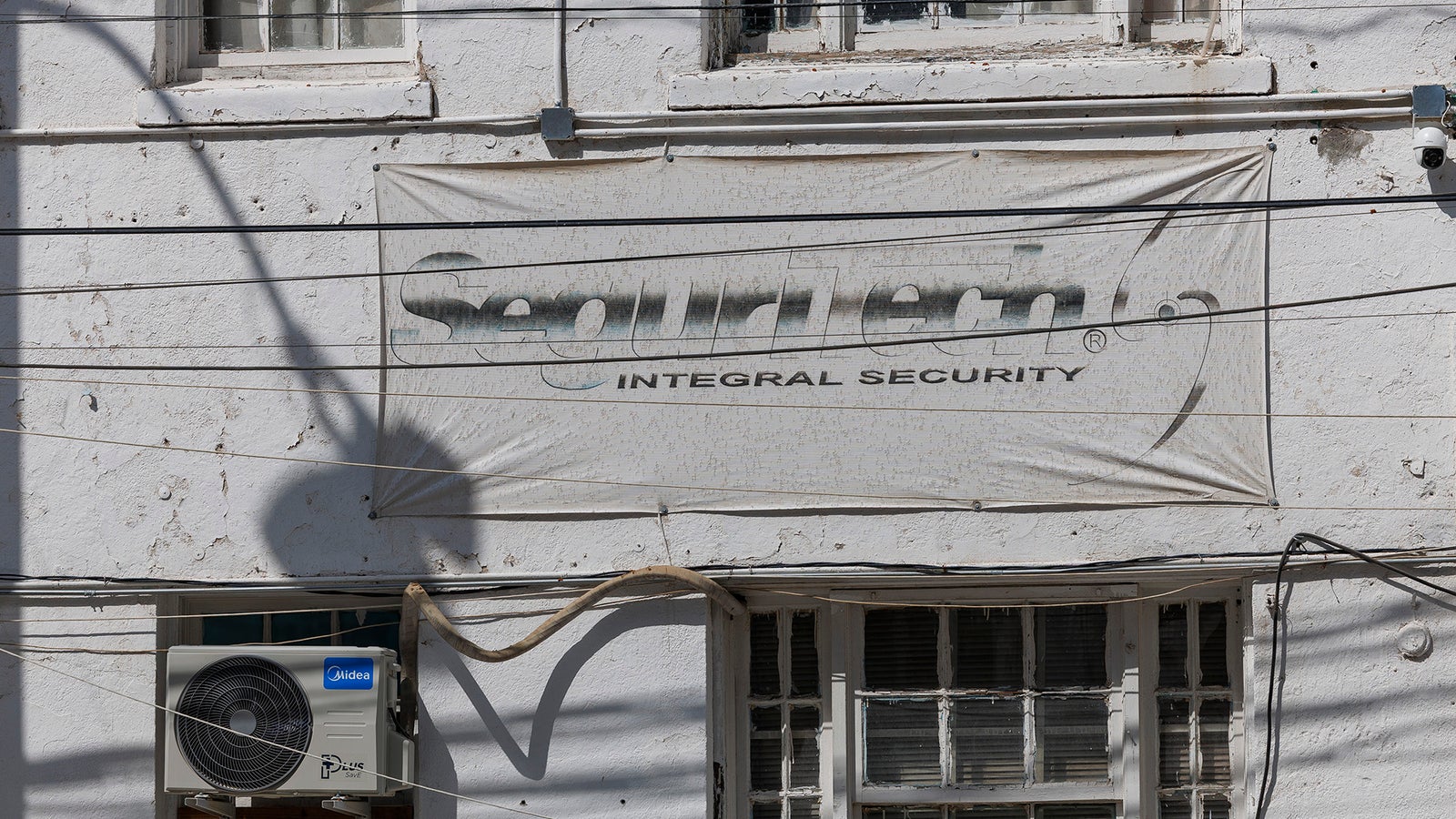
A Seguritch banner at the the Centinela Tower construction site in Ciudad Juarez in October 2025. -
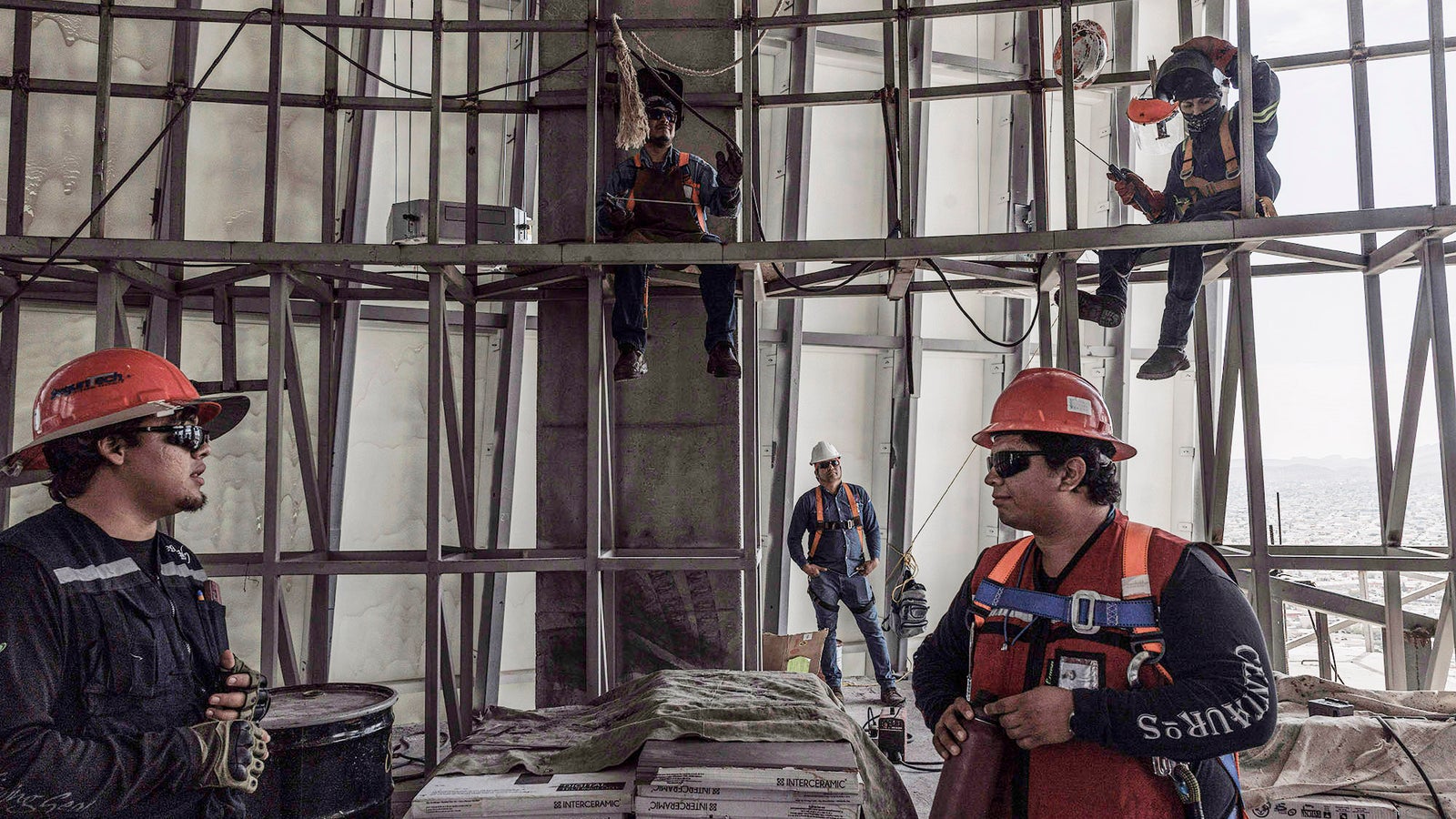
Construction workers at the Centinela Tower in October 2025.
Adriana Zehbrauskas for Rest of World
Last year, a Seguritech contract to provide technology to Mexico’s customs agency was terminated for “excessive costs,” Mexican outlets reported. In a statement to the Mexican newspaper Reforma, the company defended its work, saying it complied with all of the contract’s requirements and maintains the “highest standards for the quality of our maintenance services.”
In June 2025, the news outlet PopLab, an independent Mexican investigative publication, reported that years after Seguritech received a contract from the state of Guanajuato to provide technology for the state’s surveillance and security system, the governor moved into an expensive home in Texas after he retired. The home was registered to a former Seguritech executive. Critics of the former governor called for an investigation into the possible quid pro quo. The current state government, represented by the same political party, closed the investigation this January, claiming there was no conflict of interest.
“This needs to be cleared up,” Mexican President Claudia Sheinbaum said during a press briefing on the matter last July. “The point here is that it is a contract that the ex-governor made with a company. And he presumably lives in one of the company’s homes in the United States. If that is proven to be true, well, that is corruption.”
Grupo Seguritech told Rest of World and Type Investigations that its work with Guanajuato is “one of the most significant projects in our history,” and that state and federal auditors had reviewed the contracts repeatedly and found no evidence of impropriety. The company said it has always upheld its contractual commitments.
“In 30 years of existence, Grupo Seguritech has complied 100% with all its contractual responsibilities and has never faced any lawsuits or criminal sanctions,” the company said.
Today, even as it has secured its position as a leader of Mexico’s security tech industry, Grupo Seguritech is looking to expand its operations far beyond its home country.
In 2017, it began work across Latin America, registering a subsidiary in Colombia called Seguritech Colombia S.A.S., government records show. Four years later, the firm signed a contract worth nearly $56 billion Colombian pesos ($14.4 million) with Colombia’s National Roads Institute to establish surveillance infrastructure along major highways, according to a company press release and a copy of the contract.
In 2020, Grupo Seguritech expanded to Brazil, registering the subsidiary Seguritech Brasil, records show.
In 2019, Seguritech came under scrutiny in El Salvador, after it reportedly flew out a top minister from President Nayib Bukele’s government to Mexico City in an attempt to establish a contract with the Salvadoran government. El Faro, a major Salvadoran investigative outlet, reported that the flight was paid for by the company. In response to El Faro, Seguritech denied having any contracts in El Salvador. “We have not considered participating, nor are we participating, in any biddings in El Salvador,” the company said at the time.
A 2021 press release by the American multinational tech firm Oracle, highlighting Seguritech’s use of the company’s computing infrastructure, suggested that Seguritech has been active in El Salvador, Ecuador, China, and Israel. This could not be independently confirmed, however,and it is unclear what types of services Seguritech may be providing in these countries. Oracle did not respond to a request for comment.
The company’s most significant presence outside of Mexico appears to be in the United States. Seguritech-affiliated companies have registered at least four businesses in Texas and Delaware since 2016, according to incorporation records reviewed by Rest of World and Type Investigations.

Adriana Zehbrauskas for Rest of World
Just last year, Seguritech set up two new entities in the U.S. The Texas-based Seguritech & Condor Solutions LLC offers surveillance and security technology, telecommunication services, and “design and construction of critical infrastructure,” according to its promotional materials, which feature images of a Seguritech C5 command center in Mexico. The company also offers to help American executives travel safely through Mexico and navigate the bureaucratic world of Mexican permits. Seguritech International LLC was incorporated in Delaware but operates in Texas, records show.
As the company works to shore up business in the U.S., its work in Chihuahua reaches across both sides of the border. The Plataforma Centinela system is explicitly designed as a crossborder surveillance operation. Chihuahua’s agreement with Texas notes, for instance, that the platform allows police to track vehicles from Juárez until they cross into the U.S. “We are willing to share that information with Texas State authorities and commercial partners directly,” the document states.
Neither Texas nor Chihuahua authorities have spoken publicly about the collaboration. In response to a public records request, the state of Chihuahua shared only limited information confirming a Seguritech contract with the Mexican state’s Secretariat of Finance, without mentioning how much money the company was paid or which projects it worked on. Still, during the October visit to Ciudad Juárez, Mexican officials were eager to talk about their work with federal agencies in the United States.
In addition to confirming its operations in Mexico and Colombia, Seguritech told Rest of World and Type Investigations that it is, “in the process of actively expanding into the United States and South America.”
Luis Ángel Aguirre Rodriguez, the official in charge of Chihuahua’s special operations forces, works from a headquarters in Juárez. During an interview in October, with country music playing in the background, he spoke at length about his agency’s collaboration with U.S. border officials — and their use of Seguritech technology to aid their investigations.
A bespectacled man with a serious demeanor, Aguirre described an operation in which state police infiltrated a migrant camp in Ciudad Juárez and arrested two Venezuelan men, whom they alleged to be exploiting migrants at a camp in Juárez. After they dismantled the camp, the police placed the men’s information into the Centinela system. That information was shared with U.S. Border Patrol agents, who told the Chihuahua officials the men were gang members who had been previously arrested in Costa Rica. The operation, Aguirre said, showed the power of cross-border data sharing.
Chihuahua state officials also confirmed in October that some of their intelligence is shared with other U.S. agencies, including Customs and Border Protection, the FBI, the Drug Enforcement Administration, the ATF, and Immigration and Customs Enforcement. In one instance, they said, Mexican police shared data with U.S. Customs and Border Protection about an elderly man who had disappeared from his home in the city of Cuauhtémoc, leaving his family in a desperate search. The surveillance technology allowed them to provide the exact details of the man’s car to CBP. In less than 20 minutes, CBP agents were able to locate the man on the U.S. side of the border. Local police later helped him reunite with his family in Mexico.
The success stories were only possible thanks to Seguritech technology, Aguirre and his boss, the public security chief Loya, explained.
Adriana Zehbrauskas for Rest of World
“We had been doing an analysis for what was in the market — we were speaking with Chinese companies, we were looking at other solutions from other Mexican companies,” Loya said. “There were more advantages with Seguritech. They had more projects throughout Mexico.”
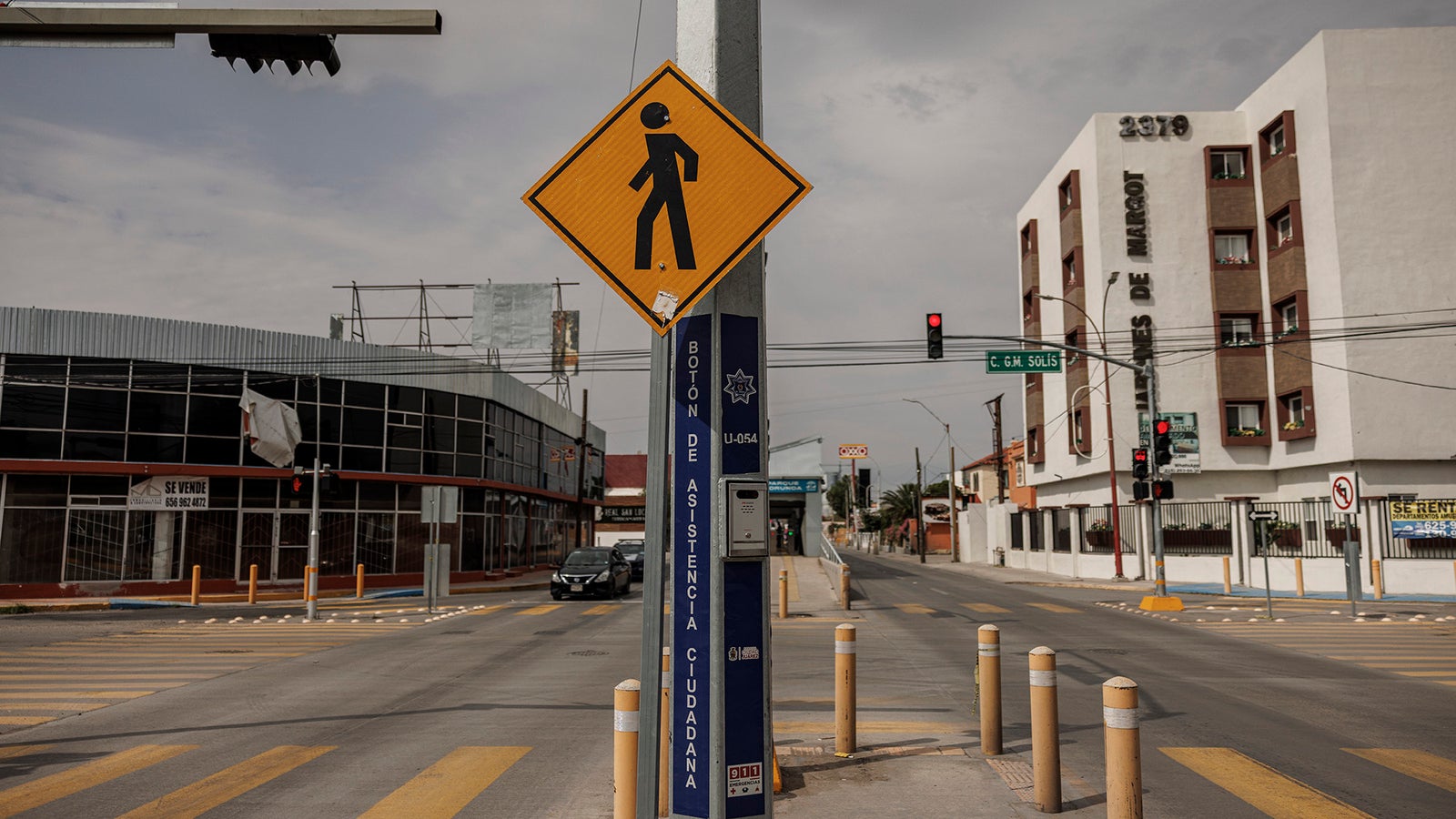
On a drive through Ciudad Juárez, officials pointed out Seguritech technology on the city streets: license plate readers, stationary cameras, and panic buttons abound.
That week, government officials were investigating the killing of state police forces during a shoot-out with alleged criminal groups in a remote mountain range. During a steak lunch at a local restaurant, one official ran out to take a call. He returned to the dimly lit room with an update on the case. The suspects had been caught thanks to high-tech drones that had tracked their movements in the days following the shooting.
It was more proof, the security officials said, that Seguritech’s technology was working.