



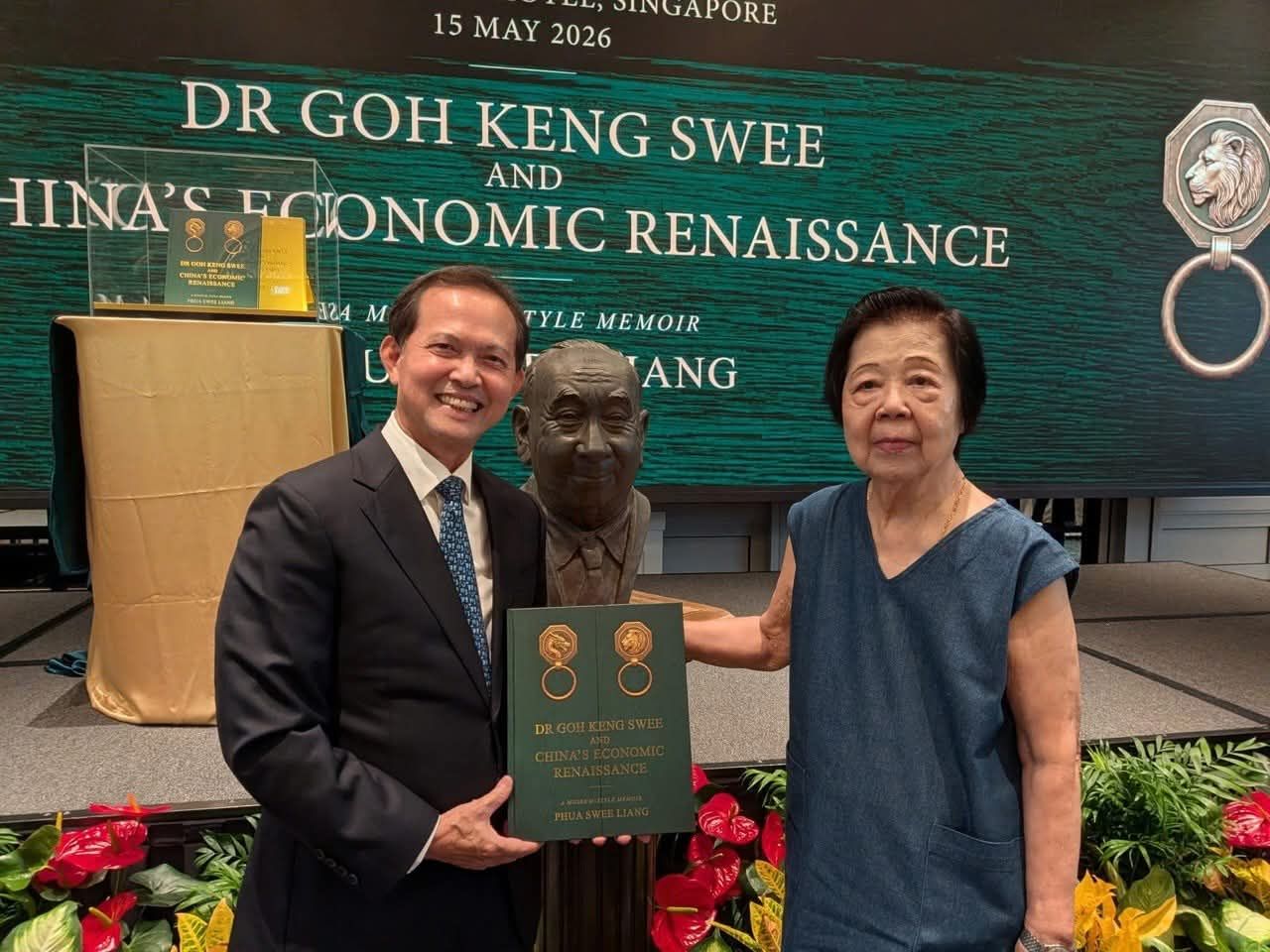
SINGAPORE: Progress Singapore Party (PSP) secretary-general Leong Mun Wai has revealed that he was invited by Dr Phua Swee Liang, the widow of late elder statesman Dr Goh Keng Swee, to attend the launch of her new book, Dr Goh Keng Swee and China’s Economic Renaissance.
Describing the invitation as a “great honour,” Mr Leong paid tribute to Dr Goh, whom he called one of his “greatest heroes and inspirations.”
“He was not only a founding father of Singapore and an outstanding political leader. He was also a rare strategist and nation-builder who could turn bold ideas into reality,” Mr Leong said.
“Many politicians are good at rallying support, or sometimes, merely playing political games, but far fewer have the ability to design and execute visionary economic plans that can fundamentally transform a nation. Dr Goh was one of those rare leaders.”
Mr Leong also reflected on what he described as the importance of strong leadership in safeguarding Singapore’s future, saying he believed the “Singaporean Core” would be in a stronger position today if leaders like Dr Goh were still around.
Sharing that Dr Goh is “deeply missed,” Mr Leong said, “This book launch is therefore not just an occasion to remember history. It is also an opportunity to reflect on the kind of leadership Singapore needs for the future.”
He added, “May future generations of Singaporeans continue to learn from Dr Goh’s legacy, honour his contributions, and never forget the immense role he played in building modern Singapore.”
Widely regarded as one of the principal architects of modern Singapore, Dr Goh played a pivotal role in shaping the republic’s economy, defence capabilities and public institutions during the country’s early decades after independence.
Born in Malacca in 1918, he was among the founding members of the People’s Action Party (PAP) and held several major ministerial appointments after Singapore achieved self-government and later independence. Over the years, he earned a reputation as one of Singapore’s foremost policy thinkers and strategists, helping steer the country through periods of economic uncertainty, political fragility and regional instability.
As Singapore’s first finance minister, Dr Goh introduced policies that laid the groundwork for the nation’s industrialisation and rapid economic development. He was also central to building Singapore’s defence system following the republic’s sudden separation from Malaysia in 1965, at a time when the young nation faced significant security concerns.
Historians and political observers have frequently credited him with helping secure Singapore’s sovereignty during one of the most precarious chapters in Southeast Asian history.
Beyond domestic policy, Dr Goh also played a significant role in Singapore’s long-term relationship with China. Although formal diplomatic ties between Singapore and China were only established in 1990, after Dr Goh had stepped away from frontline politics, he was recognised as one of the Singapore leaders who understood early the strategic importance of engaging Beijing.
Throughout the 1970s and 1980s, Singapore maintained a cautious but steadily developing relationship with China amid Cold War tensions and wider regional concerns about communist influence. Dr Goh supported a pragmatic approach towards engagement while balancing Singapore’s relationships with Western countries and neighbouring states.
Analysts have since noted that Singapore’s calibrated approach during that period helped lay the foundation for the close bilateral ties that later emerged between the two countries.
After Dr Goh retired from politics in 1984, then Chinese leader Deng Xiaoping sent a high-level delegation to Singapore to invite Dr Goh to advise China’s newly established special economic zones.
Dr Goh developed close ties with Deng as well as other senior Chinese leaders of the era, including Zhao Ziyang and Gu Mu. These relationships and interactions form a major part of Dr Phua’s newly launched book.
Among the photographs featured in the publication is an image of Dr Goh with current Chinese President Xi Jinping, who at the time was serving in a provincial leadership position in Fuzhou.
Dr Phua described the 244-page publication as a “museum-style memoir,” assembled from photographs, gifts, travel itineraries, and personal records from Dr Goh’s years advising China.
She wrote in the book’s preface that major historical turning points often unfold quietly. “It is these moments that I feel compelled to preserve, for without them the larger narrative remains incomplete,” she said.