



The rise of social media has opened the door to electoral campaigning that takes the form of ugly and dirty accusations, provocation and personal attacks.
Language like this has the power to capture attention, mobilise or suppress supporters, and spark debate. It can also be very divisive.
This is true in all countries. It is relevant in Nigeria too, where concerns about misinformation, intimidation and negative political rhetoric are top of mind as the country prepares for its 2027 general election.
In early October 2026 the National Peace Committee, a non-governmental initiative promoting peaceful elections and democratic stability, reported 60 election-related incidents. They were recorded between August 19 and September 19 on its Election Security Information Hub platform. Nearly half related to misinformation and disinformation messaging.
I am a political scientist whose research examines how negative campaigning and political communication shape voters’ judgments, electoral trust and democratic attitudes in multi-ethnic societies.
How negative messages erodes election trust
Politicians and political parties have several reasons to attack their opponents. Negative messages can attract attention, distinguish candidates, and give voters reasons to question an opponent’s qualifications for office. But attracting attention does not necessarily translate into winning support.
Research shows that negative campaign messages carry several costs. Studies suggest that it can discourage voter participation, depending on when negative messages are used during a campaign. Negative attacks can also damage public perceptions of both the politician making the attack and the opponent being targeted. Sometimes they benefit a third candidate who is not involved in the exchange.
The costs of negative campaigning may extend beyond the politicians who use it. In a recent paper I looked at whether negative campaign messages erode trust in the electoral system by fostering cynicism and undermining confidence in politicians. I also looked at whether strong and autonomous electoral institutions made a difference to these effects.
I drew on Afrobarometer survey data from 18 countries across three rounds, expert assessments of negative campaign coverage from the Negative Campaigning Comparative Expert Survey, and measures of the autonomy of electoral institutions from Varieties of Democracy.
My findings show that the relationship between negative campaign coverage and trust in elections depends partly on the independence of electoral bodies. Negative coverage is more damaging where these institutions have less autonomy. This matters because voters assess not only the claims made during campaigns but also whether the institutions overseeing elections can be trusted to act independently and fairly.
What this means for Nigeria’s 2027 election
In Nigeria, the findings of my study highlight the importance of the independence and credibility of the Independent National Electoral Commission in maintaining public trust in elections. As AI makes it easier to produce and circulate negative and misleading content, clear communication and accountability become important. AI can make it easier to produce and spread misleading claims but its effects on public confidence will also depend on how electoral institutions respond.
My research across 18 African countries shows that negative campaign coverage is more strongly associated with lower trust in elections where electoral management bodies have less autonomy. For Nigeria, this underscores the importance of protecting the independence of the electoral commission, making electoral procedures transparent and communicating decisions clearly and promptly.
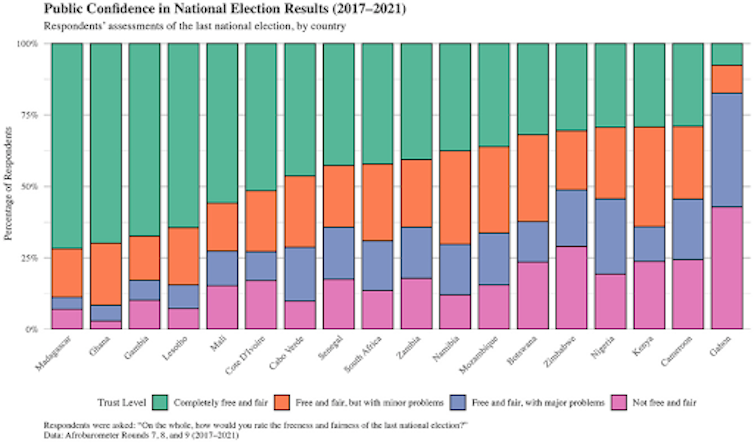
As the 2027 campaign unfolds, politicians, journalists and voters also all have a role in shaping political campaigns. For politicians, negative campaigning is not a guaranteed way to win public support.
Personal, performance and identity-based appeals may attract attention, but they can also damage candidates’ credibility. Focusing on policies and governing records gives voters a clearer basis for comparing candidates.
For journalists, the challenge is to verify claims, question unsupported allegations and give voters meaningful information about candidates’ policies and records. For voters, the task is to look beyond the accusation and ask: what evidence supports this claim? Is it relevant to the candidate’s record or plans, or is it simply intended to stir hostility towards an opponent or a particular group? Negative campaigning does not automatically undermine democracy.
Nigeria’s 2027 election presents an opportunity to examine how campaign messages shape voters’ judgments. The key question is whether these attacks help voters make informed choices or leave them more distrustful of politicians and the democratic process.