



The Marine Environment Protection Committee’s 85th session, known as MEPC 85, will be followed by a separate session provisionally scheduled for 4 December to consider adopting the proposed Net-Zero Framework (NZF). Approved in April 2025, the framework’s adoption was delayed for a year following opposition from the United States and other countries.
The framework combines limits on the greenhouse gas intensity of shipping fuels with emissions pricing linked to compliance. It aims to tackle a sector responsible for roughly 3 per cent of global greenhouse gas emissions.
Governments are now weighing whether to retain its architecture or make further concessions.
Liberia, the world’s largest flag state, has submitted a proposal that builds on an earlier joint text with Panama and Argentina. According to the Clean Shipping Coalition, it would allow ships to continue using conventional fuels if cleaner alternatives are too costly or unavailable, and drop mandatory payments into a Net Zero Fund.
Japan, one of the world’s biggest shipbuilders, has proposed softer fuel-intensity targets in the framework’s early years. It has also proposed letting shipowners direct compliance payments to projects of their choice instead of paying into a central fund.
“
Delaying the agreed carbon intensity targets, or removing the pricing element altogether, would deny countries the finance through the compliance revenue that they need for this transition.
Em Fenton, Senior Director of Climate Diplomacy, Opportunity Green
The NZF already represented a compromise for climate-vulnerable countries and small island states, said Em Fenton, Senior Director of Climate Diplomacy at nonprofit Opportunity Green. She warned that proposals from Japan, Liberia, Panama and others risked weakening both its environmental safeguards and its ability to deliver a fair transition.
“Delaying the agreed carbon intensity targets, or removing the pricing element altogether, would deny countries the finance through the compliance revenue that they need for this transition”, said Fenton in a press briefing on Tuesday.
The framework could generate up to US$15 billion annually, she said. That is potential revenue for the framework as a whole, but the precise amount for developing states is yet to be negotiated, she told Eco-Business. According to the IMO, the proceeds would also reward low-emission ships and finance training, technology transfer and other transition initiatives.
Fenton acknowledged concerns about disproportionate trade impacts on remote economies. But she argued that abandoning the framework would prolong fossil fuel dependence while climate damage mounts.
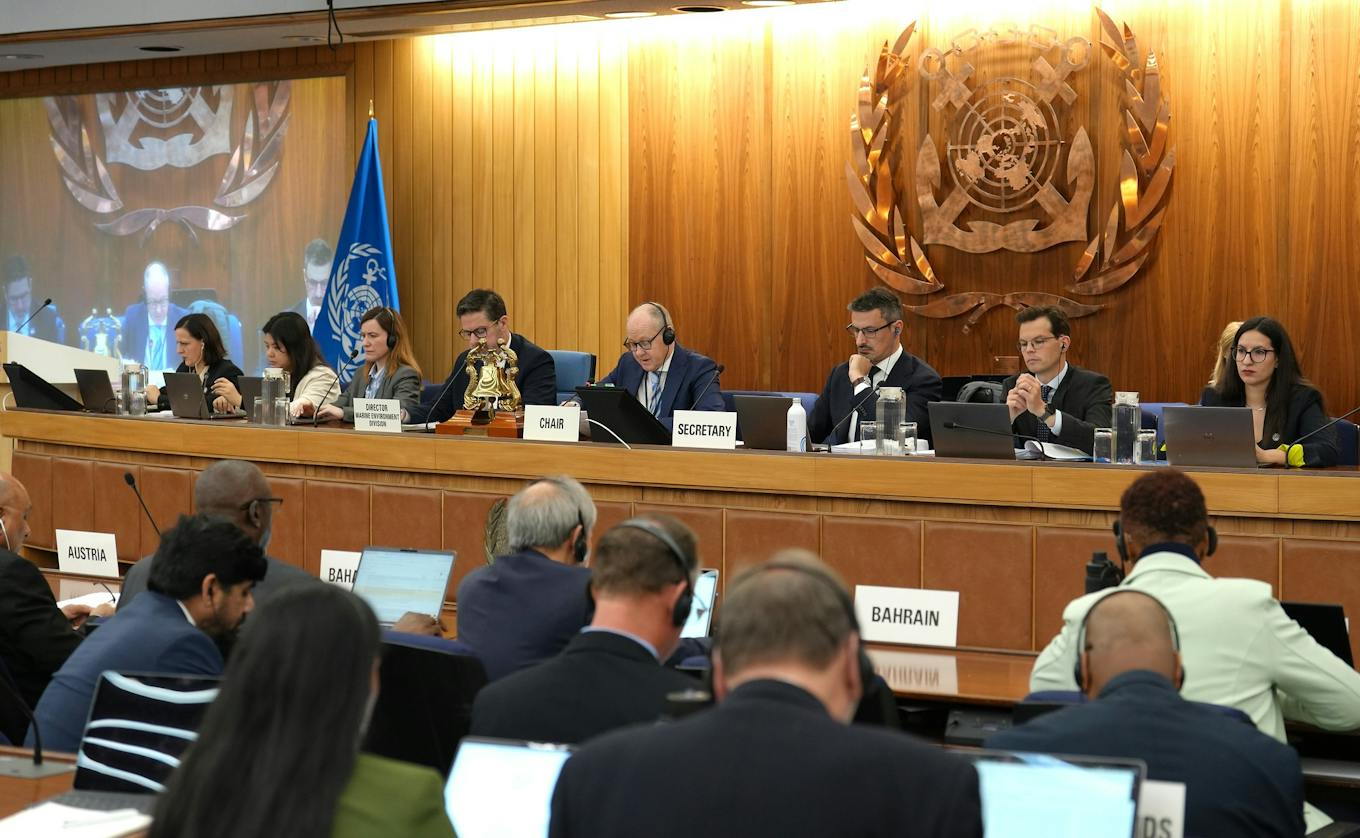
Negotiators opened the intersessional talks at the International Maritime Organization (IMO) in London, held from 23 to 27 November 2026. The Marine Environment Protection Committee’s 85th session (MEPC 85) begins on 30 November. A resumed extraordinary session to consider adopting the Net-Zero Framework is provisionally scheduled for 4 December. Image: IMO
Opportunity Green’s Director of Analytics, Tom Grylls, said the cost of that damage was missing from much of the debate, which had focused on the expense of regulating shipping emissions, not the cost of leaving them unchecked.
Citing research by Zero Carbon Analytics, he said international shipping emissions had already caused almost US$1 trillion in climate damages. That study found that China, the world’s biggest shipbuilder, and the United States, a major global trade destination and cargo market, suffered the largest losses in absolute terms, while low-income countries and countries in the Middle East faced some of the heaviest burdens relative to the size of their economies.
“By most metrics, the cost of doing nothing will be more expensive than the cost of implementing a Net-Zero Framework,” Grylls said.
Based on analysis released by Opportunity Green this month, he put the NZF’s cost at between 0.16 and 0.19 per cent of global GDP in 2050. The upper figure is deliberately pessimistic, the report said, and excludes economic opportunities such as new green industries.
Even after scaling climate damages down to reflect shipping’s roughly 3 per cent share of global emissions, most studies estimate the economic impacts of climate change in 2050 to exceed that cost, according to the report. Grylls acknowledged the methodological challenges of making such comparisons.
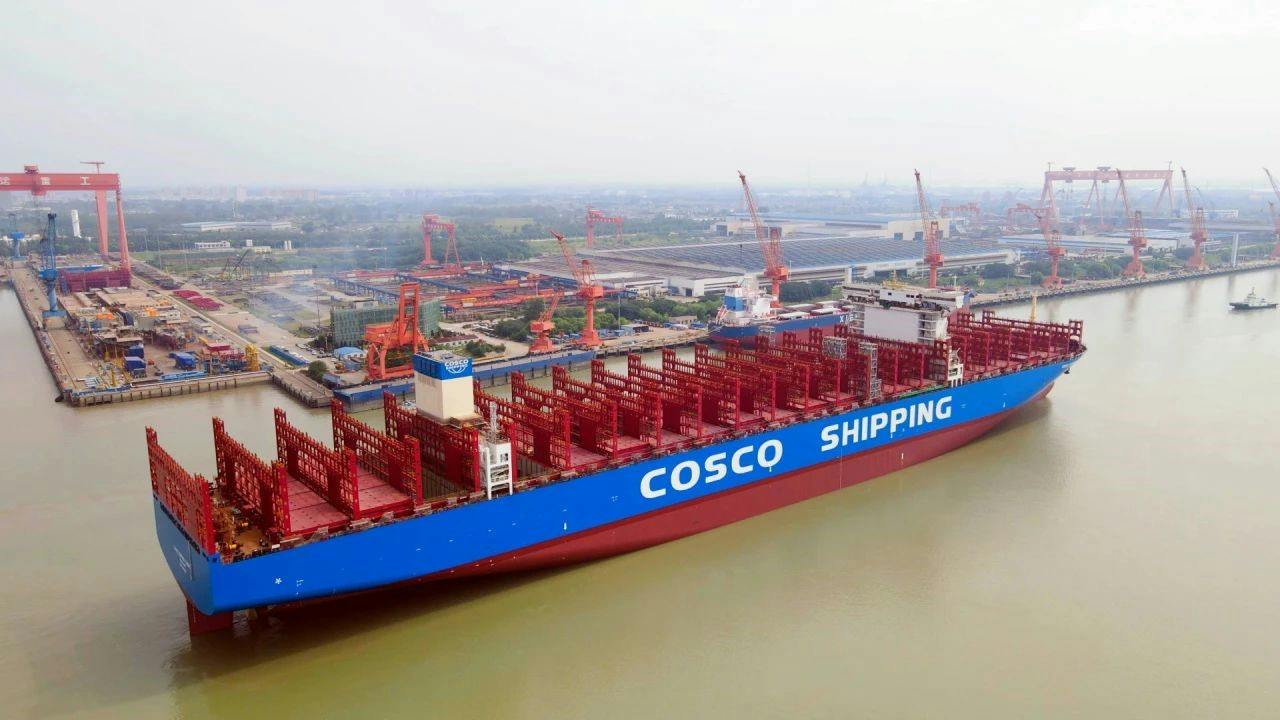
China Ocean Shipping (COSCO), a state-owned conglomerate and the fourth-largest maritime company in the world, only plans to meet its carbon neutrality target by 2060. However, it has made significant commitments on methanol-capable vessels in the past two years. Image: COSCO
Asia’s shipbuilders could hold the key to a compromise
The costs of weaker rules would not fall only on poorer nations, Fenton told Eco-Business. “Weaker regulation has impacts globally,” she said.
That matters for Asia, home to the yards that will build the next generation of ships. China won 81.8 per cent of new merchant ship orders worldwide in the first nine months of 2026.
Asian governments have shifted positions over the past year. Japan and South Korea, two other leading shipbuilders, backed a global levy on shipping emissions in early 2025 but abstained in October’s vote to postpone adoption. China opposed the levy at the time, arguing it would raise costs and hurt exports from developing countries. It later supported the framework approved in April 2025, then backed the postponement in that same year.
Asked what could bring Japan back into active support, Fenton pointed to two areas for compromise. One is a softer early fuel-intensity trajectory that still reaches net zero by 2050, which many states favour. The other is how compliance revenues are governed. A “facility” proposed by Brazil, instead of a new fund, could address concerns about the IMO’s capacity to manage a fund, she said.
Fenton said that China had opposed an IMO Net-Zero Fund, favouring other financial arrangements, and had shown interest in a multiplier rewarding future fuels and technologies.
In February 2025, China, Indonesia and Brazil opposed a levy on all shipping emissions, arguing it would be costly, reduce exports from developing countries and affect food security. Large Chinese shipping companies have pledged to reach net-zero by 2060, rather than mid-century, in line with China’s goal of carbon neutrality by 2060.