




When SpaceX’s giant Starship rocket exploded over the Caribbean last year, the internet lit up with videos from airline passengers, island tourists and locals showing flaming debris shooting across the sky. Even some airline pilots recorded the fiery aftermath as planes scrambled to move out of its path.
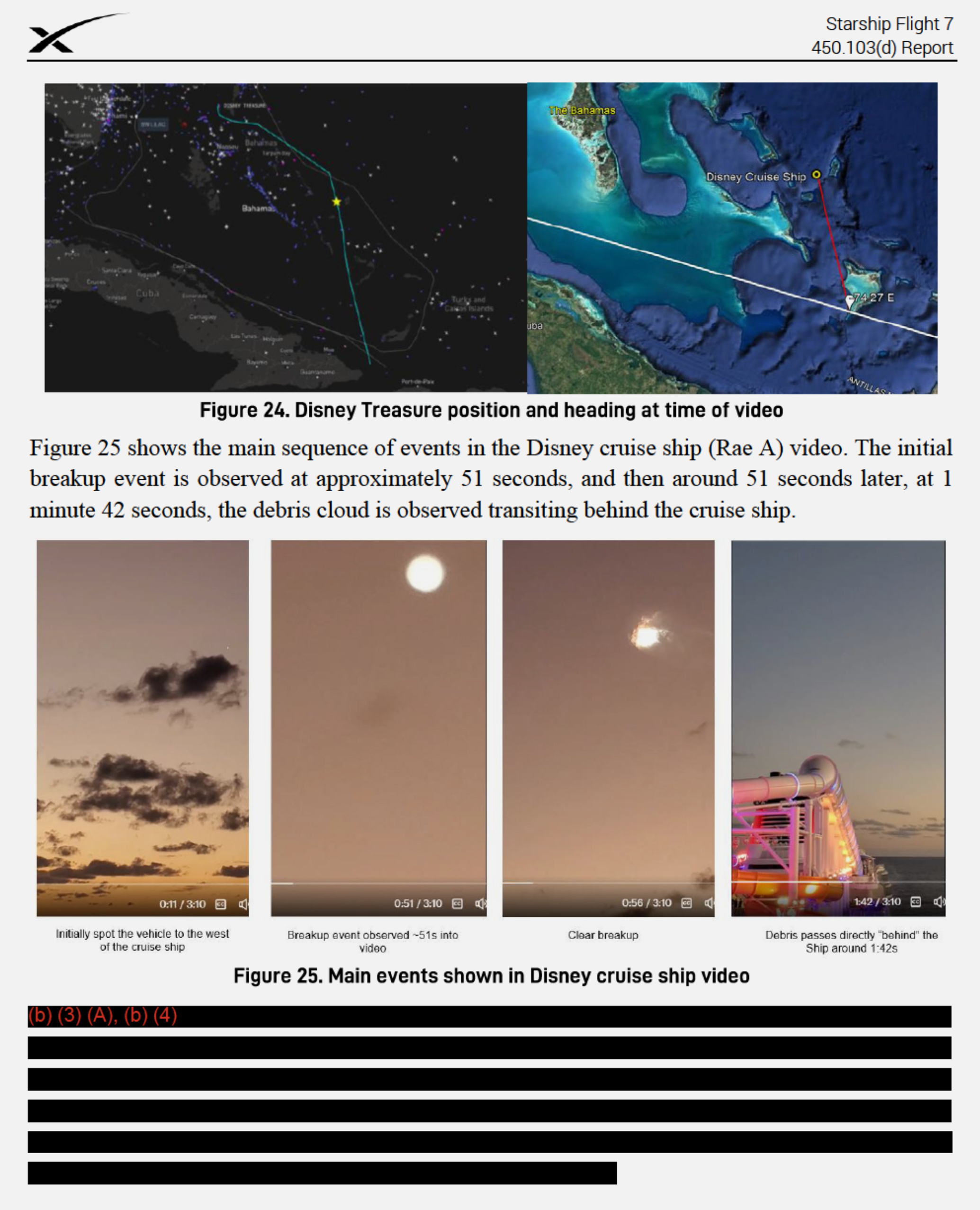
Some of those videos of Starship’s seventh test flight — including ones taken from Disney and Royal Caribbean cruise ships and a Club Med resort — went on to play a role in the company’s efforts to count and track pieces of debris after the explosion, a report obtained by ProPublica says.
The report — obtained by ProPublica from the Federal Aviation Administration through a freedom of information request — shows video captured a fireball, then a shower of sparkling debris in the sky moments after the explosion. It includes maps pinpointing where the images were shot, which helped the company understand how debris tumbled to earth after the blast.
“At 1 minute 42 seconds, the debris cloud is observed transiting behind the cruise ship,” says the report, which SpaceX provided the FAA two weeks after the so-called mishap.
Such reports are required by federal rules in the days after a rocket failure and are supposed to describe what happened and where hazardous debris landed. The information is key for the FAA’s efforts to keep busy air traffic corridors safe at a time of rapid growth in the commercial space industry as companies like SpaceX develop and test rockets that they hope will eventually reach the moon and Mars.
During launches, the FAA preventively closes airspace. It has also been forced to clear areas quickly after test flights of massive spacecraft went wrong.
Starship flights 7 and 8 broke apart last year and scattered debris above airline traffic over the Caribbean. Before Flight 9, the FAA moved to greatly increase the size of the airspace it walled off pre-launch.
The agency defined its no-fly zones, which are closed to airplane traffic during a launch, and its so-called debris response areas, which are closed after a mishap, using information from SpaceX and modeling from Space Force, the branch of the military that deals with the nation’s space interests, to predict where debris might fall.
Nearly doubling those pre-launch no-fly zones “only makes sense if the prior margin was judged inadequate rather than just unlucky,” said Moriba Jah, a professor of aerospace engineering at the University of Texas at Austin.
Earlier this year, the FAA issued a warning that rocket launches could “significantly reduce safety” for airplanes, after ProPublica reported that 21 planes appeared to make sudden turns to exit or avoid an FAA-designated emergency no-fly zone in the minutes after the Flight 7 explosion. Such disruptions are likely to become more frequent. SpaceX is seeking to launch Starship up to 76 times a year from Cape Canaveral, Florida.
The FAA provided ProPublica the reports on Starship flights 7, 8 and 9 — all of which involved mishaps — after we requested them under the Freedom of Information Act. The FAA redacted the vast majority of all three reports, citing, among other things, exemptions in the law that protect confidential business information from disclosure. The blackouts were, in part, a reflection of SpaceX’s objections; FAA allowed the company to challenge the release of information it deemed proprietary.
The FAA refused to release information that would show SpaceX’s estimates of where debris fell during the three rocket failures. It’s unclear what the agency or the company knows about how close any airplanes came to falling debris.
“Withholding the underlying debris estimates makes it impossible for anyone outside SpaceX and FAA to check whether that pattern is improving or repeating,” Jah said. “Given a regulator already revised its own safety margins once, the public has a real interest in seeing the data behind both the old margin and the new one.”
The unredacted part of the report did not show whether the debris from the Flight 7 explosion fell where SpaceX and the FAA expected it to. But the references to Disney and Club Med guests’ video suggest SpaceX did not have a full picture of where the debris landed without them. “I would read it as evidence their own tracking did not carry cleanly through the debris cloud phase, so they used the public to fill the gap,” Jah said.
SpaceX did not respond to requests for comment. The company has said that it learns from its mistakes and that each test improves Starship’s reliability. Last December, it said on X that “SpaceX is committed to responsibly using airspace during launches and reentries, prioritizing public safety to protect people on the ground, at sea, and in the air.”
The FAA did not respond to a request for comment, nor did Disney, Royal Caribbean or Club Med.
Ron Madler, a professor of aerospace engineering at Embry-Riddle Aeronautical University, said the videos could help SpaceX “either confirm their breakup models or possibly to improve them.”
The mishap report for Flight 8, which rained debris near the Bahamas, said before that flight’s explosive failure, SpaceX did not have the proper “test stand” that was capable of testing the rocket’s engines “for a full Starship mission.” The remainder of the page was blacked out, so it was unclear from the report whether the company had found another way to fully test the engines before launch.
Flights 7 and 8 both involved the same model. Both ended in engine-related failures.
Text in the report around the statement about the test stand was redacted. But Jah said it “means some part of the engine’s actual flight behavior was being verified for the first time in flight rather than on the ground.”
John Crassidis, an aerospace engineering professor at the University at Buffalo, said launching before having a fully capable test stand was likely “a cost-saving decision.” In building rockets, he said, SpaceX CEO Elon Musk has used both the old approach of launching and then fixing any issues that arise, and the newer approach of running simulations and ground tests first to head off problems.
“Doing too much of the old school can lead to too many mishaps and cost overruns,” he said. “Doing too much of the new school leads to long times to get things done and a reduction in flexibility.”