



As the school year winds down and families start planning summer activities, possibly anticipating those inevitable rainy days, I have found myself returning to a simple but powerful joy: sharing museum experiences with young children.
As a professor and a lifelong student of early childhood education, my research has centred on how young children engage with the world around them.
With my rich experiences — including discussions about early childhood classrooms with teacher candidates and now as a grandmother — I am continually struck by the depth with which children respond to and appreciate any art form, often in surprising ways.
Museums and galleries are perfect environments that provide unique opportunities where children and adults can explore side by side. When thoughtfully engaged, they can foster the exchange of meaningful insights across generations.
Museums are credited widely as compelling places for learning that indeed may extend well beyond a classroom.
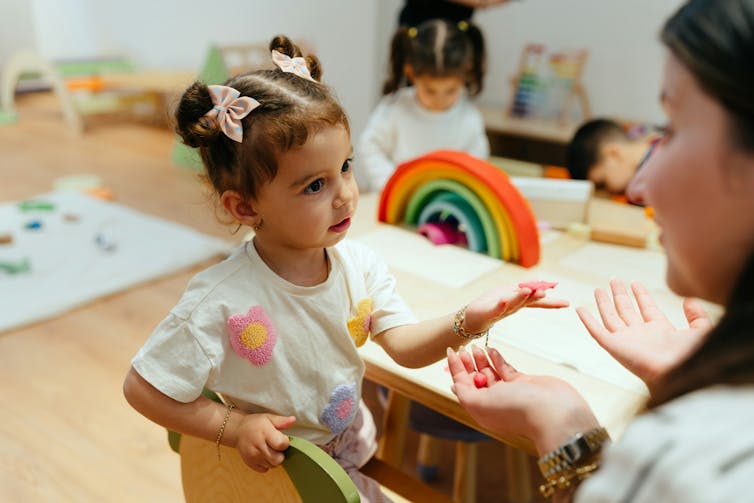
Along with shared experiences with parents, peers or educators, dialogue and guided discussion that help make thinking visible can help children make meaning from what they see and do every day.
(Yunus Tug/Unsplash)
Helping children find connections and meaning
With that in mind, nothing is more powerful than learning from children themselves. Recently, my four-year-old grandson was jumping on my bed (something this grandmother allows) during a visit. As he bounced around holding my hands with joy, he suddenly stopped in front of a framed charcoal drawing hanging above my bed.
It was of a middle-aged woman seated pensively on a wooden chair as she looked down at the ground. He paused, turned to me and said, “Why is she so sad?”
I was taken aback by his spontaneous question. Instead of offering him an immediate reason, I asked him why he thought she looked “so sad.” After studying the sketch, he replied, she looked sad because her body was “slumpy and her face was just not happy!”
I could see he was convinced by his own interpretation. Still, rather than agreeing or correcting him, I gently asked again, “Why do you think she is so sad?” He responded straightforwardly, “Maybe because she is lonely and there is no one else in the picture.” He then continued to jump.
It was a beautiful moment. What struck me was not just his spontaneous observation, but the connection he made between visual expression and emotional meaning.
Adult roles as facilitators and guides
(Tommao Wang/Unsplash)
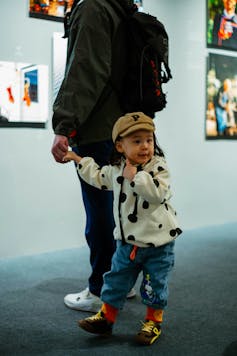
Through conversations about artwork, children are able to articulate their interpretations, make connections to prior experiences and co-construct meaning with adults.
This process reflects children’s meaning-making through art observations and principles of back and forth or “serve-and-return” interactions.
Such exchanges support children’s social, emotional, cognitive and language development.
In the exchange with my grandson, there was a lesson in perception and a reminder of how children naturally search to understand the inner lives of others and to connect. When we are attentive to their search, we also deepen our own appreciation of art and humanity.
With these understandings of children’s capabilities to express their interests, adults’ can grab the opportunities to engage with children at a museum and take on their role as facilitators and guides.
Children’s own interpretations
Visiting a museum can support curiosity, communication and deep understandings through active exploration.
Research highlights the importance of inter-generational learning in museums, particularly when family visits are involved. Adult family members can play a significant role in guiding how children interpret exhibits, often turning museum trips into collaborative meaning-making moments.
Studies in museum education show that children learn through active engagement with objects, environments and people — particularly when they are encouraged to observe, ask questions and interact with exhibits.
Research grounded in sociocultural learning theory emphasizes that museum learning is rarely individual; it unfolds in dialogue and conversation as children find language to express themselves.
(AP Photo/Sophie Bates)
Not just transmitting facts
Rather than simply transmitting facts, families can be connected in shared discovery — negotiating ideas, asking each other questions and building understandings between exhibits and everyday life.
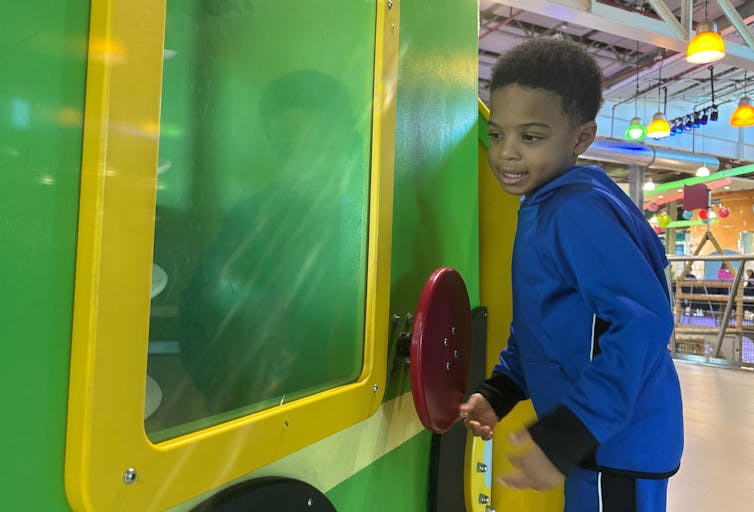
This is especially evident in children’s museums and science centres, where interactive displays are designed to invite play, experimentation and conversation across age groups.
These informal learning environments can support children’s cognitive and emotional development while strengthening family relationships through shared exploration and sheer pleasure.
Importantly, museums can offer the space for children and adults to interact dynamically. Adults can connect to children and guide them by encouraging active observation and linking exhibits to their personal experiences.
For example, at many science museums, families have opportunities to engage in hands-on activities where children and adults can experiment, build and explore scientific concepts together.
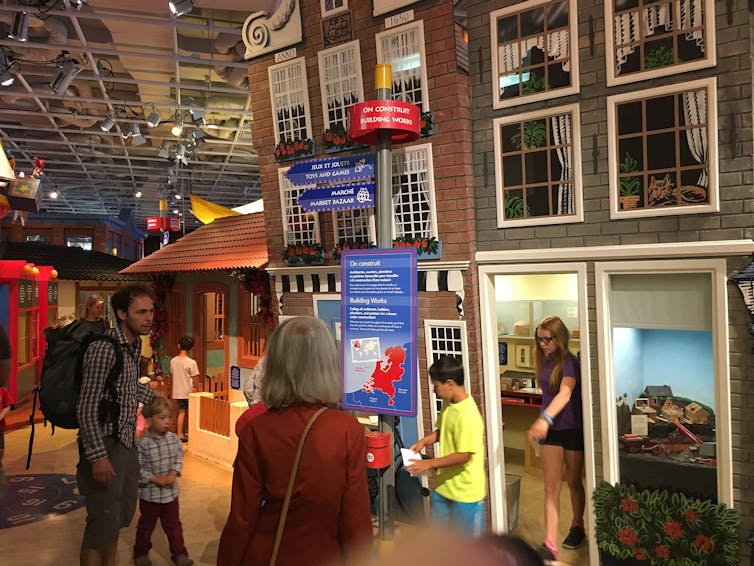
A parent might help a child test a simple machine or discuss why a structure stands or collapses, turning the visit into a collective problem-solving endeavour. At a history museum, exhibits may invite storytelling or imagining roles, allowing families to relate cultural knowledge or personal connections.
(Ross Dunn/Wikimedia), CC BY-SA
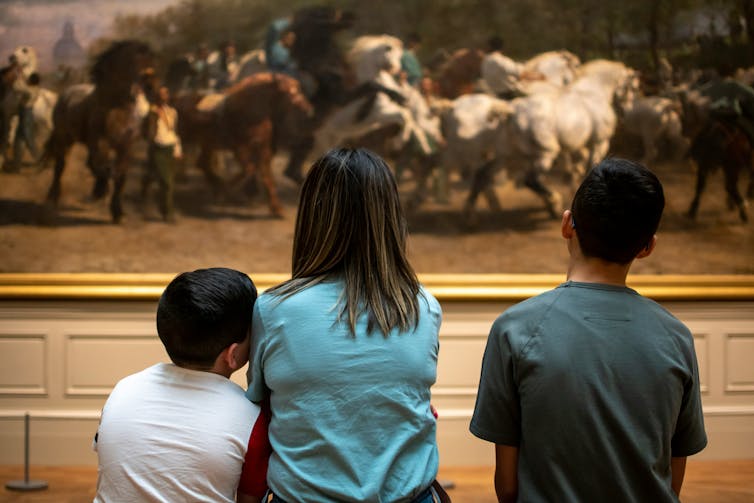
In a fine arts museum, families can interpret artworks together, discussing shapes, colours, emotions, context and possible meanings behind a painting or sculpture.
Consider open-ended questions such as:
“What do you notice?”
“What do you think is happening here?”
“Why do you think this was made this way?”
“How does this make you feel?”
Through such inquiries children can be encouraged to observe deeply, or imagine stories about what they see or even compare works of art to personal life.
(Gabriel Tovar/Unsplash)
Adults modelling curiosity
Respectfully, adults can model curiosity and ideas. These shared interactions not only deepen children’s understanding but also strengthen family bonds. Learning becomes a social, participatory process of conversation and joy.
Museums can provide opportunities for children and families to share experiences and conversation, something that is increasingly lost in a world dominated by screens and digital distraction.
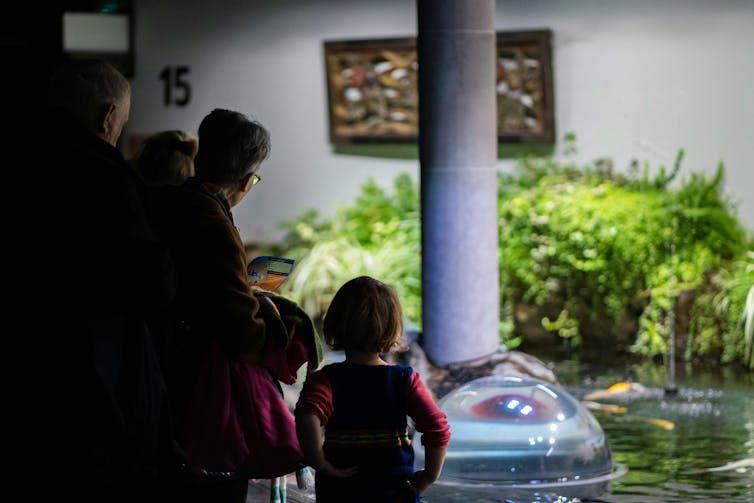
By stepping into museums, families can connect to create a place for children’s imagination, creativity and critical thinking to flourish. These can be the moments when children explore freely, express ideas, move their bodies and develop important skills that engagement with screens cannot replace.
(Tiqets/Unsplash)
Time passes quickly, and childhood is all too brief; the chances for adults to nurture curiosity and build lasting connections should not be overlooked. Museums are not just places to visit. Think of them as “environmental opportunities” that can support family relationships.
Many museums, science centres and galleries across Canada have interactive exhibits that are perfect for family visits. Check online tourism or museum listings.
While learning together, adults invest in a child’s development in ways that truly matter. Hold their hand, enter that world of discovery and enjoy.