



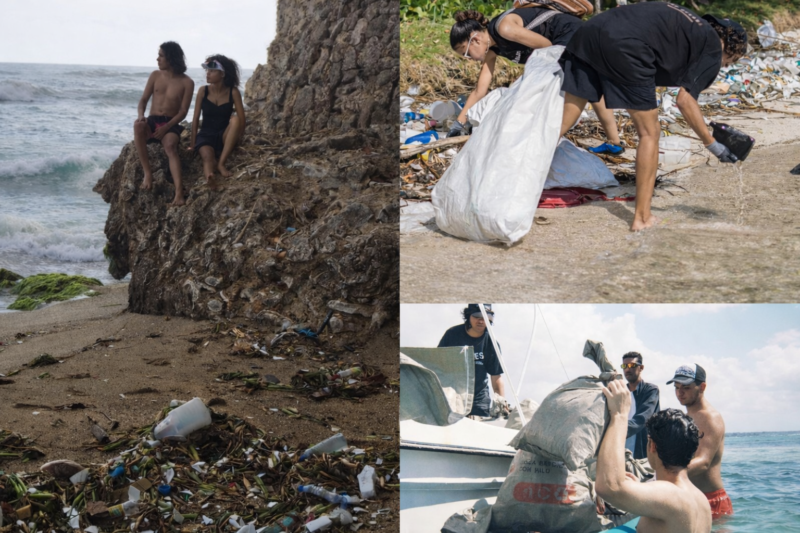
 Environmental activism efforts in the Dominican Republic. Photo via Raíz Climáctica, used with permission.
This article by Zahiris Priscila Francisco Martínez first appeared in Raíz Climáctica on February 14, 2026. An edited version is being republished on Global Voices under a content partnership agreement.
This story is part of Global Voices’ May 2026 Spotlight, “Global crisis, local solutions.” This series offers stories of resistance and successful climate action, insight into how communities in the Global South are fighting back against the crisis, analysis of what this might mean for future generations, and more. You can support this coverage by donating here.
The Dominican Republic closed 2025 with an historic record of 11,676,901 visitors, a figure announced by authorities and confirmed in official reports that say it reflects sustained growth in the tourism sector, as well as increased air and maritime connectivity. The country’s participation in the International Tourism Fair (FITUR) in January 2026 echoed these claims: negotiations and agreements worth more than USD 13.37 billion are expected to expand the hotel supply with nearly 10,000 new rooms in the coming years, and, according to consolidated reports from the DR’s tourism intelligence system, the national average hotel occupancy rate in 2025 exceeded 71 percent.
That narrative of prosperity, however, conceals the less visible but more urgent issue of environmental pressure on coasts, rivers, and reefs. With more than 1,600 kilometers (994 miles) of coastline, including beaches like Punta Cana, Bávaro, Saona Island, Bayahibe, and Bahía de las Águilas, the relationship between growth and waste has become tangible in ways that some experts had already predicted. A 2023 market study led by Intellectual Capital Exchange (ICEX) on urban solid waste, reported that the country generates more than seven million tons of solid waste per year, with an average per capita generation of 650 kilograms per inhabitant. Such indicators place waste management as a bottleneck for tourism sustainability.
Management infrastructure has not grown at the pace of demand. Diagnoses by the government and international cooperation agencies documented the existence of around 240 open-air dumps. While some of these have since been closed, in 2021 the Ministry of Environment and Natural Resources, with support from the Japan International Cooperation Agency (JICA), reported a connection between the dumps and the leakage of waste into watersheds and coastlines. In addition, baseline diagnoses on marine pollution identified that the municipality of Santo Domingo Este generates about 72,738 tons of plastic waste annually; of this, thousands of tons that are not collected end up in bodies of water. Such volumes explain why beaches and mangroves constantly receive debris that degrades habitats.
Legislatively, there has been progress: the General Law on Comprehensive Waste Management and Co-processing (Number 225–20), enacted in 2020 with further amendments in 2023–2025, established a framework to distribute responsibilities among producers, municipalities, and the state. It also incorporated economic instruments such as incentives and green bonds to promote circularity. However, implementation and municipal financing have lagged behind; municipalities continue operating under budget limitations that hinder investment in technology and modernisation of collection services, revealing the gap between regulation and operational reality.
Against this backdrop, youth ocean activism has experienced constant tension: on one hand, the joy of seeing more tourists discover the beaches; on the other, the fatigue caused by the knowledge that management measures and infrastructure are not keeping pace with growth. This ambivalence between tourism expansion and structural limitations in waste management fuels both the technical agenda and the emotional burden carried by those protecting the seas, as sustainability simultaneously requires effective policies, investment, and care for the people sustaining the cause.
Ismael Sánchez: A historic environmental victory
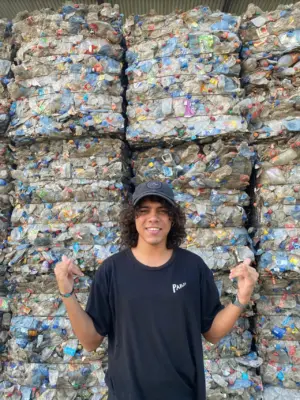
Ismael Sánchez, activist and founder of Upon the Waves. Photo via Raíz Climáctica, used with permission.
Ismael Sánchez, originally from Santo Domingo, nurtures a deep affection for the sea and is determined to transform that passion into concrete change. His motivation comes from spending hours on the coast, seeing the life sustained by reefs, and feeling an intimate responsibility toward it. “The ocean gives us oxygen, regulates the climate, sustains millions of lives and economies,” he emphasised. “If we lose it, we lose ourselves.”
This conviction has pushed him to act, first through community cleanups and later through more technical and organised initiatives. His interest in activism was awakened by the indignation he felt when, as a teenager, he saw trash on Boca Chica beach, listened to fishermen describe the loss of catches, and participated in cleanups that, despite the effort, made it clear the solutions had to be structural. His coexistence with the territory allowed him to transform his feelings into actions that helped him take responsibility for the coastline he loved.
Together with his peers, he founded Upon the Waves with the purpose of getting Dominican youth involved in marine protection. The organisation has conducted coastal cleanups and educational workshops, forged strategic alliances, and promoted communication campaigns that translate scientific data into messages communities can understand and apply. Sánchez sees his role as both technical and facilitative. “We don’t just collect trash; we conduct data collection, record affected species, and document sources of pollution,” he stated, noting that technical evidence enabled the transition from beach activism to political advocacy.
Calling his activism “a way of life,” he emphasised that to be effective, you must combine community action, education, and technical work. He sometimes feels a sense of frustration, seeing the waste and wondering “whether we [are] doing enough,” but adds: “Not everything can be struggle. You also have to enjoy it.” Learning to delegate and build teams was crucial, and he has institutionalised the organisation’s processes.
Sánchez participated in data collection on the impact of styrofoam on marine ecosystems, waste registration, source-point analysis and sampling; the evidence base was included in an initial technical draft presented to the Ministry of Environment and Natural Resources, and ultimately informed the decision to restrict the use of styrofoam products in the country. In 2025–2026, authorities established phase-out deadlines and certification requirements for polystyrene-based products, marking a major step in the legislative and regulatory effort to curb their use and the resulting public policy regarding single-use plastics.
His advice for other young people who want to get involved? Learn to measure the scope of your commitment; seek technical training that allows you to work with evidence, not just impulses, and build community as opposed to being a solitary hero. For activists to preserve their mental and emotional well-being, he insisted that enjoying the environment provides an outlet to recharge in order to sustain the struggle in the medium and long term.
Evaristo Jiménez: Learning not to give up
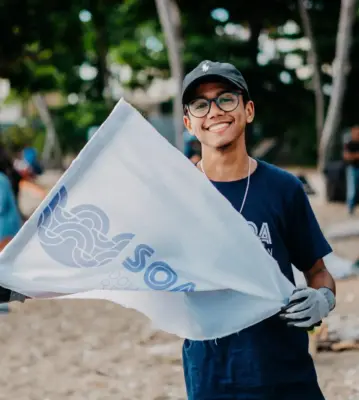
Environmental activist Evaristo Jiménez. Photo via Raíz Climática, used with permission.
At just 15 years old, Jiménez began a journey that took him from neighbourhood activities in La Romana to international forums. Five years later, he has not sought prominence, but meaning. “To me, an activist is anyone who acts with purpose,” he explained. “I believe what I do has purpose, so I 100 percent consider myself an activist.”
He began by joining youth projects in his province, where he learned about waste management issues, artisanal fishing, and the loss of coastal habitats. It was in that local space, working with initiatives such as Romana Joven, that he learned to organise educational campaigns, coordinate cleanup activities, and drive awareness initiatives in vulnerable neighbourhoods.
His continued collaboration with local organisations allowed him to professionalise his activism. He has done work with SOA Dominican Republic, Upon the Waves, and Generación por el Desarrollo, later joining projects with Fundación Blue Missions and collaborating on emerging Roots initiatives. “First it was local activism,” he recalled, “then national…and I’ve had the opportunity to reach international spaces.”
Each step involved assuming new obligations and technical learning; sometimes sacrifices had to be made. He turned down a scholarship at Universidad Católica Santo Domingo because there simply wasn’t enough time to do both things: “I knew that if I accepted it, I would have to leave behind what I was building.” To combat the
anxiety and exhaustion he experienced in the midst of intense project coordination, he began to follow a structured schedule, delegated tasks, sought institutional allies, and reserved time for rest. At times when he felt inadequate to the task, he found solace in community, which allowed him to sustain action without burning out. “Passion does not exempt anyone from exhaustion,” he advised. “I found that it wasn’t about doing everything alone, but about building with others so the cause can survive.”
Rosángela Araujo: Building boundaries
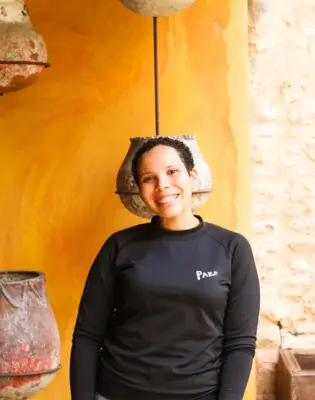
Environmental activist Rosángela Araujo. Photo via Raíz Climática, used with permission.
At the intersection of youth, climate urgency, and social commitment, Rosángela Araujo’s voice stands out for its calmness and determination. Based in Santo Domingo, she became acutely aware of the fragility of natural spaces through time spent in nature as a child.
Her work with Buceo Ecológico RD and Parley for the Oceans may be more high-profile, but she also maintains constant participation in community festivals, educational campaigns, and environmental training projects. Seeing herself as “someone who helps improve and advance projects that already exist,” she prioritised strengthening existing collective structures instead of going the route of founding her own organisation.
Linking her identity as an activist to everyday coherence, Araujo strives to live according to the values she defends. Her work is not limited to participating in campaigns; rather, it involves a constant ethical commitment that tries to ensure daily decisions do not contradict what she preaches. “We all need to depend on a community,” she advised. “Don’t try to work alone.”
Early on, she explained, she developed an extreme relationship with environmental coherence. In her attempt not to pollute, she avoided any product containing plastic, even if it negatively impacted her well-being. She recalled periods in which she “spent days without properly drinking or eating” because she refused to buy packaged food, even when no healthy alternatives were available. Her behaviour was driven by a deep sense of environmental guilt and the idea that she “couldn’t fail the cause.”
The pressure resulted in exhaustion and temporary withdrawal from important projects whenever she felt overwhelmed. There were even times when she had to step away to avoid collapsing. “You’re going to have moments,” she said, “when you feel like you’re not enough…that nothing is going to change.” However, she learned to reinterpret those emotions and dismantle that internal narrative, calling it “a lie,” because “what we do does have an impact.” For her, every small change matters: when a family stops using foam, when a festival manages to raise awareness, when someone decides to consume more responsibly. Those actions, she explained, function as emotional anchors amid exhaustion.
One of the most important lessons in her process was accepting the need for professional support. “Sometimes we try to cover the sun with one finger…but yes, the climate crisis can lead you to a psychologist,” she stated. To cope with the most difficult moments, she incorporated systematic self-care practices into her routine: periodic trips outside the city, direct contact with nature, playful group dynamics, and spaces for honest conversations with peers. “I try to leave at least once every 15 days to reconnect with nature,” she shared.
Admitting that, at first, she spoke about oceans without having had direct experiences in them, Araujo emphasised the importance of deeply understanding what one defends. Over time, she learned to dive and snorkel, which strengthened her emotional connection with the sea and transformed her way of communicating — she no longer spoke only from data, but from lived experience. This allowed her to communicate urgent environmental messages with greater honesty and sensitivity.
Regarding the balance between personal life and activism, Araujo finally came to understand that not everything had to be solved immediately, and that the sustainability of the work largely depended on protecting her physical and emotional health: “If I break down, I can’t help anyone either.” Her advice for young people interested in environmental activism included normalising psychological support and not romanticising extreme sacrifice or self-exploitation.
Psychologist Eddy Frank Vásquez Sánchez, who is also an activist, noted that the shared experience of these three young people reveals a common pattern: episodes of extreme exhaustion, guilt over resting, a persistent sense of inadequacy, pressure to remain coherent all the time, and personal sacrifices that left emotional scars.
However, it also reveals a collective transformation, once they learned that caring for their mental health does not mean abandoning the struggle. Instead, it strengthens it from within. Resilience is built by weaving real support networks, asking for help without guilt, establishing boundaries, celebrating progress, accepting imperfection and knowing, above all, that it is possible to be an example, raise the Dominican flag in international spaces, and make your country proud in the fight for the preservation of its natural resources while still taking care of themselves — or, as Araujo puts it, “Joy is also resistance.”