



The expansion of online news, smartphones, and social media use in the past ten years has been used to amplify smear campaigns against Indigenous land defenders, found a study by Bangkok-based research institution Asia Centre.
“[Climate disinformation’s] intent is to deceive the public and distort climate discourse, which ultimately contributes to the marginalisation of Indigenous Peoples (IPs) and the negation of their identity by excluding them from climate decision-making,” said Dave Gomez, regional director of Asia Centre.
“The spread of climate disinformation is especially alarming for IPs, who often live in the forested areas most vulnerable to climate and environmental crises. As a result, they face a disproportionate level of environmental, social and political threats,” he said.
The rise of online news has transformed the Philippine media landscape, with 82 per cent of Filipinos now getting news online and 63 per cent via social media, compared with just 13 per cent from print, according to data from the study.
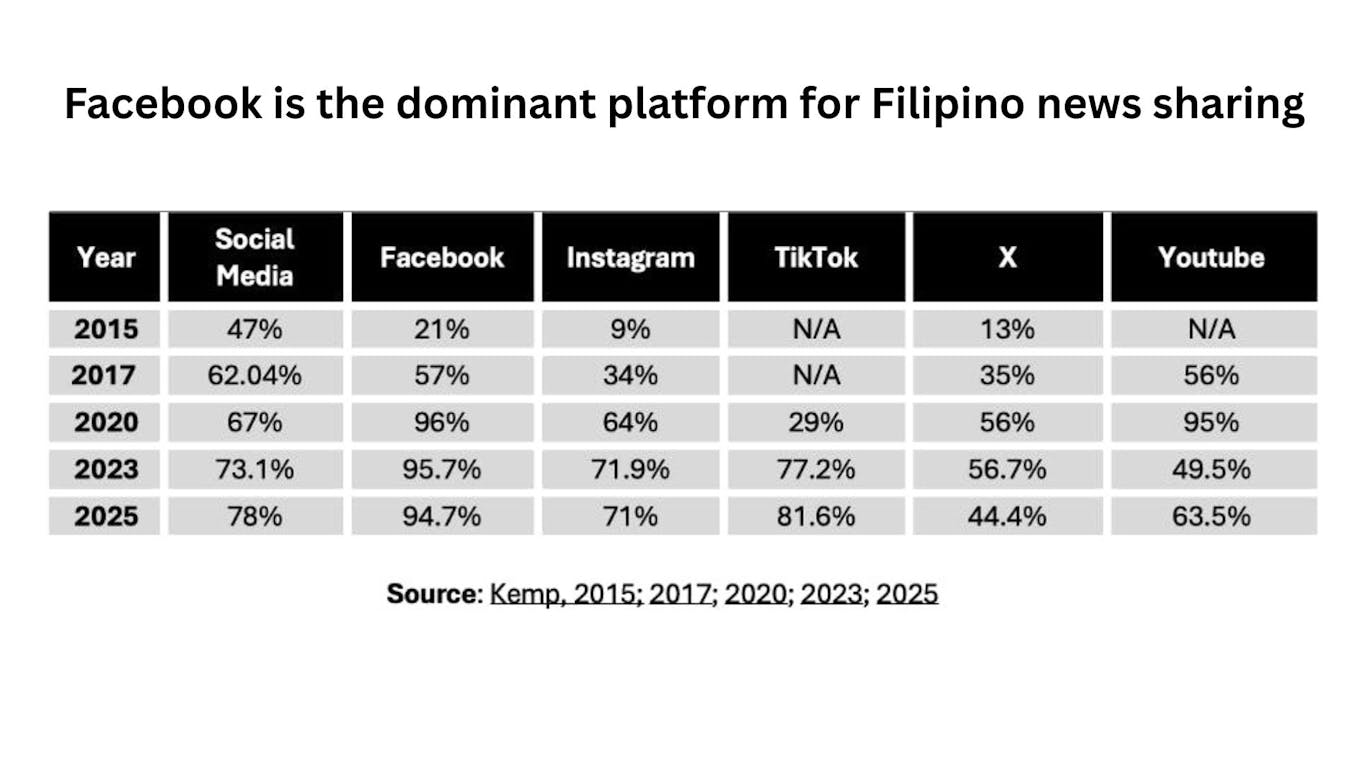
Image: Asia Centre
However, these advances can be negated by “structural disparities”, with Indigenous Peoples residing in remote areas often experiencing the greatest barriers to digital participation. Many still rely on traditional media like radio for news, public warnings, and daily communication, the report said, citing a government survey confirming that radio remains the most accessible medium for marginalised and geographically isolated communities.
Asia Centre’s analysis also showed that 78 per cent of Filipinos – around 90.8 million people – are active on social platforms, making the country one of the most digitally engaged in the world. Instant messaging services further entrench this digital dependence, with most internet users sharing news through Facebook Messenger.
Digital platforms have outpaced television and print, accounting for 42 per cent of the country’s US$6.5 billion media revenue by 2024, said the report titled Climate Disinformation in the Philippines: Legitimising Attacks on Indigenous Peoples.
“The same connectivity that amplifies Indigenous voices also exposes them to new vulnerabilities including climate disinformation, digital harassment and coordinated online attacks have become acute threats, particularly for Indigenous and environmental defenders,” said researchers.
Central to this strategy is “red-tagging” – the practice of falsely labeling Indigenous Peoples, activists and journalists as communists or terrorists to strip them of legal and social protections, said the report.
This creates a “culture of digital hostility”, legitimising cyber and physical attacks against Indigenous Peoples and activists, as demonstrated by the 2025 Global Witness survey that found 90 per cent of Filipino land and environmental defenders experiencing online abuse linked to their political affiliations. Despite the severity of these attacks, platforms like Meta have been denounced for failing to moderate red-tagging content that incites violence.
For instance, Beverly Longid, a Bontok-Kankanaey Indigenous leader from the Cordillera region and national convener of Katribu, an alliance advancing Indigenous peoples’ rights, has endured red-tagging for years due to her activism against projects harming Indigenous lands.
She has faced online harassment like doctored photos circulated widely depicting her with demonic features, as well as public accusations on a police-livestreamed Facebook news conference in 2020 labeling her a recruiter for communist group, New People’s Army.
Fabricating Indigenous consent has also been a consistent disinformation strategy, relied upon to greenlight environmentally-harmful projects, said authors.
The report highlighted how the Makilala Mining Company Copper Gold Project in the Cordillera Administrative Region (CAR) claimed on its website in 2022 that it received certification for free, prior and informed consent from its engagement with the Balatoc community, a narrative reinforced by some media websites.
Moreover, the report said that the mining firm circulated a photograph of themselves signing a memorandum of agreement with the province’s governor, wherein he was allegedly only agreeing to be a witness to the pact. These narratives were disputed by community members, saying the company failed to secure the consensus of all Balatoc members and neglected to consult with neighboring communities that will also suffer the environmental impacts of the project, said the study.
