



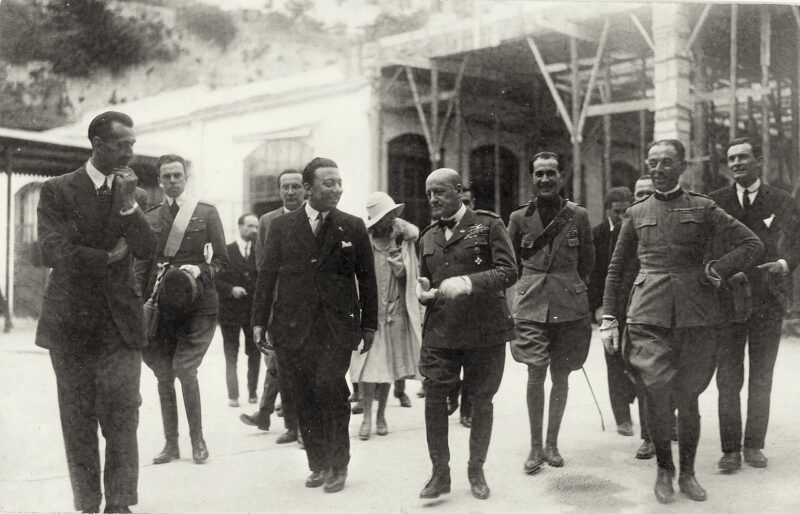
The Italian publisher Arnoldo Mondadori and author Gabriele D’Annunzio (in the middle in uniform). Photo by Archivi Mondadori on Wikimedia Commons (CC BY-SA 4.0).
This article by Stojan Sinadinov was first published by Truthmeter.mk on February 4, 2026. An edited version is republished here under a content-sharing agreement between Global Voices and Metamorphosis Foundation.
The hybrid documentary film “Fiume o morte!” (“Rijeka or death!”) by Croatian writer and director Igor Bezinović adds a fresh perspective to the already well-established view of fascism as a political movement rooted in propaganda spectacle, mass mobilization, and nationalist myth-making. In the film, Bezinović meticulously portrays the 16‑month occupation of the city of Rijeka in present-day Croatia by the Italian Decadent writer and military leader, Gabriele D’Annunzio, and his legionary army in 1919, immediately after the end of the First World War.
“Fiume o morte!” is one of the films that marked the year 2025, winning 30 awards, including the award for best documentary film from the European Film Academy, the Tiger Award and the FIPRESCI Prize at the International Film Festival Rotterdam, as well as six Golden Arena Awards at the Pula Film Festival in Croatia. It was also selected as the Croatian candidate for the Academy Award for 2026, though it was not among the final nominees.
A co-production of Croatia, Italy, and Slovenia, the film creatively merges documentary and comedy, serving as a kind of history lesson on the birth of fascism. With the participation of around 100 non‑professional actors and extras, the film “re‑creates” the year 1919 and the occupation of the Croatian coastal city of Rijeka by the paramilitary forces of the Italian poet, playwright, aristocrat, dandy, and wannabe military commander Gabriele D’Annunzio.
Here’s the official trailer of the film.
Immediately after the end of the First World War, dissatisfied that the city of Rijeka was not included in the Kingdom of Italy following the signing of the Treaty of Versailles between Germany and the Allied Entente powers, D’Annunzio entered the city on September 11, 1919 with dozens of legionnaire soldiers and formed a para‑state known as the Italian Regency of Carnaro (in Italian, “Reggenza Italiana del Carnaro”).
Over a year later, D’Annunzio ignored the fact that the Kingdom of Italy and the Kingdom of Serbs, Croats and Slovenes (SCS) (later called the Kingdom of Yugoslavia) signed an agreement in November 1920, according to which Rijeka belonged to the Kingdom of SCS. Therefore, the Italian army was forced to expel him from his “state.” D’Annunzio’s legionnaires withdrew from Rijeka on January 5, 1921, and D’Annunzio himself two weeks later, marking the end of the 16‑month occupation.
Bezinović’s film portrays the “pioneer” of Italian fascism, Gabriele D’Annunzio, through a critical lens, as befits the role model for the fascist leader Benito Mussolini. The life and work of Gaetano Rapagnetta — D’Annunzio’s birth name; his father took the surname D’Annunzio from his uncle — serve as the basis for a detailed vivisection of proto‑fascism, carried out by Bezinović with impeccable precision. The fact that viewers and critics will find numerous parallels with the current geopolitical situation and the recurring resurgence of fascism/Nazism in various forms is no coincidence —this is precisely why Bezinović made “Fiume o morte!”
The occupation of Rijeka by D’Annunzio and his legionnaires is well documented, with archives containing more than 10,000 photographs, for example, this album and hundreds of film recordings. In Bezinović’s film, these photographs and films form the basis for “re‑creating” the personalities and events of the occupation through dramatization by non‑professional actors and extras.
The following archival footage illustrates how the events of the proto-fascist occupation of Rijeka were documented at the time; it served as reference material for the film’s reconstruction.
As German philosopher of Jewish origin Walter Benjamin observed, fascism can be seen as “aestheticization of politics,” as it tends to turn politics into spectacle by using symbols, staged rituals, mass rallies, and media to mobilize people emotionally. In contrast, he argued that communism seeks to make art politically engaged. Benjamin, who died in 1940 while fleeing the Nazis, was pointing to blurring the line between politics and performance as a crucial feature of fascism.
This is the situation of politics which Fascism is rendering aesthetic. Communism responds by politicizing art.
This perspective helps frame Bezinović’s portrayal of D’Annunzio’s rule in Rijeka, not as conventional governance, but as a kind of political theater — a staged reality in which power is exercised through a masquerade of images, gestures, and myth as much as through force.
A similar artistic parallel can be drawn with Friedrich Nietzsche, who, writing in dialogue with the operas of Richard Wagner, described “tragedy being born from the spirit of music.” Wagner’s work would later be appropriated by Nazi ideology.
In Bezinović’s film, however, the early forms of fascism appear to emerge from the spirit of comedy: a theatrical, often absurd performance (in line with the Italian comedic tradition) whose inevitable tragic consequences would only become fully visible in hindsight. This interplay between the comic and the catastrophic gives the film a distinctly tragicomic dimension.
In “Fiume o morte!” D’Annunzio is shown reviving the salute from ancient Rome (often referred to as the Roman salute), with “the right arm raised to eye level,” later becoming the mandatory salute of fascists and, subsequently, of Nazis.
Bezinović also points out the brief stay in Rijeka of the Italian writer and founder of the Futurist movement, Filippo Tommaso Marinetti, who came at D’Annunzio’s invitation, but left after only two weeks.
Mussolini also stayed in Rijeka for only a single day before leaving to prepare the formation of his Fascist Party. Later, he became the Duce who embodied the ideas of both D’Annunzio and Marinetti in the political corporatism known as fascism.
“Fiume o morte!” does not omit the fact that during his rule, D’Annunzio brought more than 5,000 young Italians to Rijeka, a city that at the time had around 30,000 inhabitants, in order to change its demographic composition. Nor does it overlook the fact that at the beginning of the occupation, his legionnaires, motivated by racism, killed around 10 Vietnamese soldiers who were part of the Allied Entente forces.
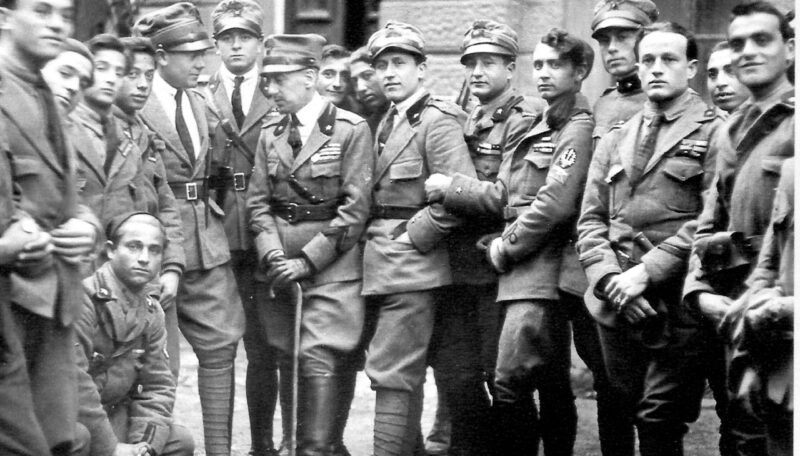
Gabriele D’Annunzio (in the middle with the stick) with some legionaries (components of the Arditi’s department of the Italian Royal Army) in Fiume in 1919. Photo on Wikimedia Commons. Public domain.
Italian writer and theorist Umberto Eco, who, among other things, analyzed the many faces of fascism in his 1995 work “Eternal Fascism: Fourteen Ways of Looking at a Black Shirt,” published under the title “Ur‑Fascism” by the New York Review of Books, wrote:
But the fascist game can be played in many forms, and the name of the game does not change…
Fascism became an all-purpose term because one can eliminate from a fascist regime one or more features, and it will still be recognizable as fascist. Take away imperialism from fascism and you still have Franco and Salazar. Take away colonialism and you still have the Balkan fascism of the Ustashes. Add to the Italian fascism a radical anti-capitalism (which never much fascinated Mussolini) and you have Ezra Pound. Add a cult of Celtic mythology and the Grail mysticism (completely alien to official fascism) and you have one of the most respected fascist gurus, Julius Evola.
“Fiume o morte!” by Igor Bezinović adds yet another nuance to the interpretation of fascism.