



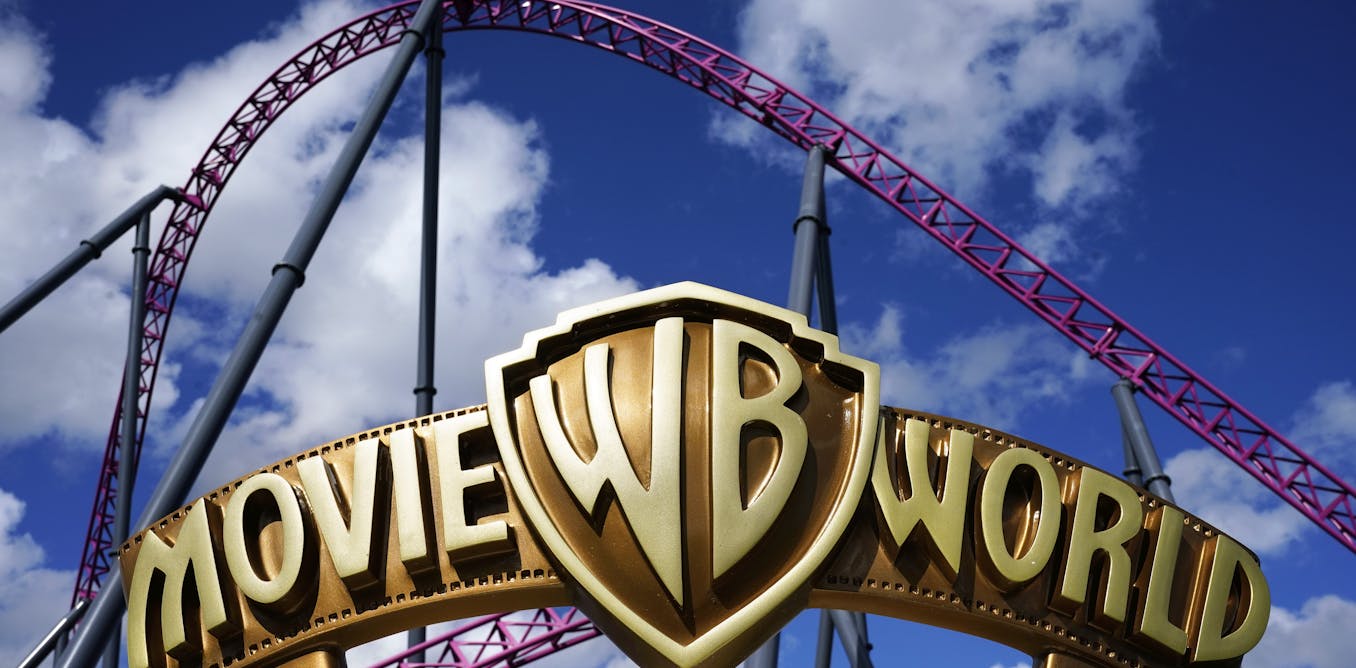
As thousands of people packed into the Gold Coast’s Warner Bros Movie World theme park for the school holidays on Wednesday, one of Australia’s biggest roller coaster rides ground to a halt.
A Village Roadshow Theme Parks spokesman confirmed all riders on the DC Rivals HyperCoaster had got off safely, before being walked back down the incline.
No one ever wants to see rides stop – not the theme parks, not the regulators, and especially not the ride passengers.
It’s not the first time it’s happened: riders were stopped on the same roller coaster in January 2024, when a loose scarf got tangled in the wheels and the ride operator stopped as a precaution.
Nearby theme park Dreamworld was home to one of Australia’s worst theme park disasters in 2016, in which four people were killed on a water ride. That tragedy highlighted failures by the theme park operator Ardent Leisure, which was later fined $3.6 million, and the need for stronger safety standards.
Yet as someone who has been voluntarily involved in writing the standards on Australia’s amusement rides for almost 29 years, here’s why I’ve felt comfortable taking my own kids on roller coasters – and what work is being done right now to improve safety further.
What tests do roller coasters have to pass?
Every morning, major theme parks in Australia such as Movie World test their rides before opening. This is mandatory under the national standard for amusement rides.
Before opening the theme park each day the roller coasters are tested both empty and loaded.
Roller coasters are a gravity ride: the roller coaster train is elevated to the top of the ride, then gravity takes it down. If it’s empty, it might get stuck on the way down because it does not have enough stored energy to get over the humps, rises and round the bends. To test it being loaded, dummies full of water are placed in the passenger seats.
The theme parks also run other tests, from practice evacuation procedures to manage unexpected stoppages, through to checking multiple trains running on the roller coaster track stay at a safe, separated distance.
Before launching every ride, there’s a diagnostic check on the passenger restraint system. There are also other checks, such as for potentially faulty limit switches, which keep the trains on the roller coaster from ramming into each other. If there is an alarm for one of these devices, the staff can’t launch the ride.
If you’ve ever been in the queue for ages, thinking “hurry up, why don’t they start the ride?” – the ride operator is most likely running safety checks, or waiting for bad weather to pass.
Beyond the morning tests, theme parks have an engineering team on standby to check and fix rides if needed. They also have a night shift to conduct preventative maintenance, particularly during peak times such as school holidays.
Also, by law, all rides have to pass an annual inspection. This comes under each state’s Work Health and Safety Act. In Queensland, for instance, Workplace Health and Safety Queensland is the regulator for theme parks.
Read more:
After damning report into Dreamworld tragedy, who can be held accountable under the law?
How dangerous is riding a roller coaster?
Australia doesn’t publish national safety data on amusement rides, as they’re regulated on a state basis. The Conversation contacted Queensland’s regulator to request state-based data, but this was not available in time for publication.
The United States is home to more theme parks than the rest of the world. According to The Global Association for the Attractions Industry’s latest safety reports, there were 1,495 injuries at North American theme parks out of around 422 million visitors in 2024.
In North America, roller coaster rides accounted for 44% of those injuries in 2024 – the highest level on record. But the overall injury rate is still lower than many other activities, with just 2.86 injuries for every 1 million attendees – down from 4.78 injuries per million a decade earlier.
To put that risk in perspective, in 2001 Britain’s national regulator for workplace health and safety, the Health and Safety Executive, compared the risks of injury or death from different activities.
Using around a decade of data, they found people were less likely to die from a fairground ride in the UK (1 in every 834 million rides) than rock climbing (1 in 320,000 climbs), canoeing (1 in 750,000 outings) or even catching a plane (1 in 125 million passenger journeys).
What’s changed since the Dreamworld tragedy?
A 2020 coroner’s inquiry into the deaths of four people at Dreamworld in 2016 recommended significant changes to theme park management, including more stringent, regular inspection of rides.
Queensland announced stricter safety rules in 2019 in response to the Dreamworld failures. In 2024, it followed up on the coroner’s recommendations, launching Australia’s first “amusement device safety” code of practice. It’s a detailed rule book for everything from theme parks to dodgem cars and jumping castles.
Nationally, there’s an independent Standards Australia committee for amusement rides and devices. I’m a voluntary member, representing Engineers Australia.
The committee is in the process of adopting the world’s best practice European standard on amusement rides. Standards Australia hopes to release a draft for public comment this year.
So there’s still more work to do. But if you’re visiting a theme park these holidays, deciding whether to let your kids try a ride, my recommendation is let them enjoy their childhood. It’s probably safer than you think.