



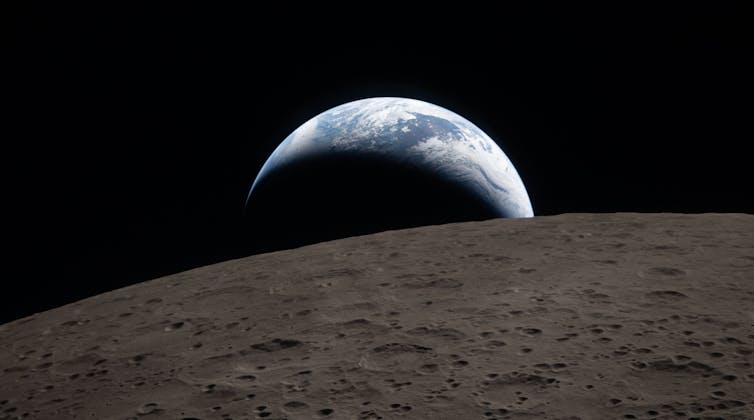
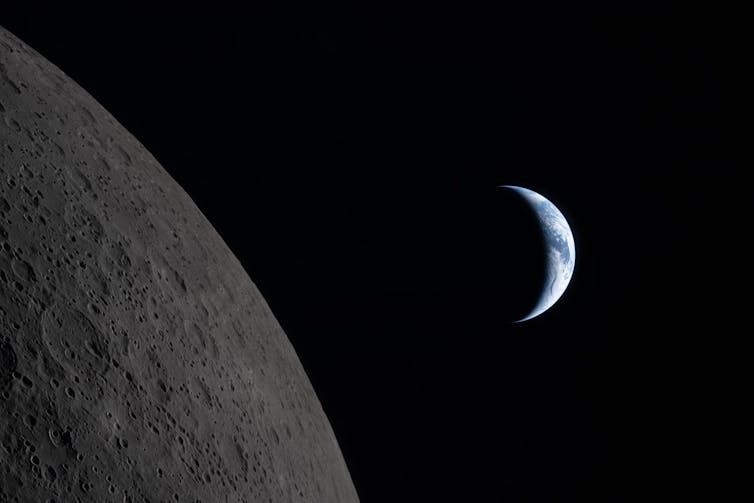
As Nasa’s Artemis II mission completed its lunar flyby, the astronauts sent back a stunning image of the colourful Earth setting behind the Moon. This breathtaking photo, called Earthset, draws inevitable comparisons with the original Earthrise photo from the Apollo 8 flight in 1968.
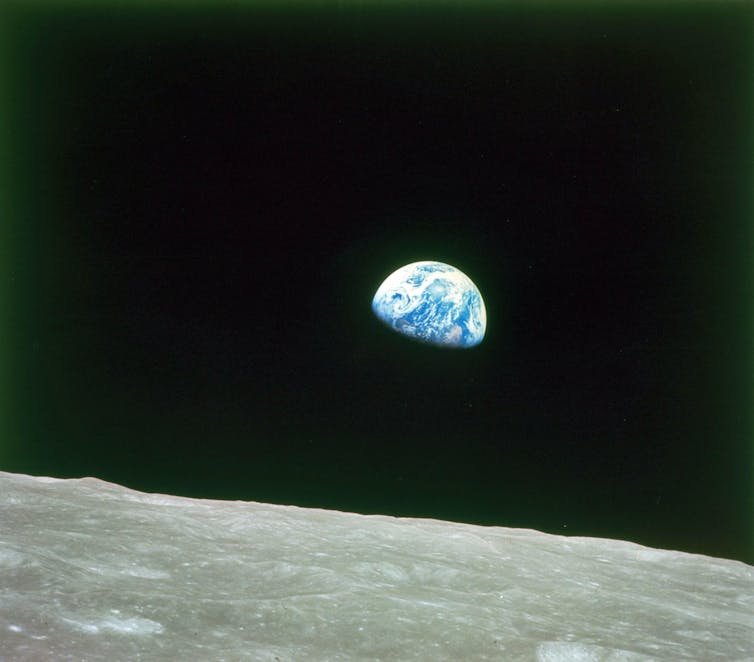
The Apollo-era photo showed our planet climbing above the lunar horizon. It revealed Earth as a bright blue oasis, standing out against the vast blackness of space and the barren Moon.
As I described in my book, Earthrise: a Short History of the Whole Earth, the effect of this image (actually part of a set) was profound. It caused a sensation on its release and helped inspire the burgeoning environmental movement.
Read more:
Earthrise to Earthset: how the planet’s climate has changed since the photo that inspired the environmental movement
The polished image from Artemis II and the slightly askew picture from Apollo 8 are, however, the product of entirely different approaches to photography from space.
“I don’t want to see you guys looking out the window,” Apollo 8 commander Frank Borman warned his colleagues Jim Lovell and Bill Anders during the 1968 mission to orbit the Moon.
Astronauts back then were discouraged from wasting film on touristy snapshots of the Earth. The Apollo 8 mission plan listed Earth images as mere “targets of opportunity”, the lowest priority of all.
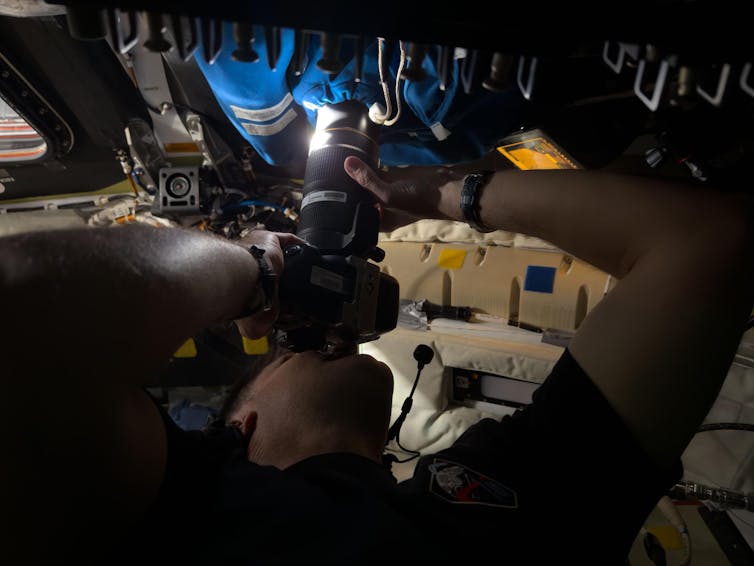
The way the two missions kicked off underline the differences between 1968 and 2026. The crew of Apollo 8 took no still photos of Earth on the way out, but had reluctantly agreed to take a black-and-white TV camera for live transmissions.
Nasa
They were unable to fit the telephoto lens to the camera in time for the first transmission, so viewers saw only a fuzzy blob of light. Once the lens was fitted, the Moon bounced around the screen while mission control tried to issue “up a bit, down a bit” instructions with a 1.3-second delay.
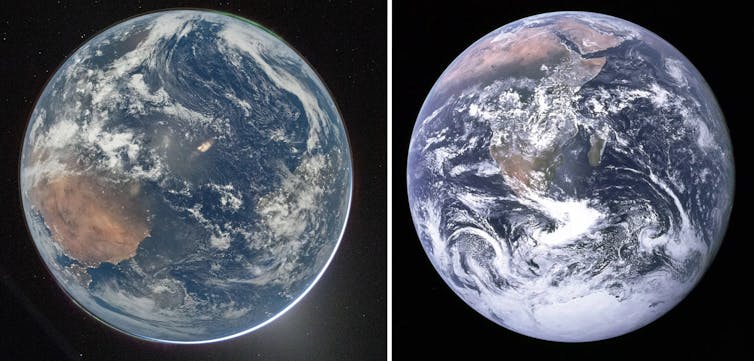
Despite this more haphazard approach to photography during some of the Apollo missions, the imagery from that era looms large in the public imagination. Earthrise is one icon from that era; another is the whole-Earth image known as Blue Marble – taken in 1972 during the Apollo 17 mission.
One of the earliest images released by Nasa from the Artemis II flight was a crystal-clear image of our planet taken on a tablet computer by the mission’s commander, Reid Wiseman. The image of Earth’s full disk, initially dubbed “Hello, World” but later changed to “mother Earth”, clearly recalls the iconic Blue Marble photo.
Unlike that famous daytime image from 1972, it shows the Earth at night – but has been enhanced to look like daylight. In the new photo, auroras can be seen at the poles and a thin crescent of sunlight is visible, glowing through the atmosphere. Both photos show a predominance of southern ocean and cloud, with Europe just visible near the rim.
Nasa
The Earthrise image from 1968 came about largely due to the initiative of Anders. On the mission’s fourth orbit around the Moon, the three crew members were busy photographing it in black and white when Anders noticed some unexpected colour out of the corner of his eye. “Oh my God! Look at that picture over there! Here’s the Earth coming up,” he exclaimed.
After a brief tussle over cameras and colour film, he snapped Earthrise using a mechanical Hasselblad camera with no viewfinder. No-one would see any of their pictures until after they returned to Earth and the film could be developed and printed.
As well as its impact on environmentalists, the image also inspired a young David Bowie in London. Shortly afterwards, he wrote the song Space Oddity about a stranded astronaut gazing upon an Earth to which he can never return.
Read more:
David Bowie and the birth of environmentalism: 50 years on, how Ziggy Stardust and the first UN climate summit changed our vision of the future
Nasa
Nasa
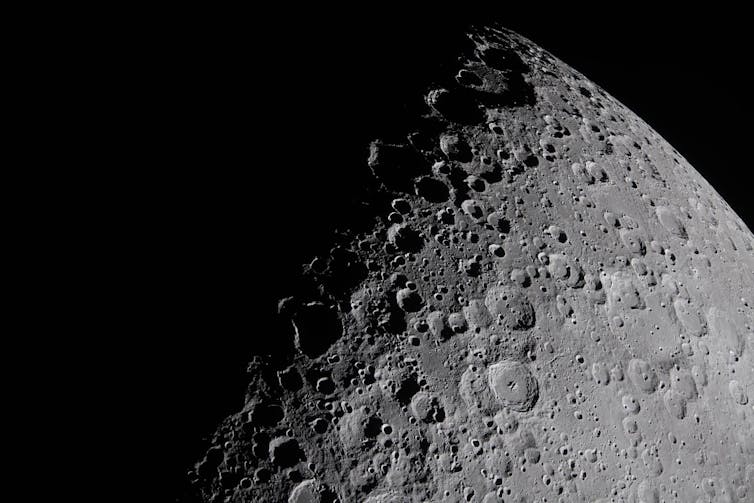
As Artemis II swung round the Moon on April 6, anticipation grew for a modern counterpart to Apollo 8’s legendary image. Before the flyby, Nasa had released simulations of what the Artemis astronauts would see. The simulations showed a half-lit Moon with the distant crescent Earth at its side and clear black space between – like twin planets.
Earthset is different from Earthrise because the Moon is farther away, and because the Earth is only partially sunlit. While Artemis II swept round the Moon in a leisurely, gravity powered slingshot five thousand miles away, Apollo 8 orbited the Moon ten time from just 70 miles up. This gives us a small crescent Earth rising and setting behind an almost full lunar disc.
Nasa seems to have chosen to showcase the Earthset image because it feels more like the familiar 1968 Earthrise. The Artemis images of the Earth rising show a small crescent Earth with its back to the lunar horizon, like the new Moon as seen from Earth.
Nasa
Environmental awakening
Apollo 8’s Earthrise, released two days after splashdown, was not seen in colour until the weekly magazines appeared. Space enthusiasts had expected Earth to appear relatively insignificant in the vastness of space. The phrase “Earth is man’s cradle, but one cannot live in the cradle forever” was a familiar quote at the time.
But viewed from the vicinity of the barren lunar landscape, the Earth looked even more like home. Borman thought “this is what God sees”, while Anders mused: “We came all this way to the Moon … and yet the most significant thing we’re seeing is our own home planet, the Earth.”
Nasa
The image’s link to the environmental movement is unsurprising when viewed in this light. The Apollo 8 image was used in the logo for the first Earth Day in 1970 and, as the Apollo programme was ending, Earth sciences – the study of our home planet – began to take off.
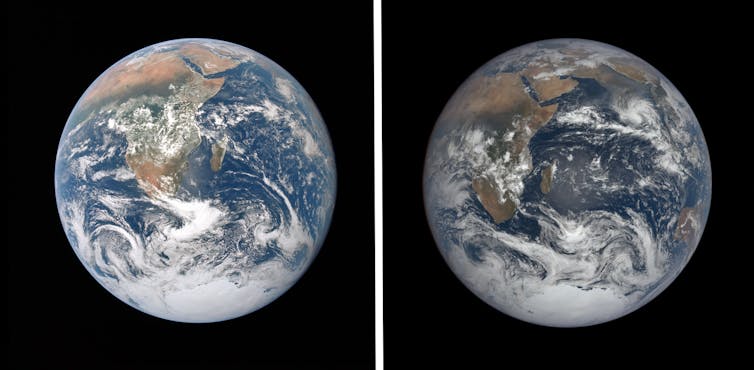
The 1972 Blue Marble image also resonated among environmentalists. It was replicated by Nasa’s deep space telescope DSCOVR 50 years later. A side-by-side comparison between the 2022 DSCOVR image and the 1972 photo highlights the effects of environmental degradation.
In the intervening years, much of Madagascar had turned from tropical green to brown from deforestation, the Sahara had expanded, the Antarctic ice had retreated, and ancient snows had disappeared from the mountains of Iran.
Nasa
It remains to be seen whether the images from Artemis II will have a comparable impact on the global environmental consciousness. However, the title of Earthset is perhaps the perfect name in an era where societies are threatened by climate change.
The crew of Artemis II have made clear where the priorities still lie. “It is so great to hear from Earth again,” said mission specialist Christina Koch as the craft regained radio contact after a brief blackout as the spacecraft passed behind the Moon.
“We do not leave Earth but we choose it … We will inspire, but ultimately we will always choose Earth.”