



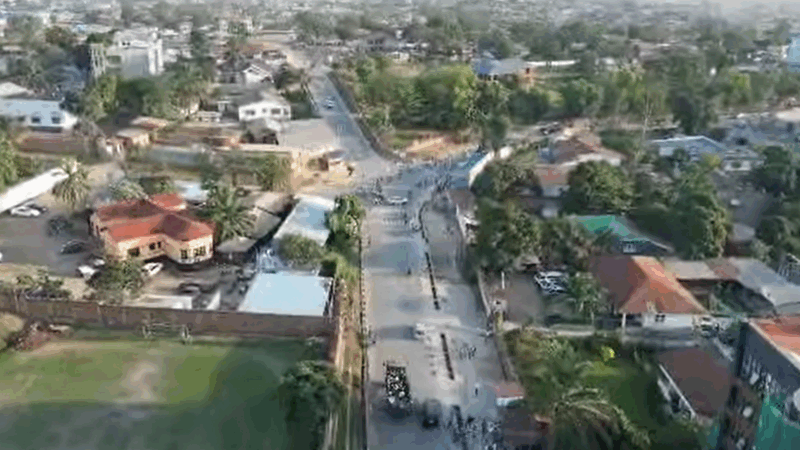
Overview of Bunia. Screenshot from the video “By early 2026, the city of Bunia will have a modern airport built in international standards” from the HK Today TV YouTube channel.
This article was first published on March 8, 2026, on www.greenafia.com. Global Voices republished the article as part of a partnership agreement with GreenAfia.
Trees planted in large cities are an integral part of the solution to climate change. Although traditionally considered less important than old-growth forests, an October 2025 study shows that they can play a major role in conservation efforts, sparking interest among scientists in the Democratic Republic of the Congo (DRC).
A scientific study conducted in the Ituri Province of Bunia, northeastern DRC, proved that urban trees are not just landscaping features. They are natural carbon sinks, capable of offsetting a substantial proportion of human activity-related carbon dioxide (CO₂) emissions.
Cities as Carbon sinks
Unlike the much-studied natural forests, African urban areas are largely absent from climate policies, due to a lack of reliable data. To address this shortage, researchers from the University of Bunia inventoried 2,311 trees across 21 one-hectare plots in three communes of Bunia: Mbunya, Nyakasanza, and Shari.
Using non-destructive methods based on tree diameter, height, and wood density, the team estimated the aboveground biomass and carbon stock without felling a single tree.
Figures from this study speak for themselves: 1,759 tons of aboveground biomass stored by urban trees in Bunia; 8,795 tons of carbon sequestered, which is equivalent to 2,374 tons of CO₂ removed from the atmosphere.
On average, one urban tree in Bunia stores 380 kilograms of carbon, which is equivalent to approximately 124 kg of CO₂ absorbed. In one urban hectare, the average carbon stock is 47.6 tons, a figure comparable to that of some degraded forest areas.
In Bunia, if an urban tree can offset up to 124 kg of CO₂, it gains a carbon value of USD 1 to 4 on the voluntary carbon market (a carbon credit trading mechanism that enables businesses and individuals to offset their carbon footprint voluntarily), proving that DR Congolese cities can transform their trees into effective climate assets.
Not all species play the same role
One of the study’s major contributions was identifying the most effective species for carbon sequestration: Eucalyptus globulus: 61 percent of the stored carbon; Mangifera indica (mango trees): 14 percent; Persea americana (avocado trees): 9 percent; Grevillea robusta: 7 percent; and Senna siamea: 5 percent.
These findings show that the choice of species is important. Some species, due to their wood density and rapid growth, play a disproportionate climatic role in relation to their number.
This study changes a great deal, especially in urban policy development, where DR Congolese cities can now include urban trees as climate infrastructure, alongside roads and drainage systems. Planting or preserving some trees, therefore, becomes a measurable climate mitigation strategy.
In terms of land use and reforestation, this study provides a scientific basis for selecting the species to prioritize, avoiding decorative plantings with low carbon impact, and focusing urban greening programs on species with a strong climate performance.
Bunia could also attract the attention of policymakers within the climate funding framework. With local data, cities like Bunia can pursue urban carbon-credit pilot projects, climate-adaptation and mitigation funding, and improved ecological management of their green spaces.
This study shows how the fight against climate change isn’t solely in the great forests of the Congo Basin, but also in the streets, fields, schools, and urban districts where every tree counts. But most importantly, every species selection, every preservation or destruction policy has a measurable climate cost.